Spain’s prime minister insists there is no solid evidence that Rabat orchestrated July’s unprecedented migration surge, despite a police report describing Moroccan forces as unusually passive and, in some accounts, actively directing migrants towards the frontier.

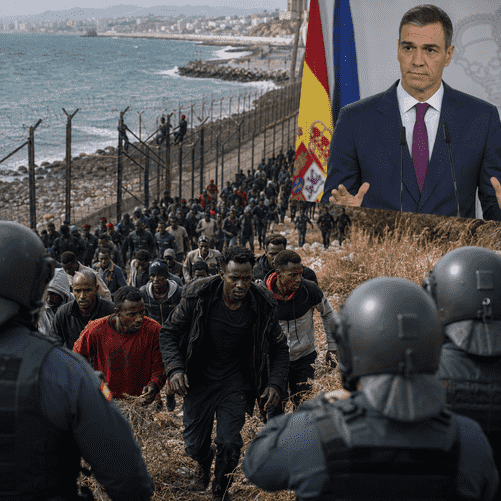
Spanish Prime Minister Pedro Sánchez has firmly rejected accusations that Morocco deliberately engineered the extraordinary mass crossing into the Spanish enclave of Ceuta in late July, putting his government increasingly at odds with allegations contained in a Spanish police investigation into one of the most serious border crises the country has faced in decades.
Addressing parliament on Thursday, Sánchez said Spanish authorities had received no credible evidence establishing that the Moroccan government planned or executed the episode, during which more than 70,000 people crossed from Moroccan territory into Ceuta over July 30 and 31. “No institution — not the diplomatic service, nor the European Commission, nor any international body — has provided the Spanish government with any solid evidence that Morocco planned or carried out the incident,” Sánchez told lawmakers, adding that there was “none whatsoever”.
His intervention came after details emerged from a report prepared by Spain’s National Centre for Immigration and Borders, or CENIF, and submitted as part of a judicial investigation. According to reporting on the document, investigators described the Moroccan security response during critical stages of the crisis as one of extraordinary permissiveness. AFP reported that the document characterised the behaviour of Moroccan police as “total permissiveness”, while other accounts of the report said officers may have actively directed groups towards crossing points and that the scale of the movement suggested a degree of prior organisation.
That assessment represents a potentially serious challenge to the Spanish government’s position. Sánchez and senior ministers have repeatedly stressed the importance of cooperation with Rabat and have avoided attributing the unprecedented influx directly to the Moroccan state.
The prime minister nevertheless acknowledged an important point: Moroccan police effectively allowed crossings to take place during a crucial period of roughly ten hours on July 30, when the movement towards Ceuta was at its most intense. What remains unclear, Sánchez argued, is whether Moroccan forces deliberately stood aside or were simply unable to contain a crowd of unprecedented size.
The distinction is politically significant. Failure to contain the border would amount to a major security breakdown. Deliberately allowing tens of thousands of people to reach Spanish territory, however, would raise much more serious questions about whether migration had been used as a tool of diplomatic pressure against Madrid.
A Crisis Without Recent Precedent
The scale of the July crossing was extraordinary even by the standards of one of Europe’s most sensitive migration frontiers. Roughly 72,000 people entered Ceuta during the surge, a figure approaching the enclave’s permanent population of about 84,000. Many crossed by land, while others attempted to swim around coastal barriers separating Moroccan and Spanish territory.
The human cost was severe. Associated Press reporting now puts the death toll at 141, substantially higher than initial estimates, with many casualties linked to the chaotic movement around the enclave and dangerous attempts to reach Spanish territory by sea.
Most of those who crossed subsequently returned to Morocco, something Sánchez has repeatedly cited as evidence of Rabat’s cooperation after the initial breach. Yet approximately 5,000 people, including about 1,200 minors, were still in Ceuta weeks after the crisis, according to figures cited by the Spanish government. The sudden influx placed accommodation, emergency services and local infrastructure under severe strain.
Morocco has denied deliberately facilitating the movement. Rabat has instead pointed to misinformation circulating online, the activities of trafficking networks and confusion surrounding a Spanish judicial ruling that some migrants apparently interpreted as creating a possible route to legal entry.
The police assessment has complicated that explanation. Investigators reportedly noted an unusually limited Moroccan security deployment near the frontier during the early stages of the crisis and questioned whether conventional trafficking organisations possessed the capacity to mobilise tens of thousands of people within such a compressed period. Some accounts contained in the investigation also suggested that uniformed Moroccan personnel were observed directing or facilitating movement towards the border.
There remains, however, an important institutional dispute over how the document should be interpreted. Spain’s police leadership has challenged reports suggesting that an official police investigation formally concluded the Moroccan state planned the operation, saying investigators had not produced a report directly attributing the planning or execution of the crisis to Moroccan security forces. The distinction between documented conduct by individual officers, institutional permissiveness and a centrally ordered Moroccan operation remains crucial.
Sánchez Under Growing Pressure
The dispute has rapidly become a domestic political problem for Sánchez.
Tens of thousands of demonstrators have taken to the streets over the government’s management of the Ceuta crisis, while opposition parties have accused the administration of failing to protect Spain’s borders and ignoring warnings that a large-scale crossing could occur. Sánchez has denied receiving intelligence indicating that an incident approaching July’s magnitude was imminent.
The controversy also touches one of the most delicate relationships in Spanish foreign policy. Madrid depends heavily on Moroccan cooperation on migration control, counterterrorism and security around Ceuta and Melilla. Morocco, meanwhile, has long contested aspects of Spain’s presence in North Africa, while disagreements over Western Sahara have repeatedly complicated bilateral relations.
Those tensions have resurfaced since the July crisis. Spain subsequently summoned Morocco’s ambassador after statements from Moroccan officials again raised questions concerning sovereignty over Ceuta and Melilla, territories Madrid insists are unquestionably Spanish.
For Sánchez, maintaining cooperation with Rabat while demonstrating that Spain is prepared to defend its territorial integrity has therefore become an increasingly difficult balancing act.
His refusal to blame Morocco appears designed partly to prevent the border crisis from developing into a broader diplomatic confrontation. But that strategy is becoming harder to sustain as more information emerges from judicial and police investigations.
The central question is no longer simply whether Moroccan forces failed to stop the crossing. Sánchez himself has effectively acknowledged that they did. The politically explosive issue is why they failed — and whether the behaviour seen along the frontier reflected confusion and operational incapacity, deliberate local permissiveness, or a coordinated policy originating higher within the Moroccan state.
For the moment, Madrid says the evidence does not justify the most serious conclusion.
But the investigation means the issue is unlikely to disappear. As Spanish authorities examine communications, surveillance footage, witness accounts and the actions of security forces on both sides of the frontier, Sánchez’s categorical defence of Morocco may ultimately depend on what those inquiries establish.
Until then, the Ceuta crisis remains far more than an immigration emergency. It has evolved into a test of Spain’s border security, its relationship with Morocco and the political credibility of a government attempting to reconcile evidence of extraordinary events on the ground with its determination to preserve one of Madrid’s most strategically important diplomatic partnerships.