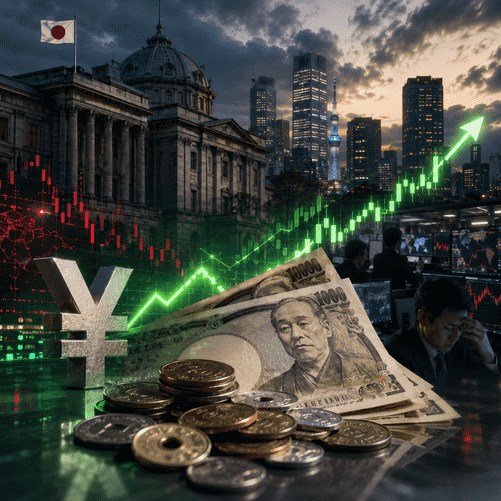
Japan’s currency surges to a one-month high against the dollar as investors bet Tokyo is preparing to tighten monetary policy, adding another source of uncertainty to already volatile global bond and currency markets.

The Japanese yen surged against the US dollar on Thursday, climbing to its strongest level in a month as investors sharply increased their bets that the Bank of Japan will raise interest rates at its September policy meeting.
The currency gained more than 2% at one stage, with the dollar falling towards ¥155.6, extending a powerful rebound that began during Wednesday’s trading. The move represents a striking reversal for a currency that only weeks ago was under intense downward pressure and had required an exceptional joint US-Japanese intervention to halt its decline.
Behind the latest rally is a growing conviction among traders that Japan’s central bank is preparing to accelerate a monetary tightening cycle that, until recently, had been proceeding cautiously.
Expectations strengthened after Bank of Japan policy board member Hajime Takata indicated that monetary policy may need to respond more “nimbly” to economic and inflationary developments. His comments, delivered in Sapporo on September 2, added to a series of signals from senior policymakers suggesting that the bank is becoming increasingly uncomfortable with persistent price pressures and the consequences of a weak currency.
The Bank of Japan’s next monetary policy meeting is scheduled for September 17 and 18, when investors increasingly expect policymakers to lift the benchmark rate from its current 1%.
A Reuters survey of economists published in late August found that a majority expected the central bank to increase the rate to 1.25% in September, earlier than previously anticipated. The shift reflects concerns not only about domestic inflation but also about higher energy costs, the weakness of the yen and changing conditions across global financial markets.
From Currency Intervention to Interest Rates
The speed of the yen’s recovery is particularly significant because Japan has spent much of the year confronting precisely the opposite problem.
Before authorities intervened in late July, the yen had fallen to around ¥163.98 against the dollar, its weakest level in roughly four decades. Japan and the United States then carried out an exceptionally rare coordinated intervention in the foreign-exchange market, temporarily driving the currency as high as approximately ¥155.21. Much of that advance was subsequently surrendered before the latest rally began.
Currency intervention can provide immediate support, but its effectiveness is often limited if the monetary fundamentals that caused the weakness remain unchanged.
For Japan, the central issue has been the enormous interest-rate gap between the country and other major economies, particularly the United States.
For years, ultra-low Japanese interest rates encouraged investors to borrow cheaply in yen and invest the proceeds in higher-yielding assets elsewhere. This strategy, known as the yen carry trade, contributed to persistent selling pressure on the Japanese currency.
Higher Bank of Japan rates change that calculation.
If Japanese borrowing costs rise while the Federal Reserve becomes less aggressive, the return available from borrowing yen to purchase dollar-denominated assets becomes less attractive. Investors may consequently unwind those positions, buying yen in the process and potentially accelerating its appreciation.
That mechanism appears to be contributing to the latest market movement.
Washington Adds to the Pressure
There is also an unusual international dimension to Japan’s monetary debate.
US Treasury Secretary Scott Bessent has publicly signalled that he expects Japanese authorities to take steps that ultimately lead to a stronger currency. His comments have been widely interpreted by markets as Washington favouring conventional monetary tightening rather than repeated intervention in the foreign-exchange market.
That matters because coordinated US-Japanese currency intervention is exceptionally rare.
A sustained increase in Japanese interest rates would address one of the fundamental forces behind yen weakness rather than simply counteracting its effects in currency markets.
Bank of Japan governor Kazuo Ueda has also strengthened expectations that action could come soon. He said this week that policymakers would discuss whether inflation risks justified raising rates at the September meeting, providing one of the clearest indications yet that another increase is under active consideration.
Japan’s Bond Market Sends a Warning
The currency rally is unfolding alongside dramatic changes in Japan’s government bond market.
The yield on Japan’s benchmark 10-year government bond reached 3% this week for the first time since 1996, reflecting investor concerns about inflation, fiscal policy and the likelihood that the central bank will have to tighten monetary conditions more rapidly than previously expected.
For a country accustomed to near-zero or even negative borrowing costs, the change is profound.
Japan spent decades battling deflation and weak economic growth. The Bank of Japan became synonymous with unconventional monetary policy, employing negative interest rates and enormous purchases of government bonds in an effort to encourage lending, investment and inflation.
That era is increasingly disappearing.
Inflationary pressures, higher wages and changes in the global economy have forced policymakers to gradually dismantle the extraordinary measures that defined Japanese monetary policy for years.
The question confronting markets is now not whether Japan will normalise interest rates, but how quickly that normalisation will occur.
A Nervous Global Market
Japan’s policy shift is also occurring at an awkward moment for international markets.
Government bonds across several major economies have experienced heavy selling as investors reassess the outlook for inflation and interest rates. Rising oil prices have intensified those concerns, while geopolitical instability has raised the possibility that energy costs could remain elevated.
Japan is particularly exposed to such developments because it imports much of its energy. A weaker yen makes dollar-denominated commodities such as oil even more expensive, amplifying imported inflation.
A stronger currency therefore offers the Japanese authorities an important advantage: it can help reduce the cost of imports and ease pressure on households.
But a rapidly appreciating yen also has drawbacks.
Japan’s major exporters have historically benefited from a weak currency because overseas earnings become more valuable when converted back into yen. Automakers, electronics groups and industrial manufacturers could therefore face pressure if the currency strengthens substantially.
There are also consequences far beyond Japan.
Japanese investors collectively own enormous quantities of overseas assets, including US Treasury securities and European government bonds. As returns on Japanese securities become increasingly attractive, some institutions could choose to repatriate capital.
Even relatively modest changes in those investment flows could influence global borrowing costs.
The Federal Reserve Enters the Equation
The yen’s rally has received additional momentum from developments in the United States.
Federal Reserve governor Christopher Waller said on Thursday that he would favour keeping US interest rates unchanged at the central bank’s next meeting if forthcoming economic data confirmed that inflationary pressure was easing.
His comments pushed down US Treasury yields and weakened the dollar, reinforcing the yen’s rise.
The resulting divergence is increasingly important.
Markets are beginning to contemplate a situation in which the Federal Reserve becomes more cautious about further tightening at precisely the moment when the Bank of Japan becomes more aggressive.
Such a shift could rapidly narrow the interest-rate differential that has supported the dollar against the yen for years.
September Becomes a Crucial Test
Attention will now focus on the Bank of Japan’s September 17-18 meeting.
A quarter-percentage-point increase to 1.25% would hardly constitute restrictive monetary policy by international standards, but in Japan it would carry considerable symbolic and financial significance.
It would confirm that the central bank is willing to accelerate its departure from the ultra-loose policies that dominated the country’s economy for decades.
For currency traders, it could also reinforce the idea that the yen’s prolonged period of weakness is approaching a turning point.
Yet markets remain vulnerable to sudden reversals. US employment figures, inflation data, oil prices and geopolitical developments could all alter expectations before Japanese policymakers meet.
For now, however, the direction of travel has changed decisively.
Only weeks after authorities were forced to defend the yen from a historic decline, investors are increasingly buying the currency voluntarily — not because they expect another intervention, but because they believe Japan may finally be entering a fundamentally different interest-rate era.
And if that assessment proves correct, the implications will extend well beyond Tokyo’s foreign-exchange market. Japan’s transition from the world’s great source of ultra-cheap money towards more conventional monetary policy could reshape capital flows, bond markets and investment strategies across the global financial system.