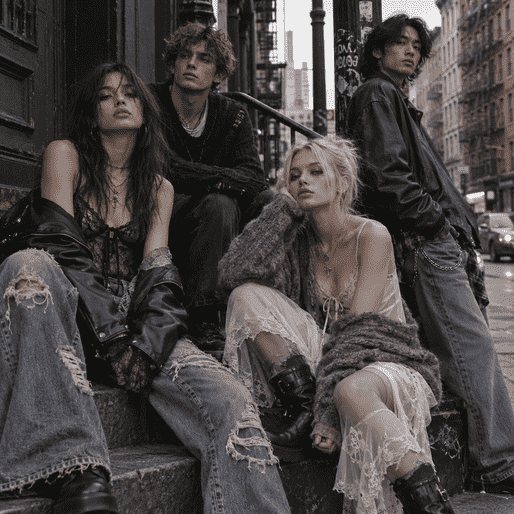
A new generation is reviving the spirit of 1990s anti-fashion, but replacing heavy plaid and thrift-store uniformity with gauzy fabrics, distressed denim, lingerie references and highly personal styling shaped by TikTok.

Grunge is back, but it no longer looks quite like grunge.
For a generation too young to remember Nirvana’s first wave or the original Seattle scene, the aesthetic that once defined 1990s anti-fashion is being dismantled and rebuilt into something lighter, more sensual and far more individual.
The emerging Fall 2026 interpretation has been described by Vogue as a form of “new grunge”: an undone style built around gauzy layers, distressed denim and a deliberately imperfect sense of ease rather than the familiar combination of oversized flannel shirts, combat boots and floral dresses associated with the original movement.
The shift is significant because it reflects a wider transformation in the way younger consumers use fashion.
Where previous generations often adopted recognisable subcultures almost as uniforms, Gen Z is increasingly mixing references from multiple decades and identities at once.
The result is less about belonging to a single tribe and more about creating an outfit that feels difficult to categorise.
The new grunge is softer
Traditional grunge was built around resistance.
Its clothes were cheap, practical and often deliberately indifferent to conventional ideas of glamour. Oversized knitwear, faded denim, flannel shirts and worn-out boots became visual shorthand for rejecting the polished excesses of late-1980s fashion.
The 2026 version keeps the rejection of perfection but removes much of the heaviness.
Instead of thick plaid, there are translucent knits and delicate fabrics.
Instead of shapeless layering, designers and stylists are combining rough denim with silk, lace and lingerie-inspired pieces.
The contrast is central to the look.
A distressed pair of jeans might be paired with a fluid silk camisole. A sheer dress may appear under an oversized leather jacket. Romantic lace can sit beside battered denim or utilitarian footwear.
The styling looks accidental, but increasingly it is anything but.
It is a carefully constructed form of disorder.
Vogue’s September fashion coverage highlighted this tension explicitly, showing how luxurious materials such as silk can be paired with visibly worn denim to create a look that feels simultaneously refined and damaged.
That contradiction is what gives new grunge its appeal.
It allows younger consumers to appear unconcerned with fashion while engaging very deeply with it.
Why Gen Z is attracted to imperfection
The revival is arriving at a moment when fashion itself is becoming increasingly polished digitally.
Social media is filled with heavily edited imagery, algorithmically optimised aesthetics and precisely defined micro-trends.
Against that background, visibly imperfect clothing can feel almost rebellious.
Frayed hems, unfinished layering, faded fabrics and mismatched textures introduce a kind of visual friction.
They make an outfit look lived in rather than designed for a screen.
But paradoxically, social media is also one of the main forces spreading the trend.
TikTok has become one of the most powerful fashion-discovery platforms among younger users. Vogue Business notes that the platform has around 1.2 billion users and says roughly 70% of them are Gen Z, giving TikTok enormous influence over the speed at which fashion references circulate and mutate.
That speed has fundamentally changed the life cycle of trends.
A style that once took several seasons to move from runway to magazine to high street can now travel internationally within days.
It can also be modified immediately.
One creator may interpret grunge through distressed denim. Another combines it with gothic styling. Another mixes it with ballet-inspired pieces, vintage sportswear or Y2K accessories.
Instead of one dominant trend, dozens of variations appear simultaneously.
Fashion without allegiance
This may be the biggest difference between the original grunge era and its current revival.
In the 1990s, subcultures were often relatively coherent.
Punk looked like punk. Goth looked like goth. Hip-hop fashion had its own recognisable visual language. Grunge came with its own codes.
Gen Z is far less interested in maintaining those boundaries.
A single outfit might combine a vintage slip dress, oversized football jersey, ballet flats, biker jacket and futuristic sunglasses.
From a traditional fashion perspective, those elements may appear unrelated.
To younger consumers, that is often precisely the point.
The contemporary ideal is increasingly personal incoherence that somehow works.
Fashion is becoming less about adopting an aesthetic completely and more about sampling it.
Grunge is therefore not returning as a historical costume.
It is returning as a vocabulary.
The ripped denim, slouchy proportions, dark tones and anti-perfect attitude are available to be borrowed and combined with entirely different references.
The decline of the “clean” uniform
The trend also represents a reaction against the extreme neatness that dominated earlier parts of the decade.
Minimalist wardrobes, neutral palettes, “quiet luxury” and highly polished “clean girl” aesthetics became some of the defining fashion movements of the early 2020s.
They emphasised restraint.
Hair was smooth. Jewellery was subtle. Colours were muted. Clothes were expensive-looking even when they were not expensive.
The new mood is almost the opposite.
Fall 2026 fashion more broadly is moving toward greater texture, decoration and personality.
Recent seasonal coverage has emphasised bold prints, leather, velvet, lace, dramatic accessories and stronger silhouettes, while accessories such as brooches, scarves, charms and statement hats have also returned to prominence.
The message is increasingly clear: dressing is becoming expressive again.
For younger consumers, grunge fits neatly into that change because it offers individuality without requiring obvious luxury.
Second-hand fashion gives the trend credibility
There is also an economic reason the aesthetic resonates with younger shoppers.
Unlike many runway-driven trends, grunge can be recreated convincingly without purchasing an entire new wardrobe.
Second-hand denim, worn leather jackets, old knitwear, lace tops and oversized shirts already exist in enormous quantities in vintage stores and resale marketplaces.
That makes the look unusually accessible.
In fact, clothes that appear too new can sometimes undermine the aesthetic.
Wear, fading and imperfection are part of the appeal.
This gives second-hand clothing an advantage that conventional retail cannot easily replicate.
It also aligns with Gen Z’s broader interest in resale, customisation and combining inexpensive pieces with occasional luxury purchases.
The modern grunge wardrobe therefore sits comfortably between sustainability and style.
A twenty-year-old jacket purchased second-hand may carry more cultural value than an immaculate new one.
Luxury fashion is borrowing the disorder
Yet the movement is not confined to thrift shops.
Major fashion houses are increasingly incorporating the same visual contradictions.
Runways and editorials are pairing delicate fabrics with damaged denim, polished tailoring with distressed surfaces and romantic dresses with heavy footwear.
The industry has realised that imperfection itself can be luxurious.
That represents an interesting reversal.
The original grunge movement became fashionable partly because designers appropriated a working-class and underground aesthetic.
Today, luxury fashion is once again translating anti-fashion into high fashion—but younger consumers are simultaneously recreating the same look through second-hand clothing and inexpensive pieces.
The result is a style that can exist at almost every price level.
Accessories become more personal
Another important difference is the role of accessories.
The original grunge wardrobe was comparatively stripped back.
The 2026 version often includes much more decoration.
Charm necklaces, brooches, scarves, layered jewellery and unconventional eyewear are all emerging as important Fall 2026 accessories, according to Vogue’s latest seasonal analysis.
For Gen Z, these items provide another level of personalisation.
A distressed denim jacket may be recognisably grunge, but the pins, charms, bags and jewellery attached to it can make the outfit uniquely individual.
This reflects one of the strongest currents in youth fashion: clothing is becoming a platform for self-curation.
The garment itself is only the beginning.
Algorithms are creating anti-uniforms
There is another irony behind the trend.
Social-media algorithms are extraordinarily effective at creating fashion uniformity.
Once an aesthetic becomes popular, millions of users may suddenly encounter similar outfits.
Yet the same platforms also encourage consumers to differentiate themselves from everyone else.
This creates an endless cycle.
A micro-trend becomes popular.
Young users adopt it.
It becomes too recognisable.
They modify it or abandon it.
Then another aesthetic emerges.
New grunge works particularly well within this environment because it is inherently flexible.
There is no single correct version.
That makes it harder to exhaust.
The appeal of looking unfinished
Perhaps the most interesting element of the trend is psychological.
Young consumers have spent much of their lives surrounded by digital perfection.
Phones automatically enhance photographs. Social platforms reward polished presentation. Artificial intelligence can now generate almost impossibly perfect imagery.
Fashion may be responding by moving in the opposite direction.
A ripped hem, a faded jacket or a deliberately awkward combination of fabrics introduces evidence of human imperfection.
The clothes appear to have history.
They look used rather than generated.
In that sense, new grunge may be about more than nostalgia.
It could represent a broader desire for authenticity in an increasingly synthetic visual culture.
Not a revival, but a remix
Fashion regularly repeats itself, but rarely exactly.
The current return of grunge demonstrates how younger generations increasingly treat fashion history as an open archive rather than a sequence of eras.
The 1990s are available at the same time as the 1970s, early-2000s Y2K fashion, gothic references and contemporary sportswear.
Everything can be sampled.
That is why describing the movement simply as a “grunge revival” misses something important.
Gen Z is not recreating 1993.
It is taking the visual language of that period—distressed clothing, slouchiness, contradiction and resistance to polish—and inserting it into a completely different cultural environment.
The result feels both familiar and new.
It is romantic but damaged, luxurious but deliberately careless, digital in its distribution yet nostalgic in appearance.
And perhaps most importantly, it does not demand that young people choose a single identity.
In an era dominated by rapidly changing micro-trends, that flexibility may be exactly why new grunge is becoming one of the most convincing youth-style movements of Fall 2026