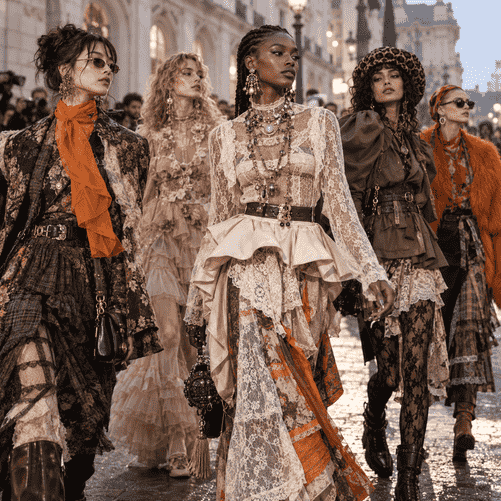
As New York Fashion Week prepares to open, early forecasts for Spring/Summer 2027 suggest the era of immaculate neutrals and tightly controlled minimalism is giving way to color, texture, romantic excess and a renewed appetite for individual style.

For several seasons, fashion’s dominant visual language has been one of restraint.
Neutral wardrobes, slicked-back hair, barely visible makeup, discreet accessories and carefully edited silhouettes became shorthand for the so-called “clean girl” aesthetic, an internet-born style that reflected the broader popularity of quiet luxury and understated dressing.
Now the mood appears to be changing.
As the international fashion calendar moves into the Spring/Summer 2027 womenswear season, designers, forecasters and retailers are increasingly pointing towards a less controlled aesthetic built around personality, imperfection and visual experimentation.
The shift is already visible in trend analysis published ahead of New York Fashion Week, which begins on 10 September. Forecasts based on consumer behaviour, social-media data, Copenhagen Fashion Week and the latest menswear collections suggest that next spring could favour clashing colours, layered prints, romantic transparency, utility dressing and deliberately unconventional combinations.
It amounts to more than another seasonal change in hemlines or colours.
Fashion appears to be rediscovering messiness.
The End of the Perfect Wardrobe
The clean-girl aesthetic became enormously influential because it translated well across both luxury fashion and social media.
Its formula was immediately recognisable: muted colours, gold jewellery, tailored coats, simple knitwear, immaculate skin and an overall impression of expensive effortlessness.
It suited the rise of quiet luxury, when consumers increasingly favoured clothing that communicated wealth through fabric and construction rather than conspicuous logos.
But aesthetics built around uniformity eventually create their own rebellion.
The emerging alternative has already been nicknamed “messy girl summer” — not because clothes are literally untidy, but because the styling deliberately avoids looking too calculated.
Instead of matching everything perfectly, garments can clash. Prints can compete with one another. Vintage pieces can sit alongside designer accessories. Feminine dresses can be worn with utilitarian shoes or oversized outerwear.
The objective is not visual perfection.
It is personality.
That distinction could become one of the defining fashion changes of 2027.
Individuality Becomes the New Luxury
The return of expressive dressing also reflects a broader challenge confronting the fashion industry.
Consumers increasingly have access to the same trends almost instantly.
Social platforms distribute runway imagery globally within minutes. Fast-fashion companies can reproduce silhouettes rapidly, while algorithms recommend remarkably similar products to millions of users.
That environment can make personal style increasingly difficult to distinguish.
As a result, individuality itself is becoming valuable.
Vogue’s Fall 2026 forecast has already identified “personality pieces” — distinctive brooches, unusual shoes, animal prints and highly decorative accessories — as an important movement in contemporary dressing. Rather than building an outfit around strict aesthetic rules, consumers are increasingly encouraged to incorporate objects that appear personal or even eccentric.
The idea carries naturally into Spring/Summer 2027.
Instead of buying an entirely new wardrobe, consumers can combine pieces from different periods, brands and price levels.
A vintage blouse might be worn with contemporary trousers. A technical jacket can accompany a sheer skirt. An heirloom brooch can transform an inexpensive knit.
Fashion becomes less about purchasing the correct uniform and more about assembling an identity.
Romanticism Meets Disorder
One of the strongest components of the emerging aesthetic is an intensified form of romantic dressing.
Sheer fabrics, flowing skirts, lace, draping and lingerie-inspired details remain prominent, but they are becoming less delicate and more experimental.
Rather than presenting romance as pristine femininity, designers are combining it with harder or more practical elements.
A transparent dress may appear beneath an oversized jacket. Lace can be paired with sportswear. Corsetry may be integrated into everyday silhouettes rather than reserved for eveningwear.
This contrast between softness and utility is becoming increasingly important.
The forthcoming Simone Rocha and Adidas Originals collaboration offers an especially clear example. Rocha has combined the romantic vocabulary for which she is known — including lace, tulle and pearl embellishment — with tracksuits, sportswear and Adidas footwear. The global collection launches on 10 September.
It is precisely the kind of combination that would once have appeared contradictory.
Now contradiction is increasingly the point.
Gardening-Core Replaces Cottage-Core
Another unexpectedly influential trend emerging for Spring/Summer 2027 is what forecasters are calling “gardening-core.”
The name sounds playful, but the underlying idea reflects fashion’s continuing fascination with practical clothing.
Apron shapes, cargo pockets, utility belts, raffia accessories and workwear references are increasingly being incorporated into fashion collections.
Unlike cottage-core, which romanticised an idealised rural lifestyle through floral dresses and pastoral imagery, gardening-core is more functional.
It suggests clothing intended for activity.
The silhouette can still be romantic, but the accessories are practical: sturdy footwear, substantial bags, belts and garments with visible pockets.
This reflects a broader movement across luxury fashion towards clothes that communicate purpose.
For an industry sometimes criticised for producing objects disconnected from everyday life, utility has become an increasingly attractive design language.
Orange Emerges as a New Statement Colour
Colour is also returning.
One of the clearest early predictions for Spring/Summer 2027 is orange, ranging from saturated citrus shades to deeper burnt tones.
Trend analysts have linked its rise to a combination of runway appearances, celebrity dressing and broader cultural moments.
Its significance lies partly in how far it sits from the beige, cream, black and grey palette associated with quiet luxury.
Orange is difficult to ignore.
That makes it appropriate for a fashion cycle increasingly interested in visibility.
The change does not necessarily mean neutral dressing will disappear. Brown, navy, charcoal and earthy tones remain important for Fall 2026, with celebrities including Rihanna already embracing rich tonal dressing.
Instead, fashion appears to be moving towards stronger contrasts.
A neutral wardrobe may increasingly be punctuated by one aggressively bright item — shoes, knitwear, a handbag or outerwear — rather than remaining monochromatic from head to toe.
The Peplum Tries Again
Fashion’s revival machinery is also turning towards one of the more divisive silhouettes of the recent past: the peplum.
The waist-flaring shape was ubiquitous during the early 2010s before becoming associated with one of that period’s most recognisable fashion clichés.
Its return demonstrates the extraordinary speed of contemporary nostalgia.
Designers are reworking the silhouette in more sculptural ways, using exaggerated construction, tailoring and unconventional proportions rather than simply recreating the fitted tops that dominated fashion more than a decade ago.
Bubble hems and dropped waists are undergoing similar reinterpretations.
The pattern is familiar.
Fashion rarely resurrects an old silhouette exactly as it was. Instead, designers exaggerate, distort or reposition it until the reference feels recognisable but new.
The peplum’s return therefore fits naturally into a season increasingly fascinated by volume and unusual proportions.
New York Becomes the First Major Test
New York Fashion Week will provide the first major indication of whether these forecasts translate into a broader runway movement.
The Spring/Summer 2027 schedule includes 63 runway shows among 126 official events, with both major American houses and international newcomers participating.
Several developments make this season particularly significant.
Diane von Furstenberg is returning to the official schedule after nine years, with Henry Zankov making his debut as creative director.
Ralph Lauren, Coach, Calvin Klein, Carolina Herrera and Thom Browne are among the established American names participating, while designers including Conner Ives and a number of emerging international labels are bringing fresh perspectives to the calendar.
American heritage fashion will be particularly closely watched.
Ralph Lauren and Coach have both successfully attracted younger consumers by reinterpreting familiar products rather than abandoning their historical identities.
Young shoppers in North America and Asia have helped drive renewed demand for Ralph Lauren polo shirts and cable-knit sweaters, while Coach’s Tabby handbag has become an important Gen Z success story.
That revival suggests another important trend: younger consumers are not necessarily rejecting traditional fashion.
They are remixing it.
Vintage Is Becoming a Language Rather Than a Category
That same instinct explains the continuing importance of vintage fashion.
Older clothing is increasingly being treated not as a separate market but as another component of contemporary styling.
The distinction matters.
A consumer wearing a 1990s jacket with new-season trousers and modern sneakers may not consider the outfit “vintage.” The older garment is simply one element of a contemporary wardrobe.
This mixing of decades helps undermine the uniformity created by algorithm-driven trend cycles.
It also gives consumers an opportunity to build combinations that are harder to reproduce exactly.
Vintage accessories, particularly jewellery, handbags and unusual outerwear, can therefore function as markers of individuality.
In a market where almost anything new can quickly become ubiquitous, rarity acquires cultural value.
Social Media Is Changing Too
Interestingly, the movement away from perfection is occurring not only in clothing but also in the way fashion brands communicate.
Meta fashion partnerships executive Eva Chen recently argued that successful brands are increasingly moving away from excessively polished social-media feeds in favour of more immediate and personal content.
Behind-the-scenes footage, spontaneous videos and direct interaction with communities are becoming more valuable as younger users become less interested in perfectly curated brand imagery.
That communication strategy mirrors the aesthetic change happening in clothing.
The old model presented fashion as finished.
The new model increasingly wants fashion to appear lived in.
The distinction explains why highly polished minimalism may be losing cultural momentum.
Imperfection creates narrative.
A Response to Luxury Fatigue
The move towards more expressive dressing is also unfolding during a difficult period for the global luxury market.
European luxury shares have come under renewed pressure as investors question the strength of the sector’s recovery. LVMH, Hermès, Kering and other major groups experienced stock-market declines in early September amid weaker demand across several important markets, including the United States and parts of Asia.
That environment makes stylistic change particularly important.
When consumers are reluctant to make major luxury purchases, brands need other ways to generate excitement.
Distinctive accessories, unusual styling combinations and recognisable statement pieces can create cultural momentum even when customers are unwilling to replace entire wardrobes.
The shift towards individuality therefore makes commercial sense.
Instead of selling a complete aesthetic, brands can sell one extraordinary object.
Fashion After the Algorithm
The most interesting aspect of the emerging 2027 aesthetic may ultimately be what it says about the relationship between fashion and technology.
Algorithms have made fashion trends extraordinarily efficient.
Consumers see the same images, receive similar recommendations and are rapidly exposed to whatever silhouette, colour or product is gaining momentum.
But efficiency has a cultural cost.
When everyone discovers the same trend simultaneously, novelty disappears quickly.
The emerging reaction appears to be deliberate inconsistency.
Mixing eras, textures, colours and cultural references makes personal style more difficult to reproduce algorithmically.
The result is a curious paradox.
After years in which digital platforms accelerated the creation of global aesthetics, fashion may now be rewarding people who look as though they are ignoring those aesthetics altogether.
The Return of Fashion as Play
That may ultimately be the most important trend heading into Spring/Summer 2027.
The clean-girl era was disciplined.
The next phase looks considerably less interested in rules.
Peplums can return. Orange can clash with pink. Sportswear can meet lace. Gardening clothes can become fashion. Vintage jewellery can sit beside futuristic footwear.
None of those ideas individually represents a revolution.
Taken together, however, they suggest a significant change in mood.
Fashion is moving away from the idea that good taste means removing things until an outfit becomes perfectly controlled.
The emerging proposition is almost the opposite: add something unexpected.
After several seasons dominated by restraint, the industry appears ready to rediscover the pleasure of dressing up — and, perhaps more importantly, the freedom of getting it slightly wrong.


