Saudi Arabia has temporarily halted its strategic East-West oil pipeline after drone attacks launched from Iraqi territory, threatening one of the kingdom’s most important alternatives to the Strait of Hormuz as regional conflict places mounting pressure on global energy supplies.

Saudi Arabia has shut down one of the world’s most strategically important oil pipelines after drone attacks struck infrastructure along the kingdom’s East-West route, opening a new front in the growing battle over Middle Eastern energy supplies.
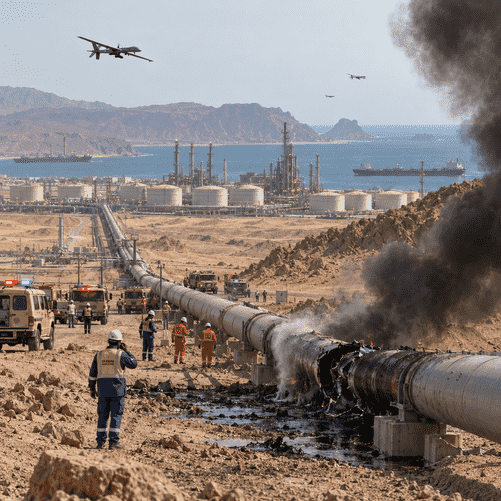
The Saudi Ministry of Energy said the East-West pipeline, also known as Petroline, was temporarily closed as a precaution after multiple attacks caused injuries and material damage. Saudi authorities said the drones responsible were launched from Iraqi territory, an assessment that Baghdad subsequently acknowledged while stopping short of identifying who carried out the operation.
The shutdown is particularly serious because the roughly 1,200-kilometre pipeline has become increasingly important since instability around the Strait of Hormuz disrupted the traditional route for Gulf oil exports.
Stretching from the kingdom’s oil-producing east towards the Red Sea port of Yanbu, Petroline allows Saudi crude to avoid Hormuz entirely. In recent months it has functioned as an increasingly valuable strategic bypass, capable of moving as much as roughly 5 million barrels a day towards the Red Sea and international markets.
Its disruption therefore attacks not simply another piece of Saudi infrastructure, but one of the principal safeguards built into the global oil system.
A pipeline designed for exactly this crisis
For decades, Saudi Arabia has understood the vulnerability created by the Strait of Hormuz.
The narrow waterway between Iran and Oman has historically carried a substantial portion of the world’s internationally traded petroleum. Any prolonged military confrontation involving Iran has therefore raised the possibility that shipping through the strait could be interrupted.
The East-West pipeline was designed partly to reduce that strategic exposure.
Crude can be moved from Saudi Arabia’s huge eastern oilfields across the Arabian Peninsula to Yanbu on the Red Sea coast. From there, tankers can sail through the Suez Canal or around Africa without entering Hormuz.
That capability has become considerably more important during the current conflict.
Oil traffic through Hormuz has been badly disrupted, forcing producers, traders and shipping companies to search for alternative routes. Industry estimates have varied because many tankers are operating with tracking systems switched off, but analysts agree that normal shipping patterns through the Gulf have been significantly affected.
Saudi Arabia consequently increased its reliance on Petroline.
The drone strike has now exposed the weakness of that contingency plan: bypassing a vulnerable maritime chokepoint provides little protection if the land infrastructure feeding the alternative route can itself be attacked.
Baghdad confirms Iraqi origin
The political implications are equally serious.
Saudi Arabia said the attacking drones originated in Iraq. Baghdad later confirmed that the aircraft had been launched from Iraqi territory and announced an investigation into how the strikes had been conducted.
Iraqi authorities moved quickly to demonstrate that they were treating the incident seriously.
Security measures were tightened around the country’s eastern frontier with Iran, and the government ordered the closure of the Shalamcheh border crossing as part of a broader response. An Iraqi military commander in Maysan province, close to the Iranian border, was also dismissed as authorities investigated the launch area.
No group had been conclusively identified as responsible in the immediate aftermath.
That distinction matters.
Iraq contains several armed organisations with historical or ideological connections to Iran, but confirmation that drones were launched from Iraqi territory does not by itself establish who ordered the attack or whether Tehran directed it.
US President Donald Trump nevertheless said on Saturday that he believed Iran was probably responsible. His assessment has not been independently established.
Riyadh has so far appeared determined to avoid an immediate escalation with Baghdad.
Saudi officials have emphasised Iraq’s responsibility to investigate the attack and prevent its territory being used for further strikes. The response suggests the kingdom is attempting to distinguish between the Iraqi government and the armed factions operating inside the country.
That restraint may prove essential.
An overt Saudi military response inside Iraq could transform an energy-security crisis into another direct regional confrontation.
Saudi oil already under pressure
The attack comes at an exceptionally difficult moment for Saudi Arabia’s oil industry.
The International Energy Agency said Saudi crude supply fell by around 2.3 million barrels a day in August to roughly 6 million barrels a day, its lowest level in more than three decades, as attacks and regional disruptions constrained production and exports.
The wider global picture is equally concerning.
The IEA has warned that continuing Middle Eastern disruptions are widening the expected supply shortfall for 2026, while inventories of refined fuels are being drawn down rapidly.
Oil prices have already moved above $100 a barrel during recent periods of heightened tension, reflecting not only reduced physical supply but the growing risk premium traders are attaching to Middle Eastern energy infrastructure.
The pipeline attack threatens to intensify that pressure.
Even a temporary closure forces Saudi Arabia to rely more heavily on alternative export arrangements precisely when maritime routes on both sides of the Arabian Peninsula are becoming less predictable.
Pressure from two strategic chokepoints
Saudi Arabia increasingly finds itself facing risks in both directions.
To the east lies the Strait of Hormuz.
To the west lies the Red Sea and the Bab el-Mandeb Strait, another narrow maritime passage through which tankers and commercial vessels must travel towards the Suez Canal.
Iran-aligned Houthi forces in Yemen have recently strengthened their position near Bab el-Mandeb, including capturing strategically important territory around Mayun, or Perim Island, at the entrance to the strait.
That development is significant because the Saudi East-West pipeline terminates on the Red Sea.
In theory, the route allows oil to escape the danger around Hormuz. But if shipping through the southern Red Sea also becomes unsafe, the kingdom’s alternative route becomes considerably less valuable.
Saudi Arabia is therefore confronting an increasingly uncomfortable strategic equation.
Its eastern export corridor is constrained by the Iran conflict. Its western maritime corridor is threatened by the Houthis. And now the pipeline connecting Saudi oilfields with the Red Sea has itself demonstrated its vulnerability to long-range drones.
For energy markets, that combination is potentially far more serious than any individual attack.
Cheap drones, expensive consequences
The incident also illustrates how dramatically the economics of attacks against energy infrastructure have changed.
Oil pipelines, pumping stations, storage facilities and refineries represent investments worth billions of dollars. Yet relatively inexpensive unmanned aircraft can threaten them from hundreds of kilometres away.
The asymmetry is striking.
A drone does not necessarily need to destroy an entire pipeline to disrupt operations. Damage to pumping stations, control systems, storage facilities or other critical nodes can force operators to halt flows while inspections and repairs are conducted.
Saudi Arabia has experienced this vulnerability before.
The 2019 attacks on the Abqaiq processing facility and Khurais oilfield temporarily removed around half of Saudi production from the market and demonstrated how precision strikes could disrupt enormously valuable energy infrastructure.
Since then, Riyadh has invested heavily in air defence and infrastructure protection.
The latest attack suggests that complete protection remains extremely difficult.
Saudi Arabia possesses an enormous geographical energy network containing oilfields, pipelines, processing plants, refineries, storage facilities and ports. Protecting every potential target continuously against low-flying drones presents a formidable military challenge.
Iraq caught between rival powers
For Baghdad, the episode presents another kind of danger.
Iraq has spent years attempting to balance relations with Iran, Saudi Arabia and the United States.
Iran remains one of Iraq’s most influential neighbours and maintains close relationships with several Iraqi political factions and armed groups. At the same time, Baghdad has worked to improve economic and diplomatic relations with Saudi Arabia and other Gulf states.
Drone attacks launched from Iraqi soil risk undermining that strategy.
If armed organisations are capable of using Iraq as a platform for strikes against Saudi strategic infrastructure, neighbouring governments may increasingly question whether Baghdad can control its own territory.
The incident could consequently intensify pressure on the Iraqi government to disarm or more tightly regulate powerful militias.
That task, however, carries substantial domestic political risks.
Global consequences far beyond Saudi Arabia
The immediate damage occurred inside Saudi Arabia, but the economic consequences may ultimately be felt thousands of kilometres away.
Asian economies are particularly exposed because many rely heavily on imported Middle Eastern crude. Higher oil prices increase transportation, manufacturing and electricity costs and can quickly contribute to broader inflation.
Europe would also feel the effect through higher energy and shipping costs.
For governments attempting to bring inflation under control, a sustained oil shock would create an especially difficult problem. Central banks can raise interest rates to suppress demand, but monetary policy cannot repair pipelines, reopen maritime chokepoints or protect tankers.
The longer the regional conflict lasts, the greater the possibility that energy disruption becomes structural rather than temporary.
That possibility is beginning to shape market expectations.
Traders are no longer pricing only the probability that Hormuz could be interrupted. They must increasingly consider simultaneous threats to pipelines, ports, refineries and Red Sea shipping.
The strategic warning behind the attack
Saudi Arabia’s East-West pipeline was built to ensure that the kingdom would still have options if the Gulf became dangerous.
That logic has now been tested.
The pipeline remains an extraordinarily valuable piece of infrastructure, and Saudi Arabia will almost certainly attempt to restore full operations as quickly as possible. But the drone attack has revealed that alternative routes are not immune from the same regional conflict they were designed to bypass.
For Riyadh, the immediate priority will be repairing the damaged infrastructure, identifying those responsible and preventing additional strikes.
For Baghdad, the priority will be demonstrating that Iraqi territory cannot be freely used to launch attacks against its neighbours.
For the wider world, the lesson is more troubling.
The international oil system has long depended on redundancy: if one shipping lane becomes dangerous, crude can be redirected through another route.
But redundancy works only when the alternatives remain secure.
With Hormuz constrained, the Red Sea increasingly threatened and Saudi Arabia’s principal cross-country oil pipeline now attacked, several of those safeguards are being tested simultaneously.
The danger for global energy markets is therefore no longer simply that one chokepoint might close.
It is that the Middle East’s entire network of alternative routes is becoming part of the battlefield.