The autumn/winter 2026–27 evening collection pairs black-and-white tailoring with elaborate surface detail, using a historic Italian home as the setting for its campaign.

Loro Piana has introduced its autumn/winter 2026–27 evening collection, bringing richly decorated womenswear and variations on the tuxedo into a predominantly black-and-white wardrobe. The release places close attention on how clothes are cut and finished, with velvet, silk, wool and cashmere providing different ways to approach formal dressing.
The collection became available on 11 November, according to SLEEK’s report, which identifies boutiques and the brand’s website as the retail channels. Coverage published this week describes a range intended for occasions extending from smaller evening gatherings to black-tie events, rather than a single narrowly defined dress code.
Its most interesting design decision is the limited colour range. Black and white leave relatively little room for colour alone to distinguish one look from another. The visual work therefore falls to proportion, surface and movement: a broad trouser leg, an embroidered panel or the contrast between a matte cloth and a reflective finish.
Womenswear puts texture at the centre
The Giles coat, Vika cape and Maela skirt are among the collection’s elaborately worked pieces. PAUSE’s account highlights gold-thread embroidery and beadwork involving around 30,000 glass elements, alongside silk velvet and sculptural shapes. The decoration gives the otherwise restrained palette a distinctly ornamental register.
That combination creates a useful tension within the collection. A garment can read as relatively simple in outline while revealing considerable detail at closer range. From a design perspective, the effect depends on the relationship between the shape and the finish: the embroidery has to remain legible without obscuring the line of the garment.
Other pieces develop volume through the cut. NOWRE’s collection report describes a cropped Miledy jacket with puffed sleeves, paired with wide trousers, as well as draped and pleated treatments in velvet and satin. Those details offer a softer route into eveningwear than a rigidly fitted silhouette.
PAUSE also identifies palazzo trousers and a Vase Clutch among the offering. Taken together, the separates and accessories suggest several levels of formality within the same visual vocabulary. A wearer could make the decorated outer layer the focus, or rely on the silhouette of the trousers and jacket to give an outfit its structure.
Menswear reworks the familiar tuxedo
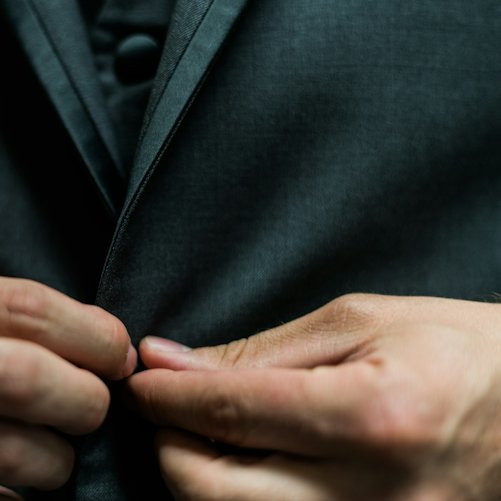
The menswear retains recognisable eveningwear references, including wool-and-silk tailoring, satin lapels and shawl collars. These are familiar components, but their proportions and combinations determine whether a suit feels severe, fluid or relaxed. In this collection, the emphasis described in the launch coverage is on adapting those components across jackets, coats and complete looks.
NOWRE singles out a shawl-collar jacket in grain de poudre cloth with contrasting satin at the collar, alongside an outerwear piece in Baby Cashmere Double. It also reports jacquard fabric and satin lapel details in the formalwear. This places variation inside the fabrics and construction rather than depending on a broad range of colours.
Such an approach makes the relationship between individual garments especially important. A soft coat over a structured jacket changes the overall outline; a polished lapel draws the eye differently from an uninterrupted wool surface. These are small distinctions, but they explain how a collection can revisit a familiar tuxedo vocabulary without simply repeating the same outfit.
The brand’s official eveningwear presentation likewise puts materials, including silk and its signature Baby Cashmere, at the centre of the offer. That is useful context for reading the launch: the garments are being presented through their fibres and finishes as well as through the occasions for which they are intended.
For the collection as a whole, the result is a conversation between decoration and ease. The beadwork brings visible formality, while the capes, roomy trousers and softer outer layers offer a different kind of presence. The design proposition is strongest where those elements work together and the wearer’s movement remains part of the finished look.
A campaign shaped by Italian interiors
The accompanying campaign was photographed by Annemarieke van Drimmelen at Casa Borsani, according to SLEEK. NOWRE identifies Leon Dame, Kayako Higuchi and Elias Monstrey as the models. The setting connects the clothes to an Italian domestic interior, placing the evening wardrobe in rooms rather than relying solely on the conventions of the red carpet.
For context, FAI’s account of Villa Borsani locates the house in Varedo, north of Milan, and dates its construction to 1943–45. Osvaldo Borsani designed it as the family’s principal residence. FAI describes an interior distinguished by rich materials and artworks within a building of recognisably modern character.
That architectural background makes the location more than an interchangeable backdrop. As an editorial reading of the campaign, the connection is the attention to surfaces and proportion shared by a room and an outfit. A restrained exterior can contain elaborate interiors, just as a controlled garment shape can carry detailed embroidery and contrasting textures.
The new release ultimately makes its case through those relationships: black against white, smooth against embellished, formal tailoring against softer volume. Its defining feature is the range of ways those elements are combined. For this season’s eveningwear, Loro Piana is using the details of construction and presentation to give a familiar wardrobe another expression.
Sources
PAUSE: Loro Piana Unveils Its Fall/Winter 2026/2027 Evening Collection
NOWRE: Loro Piana introduces its 2026–2027 autumn/winter evening collection