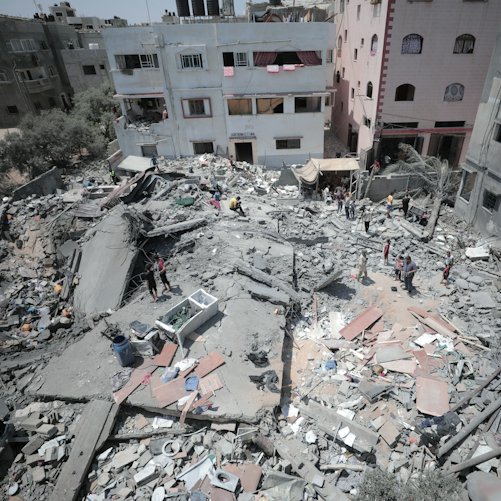
Germany says Israel plans to deploy donated cargo scanners as pressure grows to accelerate aid into Gaza. Flood damage, tents waiting outside the territory and gaps in drainage and healthcare show why the winter response depends on both reliable access and assistance reaching families inside.

Germany has urged Israel to allow substantially more humanitarian assistance into Gaza as winter rain adds to the danger facing displaced families. Foreign Minister Johann Wadephul said on Monday that Israel planned to begin using German-provided cargo scanners this week, a step he hoped would increase the volume of goods entering the territory.
The announcement comes amid mounting diplomatic pressure and warnings from humanitarian organisations that shelter and essential equipment are failing to reach people quickly enough. The immediate challenge extends beyond getting trucks approved at a crossing. Supplies must also be collected, transported and distributed, while damaged shelters and drainage systems require work that replacement tents alone cannot provide.
A promised change at the crossings
Speaking before an EU foreign ministers’ meeting in Brussels, Wadephul said his Israeli counterpart had informed him that the security cabinet approved the scanner deployment on Sunday. Germany had supplied the equipment months earlier, he said, but it had been awaiting use. His remarks described an intended operational change; they did not establish that the new system was already processing deliveries or had raised daily throughput.
The foreign ministers of Australia, Canada, Italy and the United Kingdom made a joint appeal over the weekend for faster humanitarian access. They said 150,000 tents and other supplies were being held outside Gaza and urged the entry of items needed for relief and early recovery, including equipment subject to dual-use restrictions. They also called on all parties to respect the ceasefire and allow assistance to reach civilians.
For aid operations, faster inspection could remove one constraint, but a scanner cannot resolve every subsequent delay. The relevant measures will include predictable opening hours, the range of goods admitted and the ability of humanitarian teams to collect and distribute them. An announcement about equipment is therefore an initial step whose effect must be assessed through actual deliveries.
Flood damage is already straining the response
OCHA’s 13 November situation report described early alerts suggesting that more than 46,000 households could have been affected by rain that began on 6 November. The alerts included reports of damage to over 40,000 shelters, with the detailed losses still requiring confirmation. Those figures indicate the reported scale of the emergency, rather than a completed assessment of every affected site.
The same report said sewage-contaminated floodwater, disrupted health services and damaged learning spaces were compounding the crisis. By 10 November, approximately 5,500 children remained unable to access their affected learning spaces. Repairs to shelter therefore intersect with education, sanitation and healthcare, rather than constituting a separate task that can be completed independently.
The November report also recorded 228 UN and partner aid trucks offloaded on the Israeli side of Kerem Shalom between 2 and 8 November, around 42 per cent fewer than the previous week. It linked the decline to a suspension of the Egyptian corridor, reportedly over smuggling concerns, and to reduced supplies available because of funding constraints. Those weekly figures cover a defined humanitarian channel, not every form of entry into Gaza.
Israel cites deliveries and security concerns
Israel says it is supporting winter preparedness while seeking to prevent Hamas from diverting humanitarian supplies. An official embassy update dated 13 November said its programme included more than 91,000 tents, over 8,200 trucks carrying winter items and supplies, twelve sewage-removal vehicles, and work on water and wastewater networks. These are figures presented by Israeli authorities, rather than an independently verified measure of assistance received by households.
Those totals should not be directly compared with OCHA’s one-week count: the embassy update does not identify a matching one-week reporting period, and the categories differ. Nor does the number of items admitted establish whether individual families have adequate shelter. The operational dispute concerns what is still waiting, the range of equipment allowed through, and whether available assistance is sufficient for repeated storms and the damage they cause.
The Humanitarian Country Team said on Friday that more than 150,000 procured tents were outside Gaza ready for dispatch, most in Egypt’s Al Arish. Its appeal sought predictable access for a wider set of items, including pumps, generators, fuel, repair materials and medical supplies, alongside support for families choosing to leave dangerous buildings or flood-prone sites.
Children need protection through the whole season
UNICEF reported that three children, aged four, five and eight, died with their mother when a sand dune collapsed onto their tent in Deir al-Balah during the earlier heavy rain. Its 9 November statement estimated that about 950,000 displaced people lived in areas exposed to flooding, including 400,000 in locations at extremely high risk. The figures describe exposure to future harm as well as damage already suffered.
The agency’s winter programme runs from October 2026 through March 2027. Its September appeal sought $97.5 million to help protect 540,000 children and their families across Gaza and the West Bank. It identified risks from inadequate shelter, cold, contaminated water and interrupted essential services, especially for infants, young children and those with existing medical conditions.
Britain announced a further £5 million for UNICEF’s winter response on 12 November, alongside its diplomatic demands for improved access. The UK said its wider support aimed to provide clothing, tarpaulins, tents and blankets to specified groups. These commitments demonstrate that funding can be mobilised, but money, permission to enter and distribution capacity must come together before families benefit.
The next storm makes timing decisive
UN relief chief Tom Fletcher has argued that humanitarian action cannot wait for the completion of Israeli government formation. His appeal stressed durable shelter, winter clothing and equipment for pumping water, removing debris and clearing explosive hazards. That combination reflects a sustained operation through the season, with maintenance and repairs needed alongside successive distributions.
The coming days will show whether the planned scanners translate into a reliable increase in assistance and whether other restrictions and funding gaps are addressed. The practical test is straightforward: families need dry shelter, functioning sanitation and access to care before another storm damages what remains. Progress at the border matters most when it becomes protection at the place where people are living.