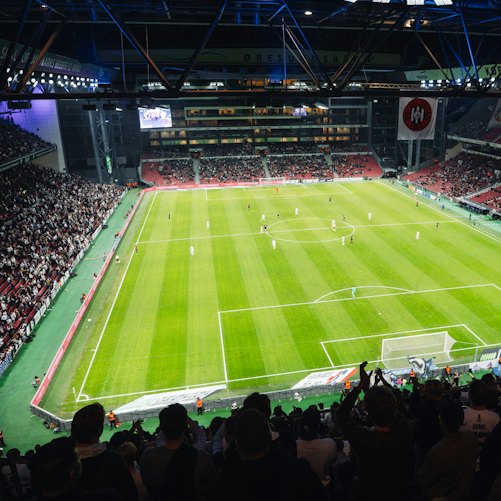
Norway recovered from two goals down in Copenhagen to beat Denmark 3–2 and secure a place in the Nations League quarter-finals. Erling Haaland’s stoppage-time penalty completed the turnaround after Martin Ødegaard’s equaliser, leaving the two neighbours level on points but facing very different challenges in March.

Erling Haaland converted a penalty deep into stoppage time as Norway overturned a 2–0 deficit to defeat Denmark 3–2 at Parken on Tuesday night. The victory secured second place in League A Group 4 and completed the line-up for the Nations League quarter-finals, transforming the closing minutes of the league phase.
The decisive kick came in the 96th minute after Denmark defender Joachim Andersen was penalised for handball. Haaland had already reduced the deficit before half-time, and Martin Ødegaard’s equaliser in the 83rd minute had kept Norway’s hopes alive. Denmark were still on course to qualify until the late penalty changed the outcome.
Denmark’s early advantage disappears
Rasmus Højlund gave the hosts the lead after 11 minutes with a close-range finish. Pierre-Emile Højbjerg headed in a second three minutes later, leaving Denmark with an early cushion in a match where avoiding defeat would have been enough to keep them ahead of Norway in the race for the last eight.
Norway’s response before the interval proved essential. Haaland finished into an unguarded net in the 37th minute after a poor clearance from goalkeeper Mads Hermansen allowed Ødegaard to intervene. The goal cut Denmark’s lead to one and ensured that the visitors began the second half within reach of changing the group standings.
Ødegaard supplied the next breakthrough, driving in the equaliser with seven minutes of normal time remaining. That restored parity in the match, but Norway still needed a winner. The distinction gave the final period its urgency: a draw could rescue a result without delivering the qualification they had travelled to Copenhagen to secure.
Haaland’s second goal then settled both contests at once. His penalty was his sixth goal of this Nations League campaign, and it left Denmark without time to recover their previous position. A match the hosts had controlled on the scoreboard after 14 minutes ended with Norway celebrating passage to the knockout stage.
Two wins over Denmark settle the group
Portugal finished first with 15 points, while Norway and Denmark each ended on nine. Norway took the higher position through the head-to-head record between the two sides. They had also beaten Denmark 3–2 in Oslo on September 24, giving them six points from their direct meetings across the league phase.
That earlier result made Tuesday’s victory especially valuable. Under the competition’s ranking rules, points won in matches between tied teams are considered before overall goal difference. Denmark’s emphatic 4–1 victory in Portugal on Saturday had improved their position, but could not protect them once Norway completed a second win in the Scandinavian contest.
Norway’s campaign had been far from straightforward. Between the two wins over Denmark, they lost home and away to Portugal and were beaten in Wales. A 3–1 home victory over the Welsh on November 14 restored their chance of progressing, making the final two fixtures a successful recovery from three consecutive group defeats.
The sequence gives the Copenhagen comeback a broader significance. Norway did not qualify through a campaign without setbacks; they won the matches that remained available after those setbacks. The two November victories accounted for six of their nine points, while the opening win over Denmark supplied the earlier foundation for their final position.
Denmark now enter the League A/B play-offs instead of the quarter-finals. Wales, who finished fourth in the same group with three points, also move into those play-offs under the competition’s adjusted promotion and relegation arrangements. For both teams, March will concern their place in the league structure rather than a route to the finals.
The final eight are confirmed
Norway join Belgium, England, France, Germany, the Netherlands, Portugal and Spain in the quarter-finals. France, Germany, England and Portugal won their groups, with Belgium, the Netherlands, Spain and Norway finishing as runners-up. The league stage has now closed, shifting attention from the tables to the draw and the next international window.
Several sections remained finely balanced at the finish. Germany, the Netherlands and Greece each collected 11 points in Group A2, with their head-to-head records separating them. Germany and the Netherlands advanced, while Greece missed out despite matching their totals. Norway’s qualification was another example of direct encounters determining the order when points alone could not.
Portugal completed their group programme with a 3–2 victory in Wales on Tuesday. The result left the defending champions six points clear of Norway and Denmark. For Norway, reaching the same knockout stage closes the immediate gap in opportunity: each quarter-finalist will now have a tie through which to pursue a place among the final four.
March brings a different examination
The knockout-stage and play-off draw is scheduled for Friday, November 20, at 12:00 CET in Nyon. The quarter-finals and promotion or relegation play-offs will follow in March 2027, with the final tournament set for June 9–13. Norway therefore have several months between the drama of qualification and the next competitive test.
The quarter-final stage is still a relatively recent addition to the competition, having first been used in the 2024/25 edition. Its inaugural four ties produced 31 goals, with three requiring extra time or penalties. The format provides another demanding round between a successful group campaign and the four-team finals.
For Norway, the immediate encouragement is the contribution of both Haaland and Ødegaard at decisive moments. Yet conceding twice inside the opening quarter-hour also gives the team a clear area to examine. A successful recovery establishes the result; it does not remove the importance of understanding how such a deficit developed.
Denmark face the reverse review after allowing an early two-goal lead to disappear in a match carrying direct consequences for their spring programme. The difference between their position at half-time and at the final whistle was stark. Norway leave Copenhagen with a quarter-final to prepare for, while the hosts must reset for a play-off.