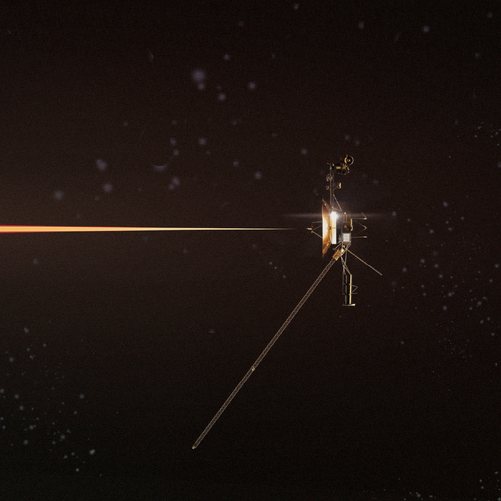
A radio signal that took 24 hours to reach Earth confirmed Voyager 1’s record distance. Engineers are now trying to recover the measurements its transmitter normally carries.

A radio signal arrived on Earth on Thursday after travelling for an entire day from Voyager 1. It confirmed that a machine launched in 1977 had become the first human-made object to reach one light-day from home. The signal carried none of the measurements that scientists normally wait for.
Since November 14, the spacecraft has been transmitting a carrier wave without the science readings and engineering reports that tell its team what is happening aboard.
Voyager crossed the mark at 10:16 UTC on Wednesday, November 18, some 25.9 billion kilometres, or 16.1 billion miles, from Earth. Engineers at NASA’s Jet Propulsion Laboratory could establish the distance from the radio signal and a trajectory calculated from years of tracking.
The two dates matter. Wednesday was when the spacecraft reached that distance. Thursday was the first time a listener on Earth could hear the signal it sent from there.
A signal without its payload
The trouble became apparent at a ground station near Canberra, Australia. Its antenna picked up the carrier, the radio wave on which Voyager normally encodes information, but none of the expected data came through. That gave engineers a first indication of what still works.
At this distance, a signal reaching the receiving dish tells them that Voyager can point its own antenna towards Earth and that equipment aboard the probe can still transmit.
Several pieces of hardware must work together to send a reading home. Instruments make measurements. A computer collects them, along with information on the spacecraft itself, and packages the material for transmission. Other equipment puts the data onto the radio signal. NASA says the symptoms point towards the computer that prepares the data. Engineers are investigating the cause.
Without its engineering reports, they have also lost one of their best ways to narrow down the fault.
Distance dictates the pace of every test. A command sent from Earth on Thursday reaches the probe on Friday. Even if the spacecraft acts immediately and can report the outcome, the earliest possible reply arrives on Saturday. A complicated diagnosis might require several such exchanges, with engineers on the ground studying each result before deciding what to send next. The mission team expects the investigation could take weeks or longer.
What engineers learned from an earlier failure
There is a precedent. In November 2023, engineers lost access to readable data from Voyager 1 while they could still detect its transmission. They eventually traced the trouble to a failed memory chip in the flight data subsystem. The chip held software as well as other information. Restoring the system meant finding other places in the computer to put the instructions that the probe needed to prepare a report.
No single free section was large enough, so engineers split the affected code into pieces. They changed references to the old memory locations so the pieces could still work together, then moved the code that handled engineering reports first.
In April 2024, the ground team received readable information on the spacecraft’s condition for the first time in five months. Two science instruments resumed returning data the following month. That recovery gives the team experience with the symptoms while it investigates the new fault.
A more recent incident offers a different comparison. During two scheduled contacts in October, ground antennas heard nothing at all. The signal returned on October 20 before engineers sent troubleshooting commands. They found that the probe had switched to backup thrusters, a response it can initiate on its own if it detects a problem. It then operated normally until November 14. The team is examining whether the October and November episodes have any connection.
Listening from three continents
Listening to Voyager requires equipment on three continents. NASA’s Deep Space Network has antenna complexes in California and near Madrid and Canberra. As Earth rotates and a spacecraft drops towards the horizon at one site, another can take over. Engineers can also combine the collecting power of several dishes.
In a 2024 test in Madrid, six antennas listened to Voyager 1 simultaneously, an experiment in receiving an increasingly faint signal as the probe travels farther away.
Aboard Voyager, the limiting resource is electricity. Its generators convert heat from decaying plutonium into power, and each year the supply available to the spacecraft falls by about four watts. By September engineers had completed a changeover from three devices to alternatives that consumed less power. All three had to switch together because the equipment also helps keep the spacecraft warm. Saving electricity in one place can leave a different part of the vehicle too cold to operate.
The science still within reach
What the team is trying to preserve has changed since launch. Voyager 1 flew past Jupiter and Saturn and later crossed the boundary of the heliosphere in 2012. Beyond that boundary, instruments can sample the magnetic field and the electrically charged gas in the space between stars. Voyager 2 reached interstellar space in 2018 along another path. The two probes offer scientists measurements from distinct locations that no other spacecraft has reached.
In April, controllers turned off Voyager 1’s low-energy charged particle experiment to save power. That left a magnetometer, which measures the strength and direction of the magnetic field, and a plasma wave instrument. Getting either stream back would give researchers observations they cannot repeat by pointing a telescope from Earth. These measurements describe conditions at the spacecraft itself.
The plasma wave instrument once settled a question about where Voyager had gone. In 2013 it registered vibrations in the surrounding charged gas after a solar eruption sent a disturbance out through space. The frequency revealed plasma more than 40 times denser than the gas encountered near the outer edge of the Sun’s bubble. Scientists used that evidence to establish that Voyager had crossed into interstellar space the previous year.
The light-day mark itself involved no physical crossing like the one Voyager made in 2012. At the probe, nothing special had to switch on or deploy at 10:16 UTC. Its record instead describes the separation between the spacecraft and the people who built, maintain and listen to it. Light can get from Earth to the Moon in about 1.3 seconds. The transmission that reached the ground on Thursday had spent 86,400 seconds in flight.
The next signal the team most wants to receive is a more ordinary one. A readable engineering report would let controllers examine the condition of the onboard equipment. Science data would put a new point on a record of interstellar space that began more than a decade ago. Until then, the carrier alone tells them something worth knowing about a machine approaching its fiftieth year in flight. Its antenna is still finding Earth.