At the Legion of Honor, 80 garments by the Tunisian-born couturier include a zipped denim dress, a beaded Tina Turner minidress and tailoring displayed beside furniture made for Marie Antoinette.

A pale lilac dress that Grace Jones wore in Paris in 1985 opens the first major American retrospective of Azzedine Alaïa. At San Francisco’s Legion of Honor, the hood frames an empty space where Jones’s face would be. Bands of jersey wrap close to the body before the skirt spreads into a train. Even without its celebrated wearer, the dress gives a remarkably precise idea of a person standing inside it.
“Azzedine Alaïa: Sculpting Fashion,” which opened Saturday, brings together 80 of the couturier’s garments and a selection of historical clothes he collected. Curators Laura L. Camerlengo and Olivier Saillard have distributed the exhibition across the temporary galleries and the museum’s permanent collection. Visitors looking for a Rodin can encounter a pair of column dresses on the way.
Jones modeled the dress for Alaïa’s spring 1986 collection and accompanied him to the French fashion awards at the Palais Garnier on October 23, 1985. He won two awards that night. Their partnership also reached cinema audiences that year through the costumes he made for her in the James Bond film “A View to a Kill.”
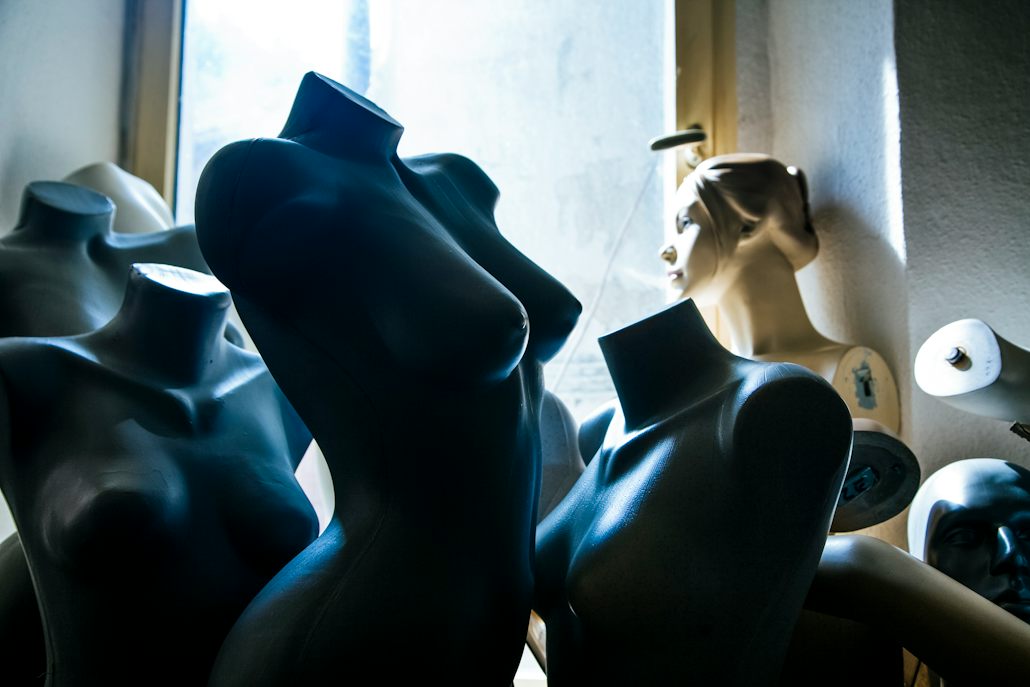
The invisible figure in the Jones dress has its own history. Alaïa had clear, headless forms made to Naomi Campbell’s proportions so his work could be exhibited as he wished. The display preserves that choice. Campbell’s contribution to the show extends beyond the clothes she modeled. Her measurements help determine how a visitor sees a garment associated with another woman entirely.
Campbell walked for Alaïa in the 1980s and opened and closed his winter couture show in July 2017, the year he died. Three decades of fittings connect the young model he worked with in the 1980s to the woman he chose for his final couture runway.
A Dressmaker in Paris and New York
Alaïa was born in Tunis in 1935 and studied sculpture there before moving to Paris in 1956. He learned to sew from his sister. As a dressmaker he kept his hands on the pattern, the shears and the final fitting, and he sometimes waited to show a collection until he judged it finished. The steps often divided among specialists in a couture house remained part of his own working day.
Some early work carried another designer’s name. In 1965, a head seamstress he knew from Dior commissioned pieces for Yves Saint Laurent. Alaïa made the prototype for Saint Laurent’s Mondrian dress and delivered the dresses himself. The young sculptor from Tunis was helping translate a painter’s geometry into clothes.
A denim dress from his spring 1986 ready-to-wear collection makes the case for looking closely at hardware. A long zipper runs down the front beneath broad lapels. The eye follows that fastening through the narrowest point of the waist. Familiar from a pair of jeans, the metal teeth give a surprisingly formal dress its most conspicuous line.
A black lambskin skirt from 1983 takes a different route to fit. Openings along the side are tied together, giving the ordinary act of fastening a skirt a decorative role. The eye follows those ties down the side of the wearer’s body just as it follows the zipper down the front of the denim dress.
American shoppers had encountered his clothes early. In 1982 Dawn Mello invited him to show at Bergdorf Goodman in New York. By the label’s third season, the United States was its largest market after France, with independent shops as well as department stores buying. The American chapter of this exhibition reaches back well before the red carpets that made his dresses familiar to millions.
Thierry Mugler helped with casting and interpreted for interviews during the New York trip. Alaïa showed black jersey dresses with no jewelry, and Andy Warhol was among the guests. A buyer who had first noticed the clothes through Bill Cunningham’s photographs could now see how that jersey behaved as the model walked.
Couture Among the Paintings
Julian Schnabel designed sculpted bronze clothes rails and a bronze table bearing Alaïa’s initials for his New York shop. When it closed in 1991, elements of that interior traveled to his Paris store. Even the fittings could have a second life.
Upstairs, pieces from spring 1992 share a gallery with a carved, gilded sofa that Marie Antoinette commissioned for her private rooms at Versailles in 1779. The connection runs through the cut of the clothes. Alaïa borrowed the lines of eighteenth-century riding coats and the sideways spread of hooped skirts, using tailoring and corsetry to fit them to a twentieth-century body.
The 1992 collection drew on Madame de Pompadour, who had studied in buildings later occupied by Alaïa’s atelier. In San Francisco, the clothes hang within sight of a Canaletto view of Venice from around 1750. The furniture, the painting and the modern clothes occupy the same room.
Elsewhere, two dresses in the form of columns have found a home in the Rodin gallery. Both sculpture and garment invite a look from the side. The dress has to borrow its bearing from that almost invisible body inside.
Alaïa had experimented with this kind of company for his clothes in his lifetime. In 1985 a contemporary art museum in Bordeaux showed his work beside pieces by Dan Flavin. Fifteen years later, a New York Guggenheim exhibition brought his designs together with paintings from Andy Warhol’s “Last Supper” series.
Historical clothes also had a place in his studio. The exhibition includes pieces he owned by Cristóbal Balenciaga, Elsa Schiaparelli and Madeleine Vionnet. He preserved many garments and took some apart to see how they were made. A dress turned inside out could answer a question a painting never could, down to the direction a panel had been cut.
The Clothes Alaïa Kept
That archive grew out of a practical offer in 1968. When Balenciaga closed his couture house, a longtime employee invited Alaïa to take garments he might recut. Once he saw their construction, he decided to keep them intact. A workshop looking for material had become a place where someone else’s way of cutting could survive.
Alaïa was particularly drawn to pieces from the 1930s and 1950s. His collecting became an exhibition subject in its own right at the Palais Galliera in Paris in 2023. San Francisco gives the collector and the dressmaker room in the same exhibition.
Keeping his own timetable mattered, too. He presented his spring 1988 collection in May, two months after the main shows. In the 1990s he carried on making couture for private clients and selling ready-to-wear through a small group of shops during a period when he stepped away from the runway. The fittings continued between public appearances.
Some of his best-known clients give the show its most striking changes of scale. Rihanna’s red halter gown, worn to the 2013 Grammy Awards, trails behind the wearer. Tina Turner’s short dress from spring 1989 concentrates its effect above the knee. Gold-colored beads embroidered on silk organza catch the light across a surface small enough to move with a dancer.
Peter Lindbergh photographed Turner with Alaïa in Paris in 1989. Her beaded dress is one of the last pieces visitors encounter in the San Francisco show. From the long train of Jones’s opening gown to Turner’s short hem, two singers with unmistakable ways of moving have given the exhibition its bookends.
The retrospective runs through April 11, 2027. It is possible to come for the famous dresses and spend as much time on a strip of denim or a piece of tied leather. Across these galleries, the same hands that shaped a gown for a night at the Paris opera also knew exactly where to put a zipper.