Strategic Imperatives and Regional Consequences in the Middle East’s Geopolitical Chessboard

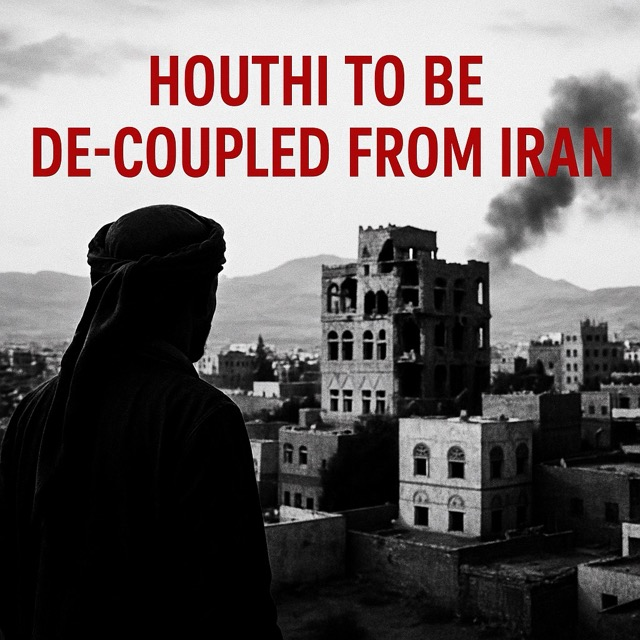
The Houthi movement, officially known as Ansar Allah, has long been associated with the Islamic Republic of Iran. This alliance, forged in mutual opposition to Saudi Arabia and Western-backed Yemeni forces, has brought strategic benefits to both parties: for the Houthis, a source of advanced weaponry and ideological validation; for Iran, a valuable proxy in its asymmetrical strategy across the Middle East. However, recent developments raise the question of whether the Houthis can—or should—be decoupled from Iranian influence.
The relationship between Iran and the Houthis is multifaceted. While the Houthis are rooted in Yemen’s local Zaidi Shia context, Iran has provided them with military technology, training, and political support, particularly since the outbreak of Yemen’s civil war in 2014. Iranian involvement has transformed the Houthis from a localized insurgent group into a formidable regional actor capable of threatening key maritime routes like the Bab el-Mandeb Strait.
This transformation has drawn increasing attention and concern from international actors, particularly the United States, Saudi Arabia, and Israel. Iran’s strategy of nurturing non-state actors as extensions of its influence—be it Hezbollah in Lebanon or Shiite militias in Iraq—has become a central component of its foreign policy. Decoupling the Houthis from this network would represent a significant shift in regional power dynamics.
Several factors make the decoupling of the Houthis from Iran a timely objective. First, Yemen remains mired in one of the world’s worst humanitarian crises. A resolution to the conflict will likely require the Houthis to engage in genuine negotiations with other Yemeni stakeholders and international mediators. Iran’s backing often emboldens the group to adopt a maximalist stance, thereby stalling peace efforts.
Second, the recent intensification of Houthi missile and drone attacks on international shipping in the Red Sea has led to renewed military responses from Western powers. These escalations risk a broader regional war that few actors genuinely desire. Reducing Iranian influence could serve to de-escalate tensions and reframe the Houthis as a domestic Yemeni movement rather than a regional proxy.
Despite the apparent advantages, detaching the Houthis from Iran is far from straightforward. The group has become ideologically aligned with Iran’s broader anti-Western and anti-Saudi posture. Additionally, Iran’s support has been instrumental in the Houthis’ battlefield successes. Without Tehran’s backing, the Houthis might fear losing leverage in peace talks or territorial control.
Furthermore, Iran is unlikely to relinquish its influence without extracting strategic concessions. The Houthis serve as a low-cost, high-impact proxy that diverts attention and resources from Iran’s other regional pursuits. A decoupling process would therefore need to be embedded in a broader diplomatic framework—possibly involving regional security guarantees or a rethinking of Gulf-Iran relations.
Efforts to decouple the Houthis from Iran must be strategic, multi-layered, and diplomatic in nature. One possible avenue involves increased engagement with the Houthis by neutral or non-aligned states, such as Oman or Qatar, to encourage political independence. Another is the provision of humanitarian aid and reconstruction incentives contingent upon disengagement from foreign actors.
Ultimately, the future of Yemen depends on internal political reconciliation. While Iran’s influence over the Houthis has undeniably shaped the trajectory of the conflict, removing that influence could empower a more autonomous and potentially more constructive Houthi role in Yemen’s post-war political landscape.
The decoupling of the Houthis from Iran is not just a strategic necessity—it is a potential catalyst for peace in a region long tormented by proxy wars and geopolitical rivalries.