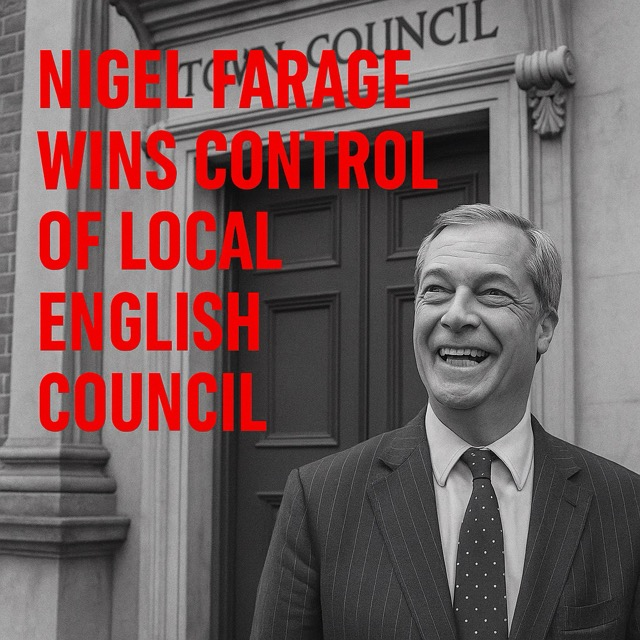
A populist comeback shakes the political establishment as Farage’s party takes charge at the local level

In a surprising turn of events that has sent ripples through the British political landscape, Nigel Farage’s newly rebranded political group has secured control of a local council in England, marking a significant return to the forefront of national debate. Often dismissed as a political provocateur, Farage has proven once again that his message still resonates with segments of the electorate disillusioned with the traditional parties.
The victory took place in a traditionally Conservative-leaning area, where voter turnout was unusually high for a local election. Farage’s campaign, fueled by promises of local empowerment, tax cuts, and immigration control, managed to convert frustration into votes. His team focused on door-to-door engagement and harnessed a populist narrative of “taking back control” from an “out-of-touch political elite.”
Analysts suggest this win is not just symbolic—it places Farage and his allies in actual administrative control, giving them the ability to influence planning, local services, and budget priorities. While council governance may lack the glamour of Westminster, it serves as a real-world platform to demonstrate whether Farage’s rhetoric can translate into effective policymaking.
The reaction from mainstream political parties was swift. Labour called the result “a wake-up call,” while Conservative figures acknowledged the deep discontent within their base. Some fear that Farage’s local-level win could be the first in a broader strategy to gain traction in future general elections.
Critics warn that the council victory could bring divisive politics to the community level, citing past controversies surrounding Farage’s statements and political style. However, his supporters argue that he offers a voice to those who feel left behind by both the political establishment and the pace of social change.
In his victory speech, Farage emphasized local pride, traditional values, and the need to “defend British communities from national mismanagement.” He also hinted at plans to contest more councils and possibly stand in the next general election, reigniting speculation about a full-scale political comeback.
Whether this win marks the beginning of a new populist wave or remains an isolated anomaly will depend on Farage’s ability to govern and expand his movement beyond its core base. What is certain is that his political instincts remain sharp, and his ability to channel grassroots frustration into tangible results continues to unsettle Britain’s political order.
As the dust settles, the question now facing the country is whether Farage’s victory will spark renewed energy among those disaffected by the status quo—or deepen existing divisions within communities already grappling with economic and cultural uncertainty.