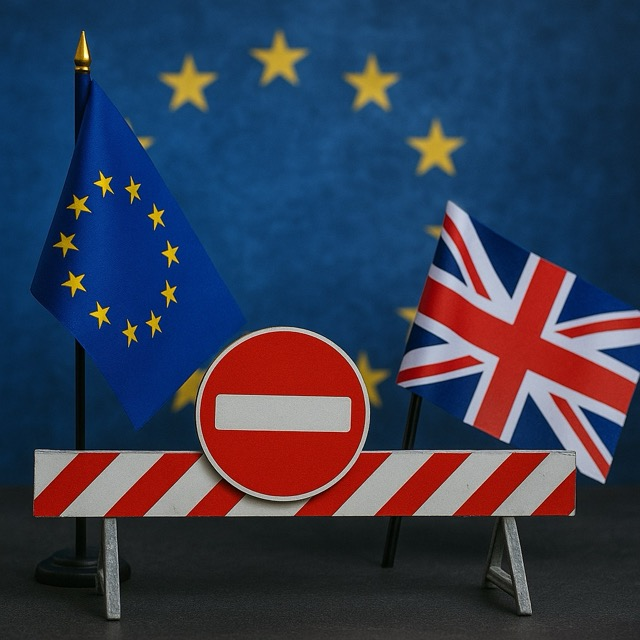
UK’s post-Brexit trade ambitions hit another hurdle as EU signals resistance to British membership in key regional economic bloc.

Tensions between Britain and the European Union have flared once again as Brussels appears to be obstructing the UK’s bid to join a significant European trade framework, the Pan-Euro-Mediterranean (PEM) convention. The move comes just days after the UK government unveiled its new trade strategy aimed at reviving lagging goods exports through deeper regional integration.
According to officials from both London and Brussels, the EU has signaled that it is not prepared to support the UK’s entry into the PEM convention, a system designed to facilitate trade across Europe, North Africa, and parts of the Middle East through common rules of origin and simplified customs procedures.
“The UK sees the Pan-Euro-Med convention as a logical step in its post-Brexit strategy to re-establish trade links and expand market access,” said a senior British trade official. “But without EU support, we can’t move forward.”
The PEM convention comprises more than 20 countries, including EU member states, EFTA nations, and key Mediterranean economies. It allows products manufactured in participating countries to benefit from preferential tariff treatment if they meet shared rules of origin. For post-Brexit Britain, membership would provide a streamlined pathway to increase goods exports to Europe and beyond.
Yet the EU’s reluctance appears rooted in broader political sensitivities. Several European diplomats say that Brussels is wary of allowing Britain back into any structure that could be seen as re-integrating it into the EU’s economic orbit without corresponding obligations. “It’s a matter of trust and precedent,” said one EU official. “After Brexit, the rules of engagement changed.”
The impasse is the latest example of the lingering fallout from Brexit, which has complicated the UK’s trade relationships with its largest and closest market. Despite having signed dozens of bilateral trade deals since leaving the EU, Britain has struggled to boost exports to pre-Brexit levels. Data from the Office for National Statistics shows that goods exports remain significantly lower than in 2018, particularly in sectors such as machinery, pharmaceuticals, and chemicals.
Business leaders are voicing frustration. “We need practical solutions, not political standoffs,” said Paul Drexler, director of the British Export Federation. “Joining the PEM convention could remove layers of red tape and improve competitiveness, especially for SMEs.”
The UK government has stated that it remains committed to pursuing membership and is engaging diplomatically with PEM members outside the EU to build support. Some non-EU countries, including Norway and Morocco, have expressed cautious openness to the idea, though any change would require consensus within the convention.
In Brussels, however, there appears to be little appetite for reopening trade frameworks to accommodate a country that has repeatedly clashed with EU institutions. “There’s still a lot of skepticism,” said a French trade attaché. “The feeling is that the UK wants the benefits without the burdens.”
Trade experts warn that the deadlock could carry broader implications. “This isn’t just about one convention,” said Dr. Alina Kovács, a senior fellow at the Centre for European Policy Studies. “It reflects the deeper question of how the EU wants to manage relations with post-Brexit Britain. Cooperation is possible—but only if there’s mutual respect and clear alignment.”
For now, the UK’s ambitions for deeper integration with regional trade networks remain on hold. And with European elections looming and political sentiment hardening on both sides, a breakthrough appears unlikely in the near term.