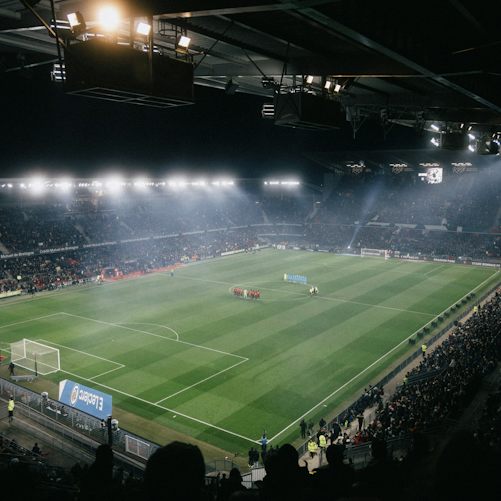
Brighton overwhelmed Crystal Palace 5–0 on Sunday, while Arsenal found a late winner and Manchester United were held at Leeds.

Diego Gómez supplied the extraordinary moment, but Brighton’s 5–0 victory over Crystal Palace on October 18 was much more than a spectacular long-range goal. A derby that might have been expected to produce a tense contest instead became an emphatic statement of attacking form, with the home side establishing control almost immediately and sustaining the punishment across the match.
Gómez scored from his own half in the seventh minute, sending the ball over goalkeeper Walter Benítez. Reuters’ account of the strike placed the distance at 51 metres. It was the type of finish that can dominate a highlights package, yet its context made it more damaging: Palace were already behind and had barely begun recovering from the opening setback.
A derby decided by an early avalanche
Jaydee Canvot’s own goal opened the scoring before Gómez’s intervention. Yasin Ayari then helped make it 3–0 inside the opening ten minutes, with Charalampos Kostoulas and Jack Hinshelwood completing the scoring. The Guardian’s match report described an afternoon in which Palace’s early defensive collapse left them chasing a game that had rapidly moved beyond their control.
An early three-goal deficit changes the problem facing a team. Remaining cautious can limit further damage but offers little route back into the match; committing more players forward risks creating additional space for the opposition. That dilemma helps explain why the opening sequence matters more than the novelty of any individual finish. Brighton had established the terms on which the rest of the contest would be played.
The final score also prevented the extraordinary second goal from becoming an isolated curiosity. Brighton’s victory was supported by contributions across the attack rather than dependent on a single unlikely shot. That breadth is the more useful point of reference when judging whether a performance can be repeated. A strike from inside one’s own half is memorable; a team that continues to create decisive moments has a more sustainable source of encouragement.
Form beyond a single afternoon
According to beIN Sports’ match report, this was Brighton’s fourth successive Premier League victory. That sequence gives the result a significance beyond local rivalry. It adds another strong performance to an emerging run, while also raising the standard against which Fabian Hürzeler’s side will be judged in the fixtures that follow.
A run of wins does not settle a season’s prospects, and a five-goal derby success should not be converted into a prediction of where the club will finish. Opponents, injuries and the demands of the schedule can alter momentum quickly. The more immediate conclusion is narrower: Brighton have given themselves evidence that their attacking approach can produce repeated results, not merely attractive passages of play.
For Palace, the priority is to separate the extraordinary from the avoidable. A remarkable long-range finish may be difficult to reproduce or plan around, but conceding repeatedly in a short opening period demands a wider examination. The response cannot rest on treating Gómez’s goal as the whole explanation. The match was already moving against them, and the subsequent scoring showed that the problem did not end with that moment.
Arsenal leave it late; United leave points behind
Elsewhere on Sunday, Arsenal beat Nottingham Forest 1–0 through Noni Madueke’s 80th-minute goal. Manchester United drew 1–1 at Leeds, where Bryan Mbeumo’s opener was answered by Dominic Calvert-Lewin. Reuters’ completed round-up placed Arsenal three points behind Manchester City and Brighton third on 16 points after the day’s results.
Those matches offered a contrast in how points were secured or lost. Brighton removed uncertainty early and then widened the margin. Arsenal had to wait until the closing stages for the decisive moment. United gained an advantage but could not turn it into victory. The table records the outcomes more simply than the matches unfolded, but those different routes can shape the questions each coaching staff takes into the next week.
The image and the underlying performance
Gómez’s goal will understandably be the first image associated with this derby. Long-range finishes compress anticipation, judgement and execution into a few seconds, and the distance makes the achievement immediately clear even to a casual viewer. It deserves its place at the centre of the match’s story without being made responsible for everything around it.
The stronger sporting conclusion is that Brighton combined the exceptional with the repeatable: one audacious strike inside a performance that kept producing goals. Palace must respond to the collective failure rather than only the spectacular moment. For Brighton, the challenge is the opposite—enjoy an unforgettable derby, then retain the standards that made it such a comprehensive victory.