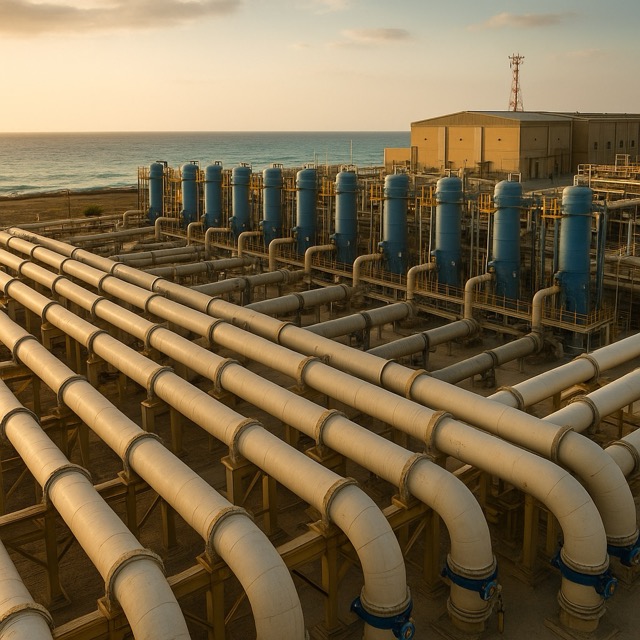
With climate change stressing traditional water sources, desalination offers hope — but not without high costs and environmental trade-offs.

As droughts deepen, rains grow erratic, and aquifers dry up, a growing number of countries are placing their bets on seawater. Desalination, the once-costly process of turning saltwater into drinkable supply, is booming. Industry analysts now predict the global desalination market will surpass $20 billion by 2027 — nearly double its size a decade ago.
From the Arabian Peninsula to Southern California, governments are investing in vast desalination plants, hoping to secure reliable water sources in an increasingly unpredictable climate. But as adoption spreads, so too do questions about the long-term sustainability and side effects of this resource-intensive technology.
“It’s a lifeline,” says Dr. Elena Fuentes, a climate-water policy expert in Barcelona. “But it’s also a warning: when you turn to desalination, it often means every other option has failed.”
Israel, Saudi Arabia, the UAE, and Australia are among the countries with the most mature desalination infrastructure. More recently, the technology has expanded into North Africa, Chile, and parts of South Asia. Even some European countries — once flush with freshwater — are reconsidering desalination as a hedge against future scarcity.
Yet the process is not without controversy. Traditional reverse osmosis plants consume immense amounts of energy, making them expensive to operate and carbon-intensive unless paired with renewable sources. For countries already struggling with power reliability, desalination poses a daunting challenge.
Moreover, for every liter of fresh water produced, roughly another liter of brine — highly concentrated saltwater waste — is discharged back into the ocean. Environmentalists warn that this effluent, often mixed with cleaning chemicals and heavy metals, threatens delicate marine ecosystems.
“Desalination should not be Plan A,” says Marcus Ortega, director of the NGO Blue Frontiers. “It’s a bandage, not a cure. Conservation, smart irrigation, wastewater reuse — those should come first.”
Still, demand is surging. In Spain, a new desalination facility near Murcia is expected to begin operations in early 2026, supplying 450,000 people. In India, Chennai’s third desalination plant is under construction, part of a wider strategy to prepare for worsening monsoons. Meanwhile, the U.S. state of Texas has approved three additional plants along the Gulf Coast.
Private sector involvement is also growing. Companies such as Veolia, IDE Technologies, and Acciona are ramping up R&D to make desalination cleaner and cheaper. Some startups are testing solar-powered micro-desalination units aimed at island nations and remote coastal communities.
But experts caution against over-reliance. ‘Desalination buys time, not security,’ Dr. Fuentes says. ‘If climate adaptation is about resilience, then we must ask: are we solving the problem, or simply deferring its worst effects?’