From mini‑subs to autonomous drones and bio‑robotic cockroaches, investors pour fresh money into Europe’s security start‑ups — €1.4bn in the first seven months of 2025 alone — as questions over U.S. alignment spur a step‑change in appetite.

LONDON/BERLIN
A step‑change after Munich
Across interviews with venture firms in the UK, Germany and the Nordics, partners describe a clear inflection point after February. Where many generalist funds once tip‑toed around defence, LPs are now explicitly asking for exposure, and specialist managers report bigger first closes. The calculus is two‑fold: Europe must shoulder more of its own security; and the war in Ukraine has dramatically shortened product feedback loops, allowing start‑ups to iterate on real, battlefield‑derived data.
The rhetoric in Munich mattered, not because it resolved anything, but because it introduced doubt. By warning that Europe’s main threat was “from within” and chiding governments over speech laws and migration, Vance signalled a harder U.S. line on transatlantic burden‑sharing. European ministers responded by talking up higher defence outlays and faster procurement. For investors, the message was clear: the addressable market for agile, software‑led systems in Europe is set to grow, with or without a perfectly aligned Washington.
Where the money is going
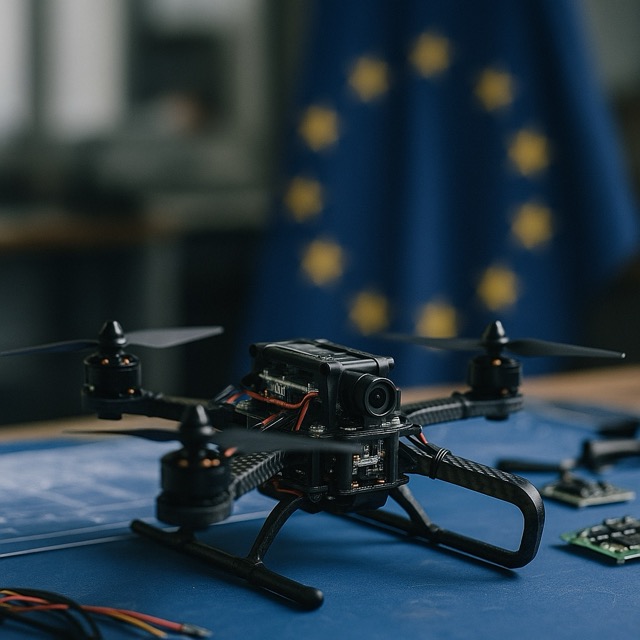
Germany has emerged as one of the biggest magnets for capital, powered by a more muscular defence posture and a dense engineering talent base. But deal flow is pan‑European: the UK, France, the Netherlands, Portugal and the Nordics all feature in the most active corridors. Early‑stage activity dominates as founders rush into gaps exposed by the war — low‑cost reconnaissance drones, counter‑UAS kits, autonomous ground robots, resilient comms links, underwater vehicles and precision‑manufacturing for munitions.
One CEO likens the moment to the early days of commercial space: familiar incumbents still anchor procurement, but nimble, vertically focused start‑ups are carving out critical subsystems and software layers. In practice, that means dual‑use: surveillance quads that can map disaster zones on Monday and provide over‑the‑hill ISR for brigades on Tuesday; uncrewed minisubs that inspect offshore wind farms yet carry sonar payloads when required.
New names, faster cycles
The era’s totems are small, smart and swarmable. In Germany, developers are testing bio‑robotic insects — live cockroaches fitted with tiny backpacks and cameras — as disposable scouts for complex urban terrains. Elsewhere, founders are building AI‑piloted fixed‑wings, autonomous ground vehicles and “loyal wingman” concepts scaled to European budgets.
Crucially, iteration cycles have compressed. Field telemetry from Ukraine and NATO exercises is feeding software updates every few weeks, not quarters. That cadence — more Silicon Valley than Schleswig‑Holstein — is persuading investors that software gross margins are compatible with defence manufacturing, provided teams pick narrow problems and ship.
The hurdles: procurement, policy and principle
Even as money flows, Europe’s market remains hard to crack. Procurement is fragmented across dozens of ministries and primes; timelines can still stretch; and export regimes vary. Several managers also flag ESG policies that historically excluded defence, leaving investment committees to rewrite mandates or carve out dual‑use allowances.
Another tension is ethical: some institutions draw red lines around lethal autonomy or offensive cyber. Founders are learning to engage earlier with policymakers and to design human‑in‑the‑loop controls as standard. That has not blunted momentum, but it has made governance a competitive advantage for start‑ups that build with certification and interoperability in mind.
Why this matters now
Strategically, Europe is racing to close capability gaps in air defence, munitions stockpiles and uncrewed systems. Economically, defence technology has become a rare bright spot in a subdued venture market, with syndicates mixing specialist funds, crossover investors and industrial strategics. Politically, the mood shift since Munich has nudged governments toward multi‑year frameworks and common procurement — tailwinds that didn’t exist five years ago.
The stakes, however, are broader than budgets. The continent’s ability to field affordable, upgradable systems at speed will shape Ukraine’s resilience, NATO’s deterrence and Europe’s own industrial base. For founders, the opportunity is to replace bespoke, slow‑to‑integrate stacks with modular, software‑defined tools that meet commanders’ needs without breaking treasuries.
Back in 2020, €30mn barely registered. Five years on, €1.4bn in seven months tells a different story — one of urgency, experimentation and a long‑overdue reset of what venture can look like in Europe’s defence sector.
By the numbers
Capital raised since January 2022: about €2.4bn.
Capital raised January–July 2025: about €1.4bn.
Benchmarks before the war: €30mn in 2020; €150mn in 2021.
H1 2025 snapshot: roughly €946m across 36 deals, with early‑stage rounds dominating, according to sector trackers.
Those figures understate the total appetite because they exclude much of the non‑dilutive money — grants, pre‑procurement pilots and strategic partnerships — that European governments and primes have started pushing through new programmes.
What the new cohort looks like
Germany’s ARX Robotics builds small, modular unmanned ground vehicles that can carry sensors or supplies and follow troops into contested areas. Portugal’s Tekever makes fixed‑wing drones used for maritime patrols and border surveillance. Munich‑based Quantum Systems produces long‑endurance aerial systems and mission software. They are part of a wider map that now stretches from Baltic EW specialists to British procurement‑software upstarts, and from French munitions scale‑ups to Nordic autonomy labs.
None of these companies can compete line‑for‑line with a prime on heavy hardware, but they don’t need to. Their edge is speed and cost: rapid updating of autonomy stacks; off‑the‑shelf components; and designs that embrace attrition rather than trying to avoid it at any price.
Risks and what could go wrong
Two things could still capsize the boom. First, if procurement reforms stall, start‑ups will burn runway waiting for multi‑year contracts. Second, if policy debates over lethal autonomy harden, some institutional money may retrench. Both risks are real — but so too is the momentum behind Europe’s rearmament and the shift toward software‑defined systems.