Bombardment, famine warnings and a last‑minute push for a ceasefire define a perilous week

Gaza City / Jerusalem / Cairo
LEDE
Under the heaviest bombardment in weeks, Gaza City awoke Monday to the thud of airstrikes and the hiss of drones as a new U.S. push to halt the war reached Hamas through back channels. U.S. President Donald Trump issued what he called a “last warning” for Hamas to accept a ceasefire-and-hostage deal that he says Israel has already agreed to; Hamas signaled it is ready to enter immediate talks through mediators. On the ground, little has slowed: Israeli strikes and ground incursions expanded around the city’s northern districts, while displaced families once again packed their few belongings and moved south—some for the fourth or fifth time since the conflict reignited in October 2023.
A LAST-MINUTE PROPOSAL
The latest proposal—transmitted by a White House envoy via an Israeli peace activist—would exchange a full release of the remaining hostages for a ceasefire that halts Israeli operations and opens a path to broader talks on ending the war. According to officials briefed on the talks, the outline contemplates the release of all 48 remaining hostages on the first day of a truce, followed by phased negotiations on a permanent cessation of hostilities. In parallel, thousands of Palestinian prisoners would be freed. Washington has also offered what interlocutors describe as meaningful assurances aimed at preventing an immediate resumption of fighting while endgame talks are underway.
WHAT HAMAS SAYS IT WANTS
Hamas, via mediators, has said it welcomes ideas that produce a comprehensive ceasefire and a full Israeli withdrawal from the Strip in exchange for releasing hostages. Privately, figures close to the group say the sticking point is not the principle of a swap but the sequence and the credibility of enforcement: guarantees that an initial truce will not be used to reset the battlefield before an enduring political settlement is reached, and that displaced civilians can return to destroyed neighborhoods safely.
ISRAEL’S POSITION
President Trump says Israel has accepted the plan. Israeli officials confirm only that the offer is under serious review while combat continues. Prime Minister Benjamin Netanyahu’s war cabinet has repeatedly framed the campaign’s aims as dismantling Hamas’s military capacity and securing the return of captives; in practice, commanders have prepared for a major push to retake blocks of Gaza City amid stepped-up evacuation orders. A proposal under discussion would see, at a later phase, an Israeli redeployment to a narrow buffer around Gaza pending security arrangements, including along the Philadelphi Corridor on the Egyptian border.
INSIDE GAZA CITY
Residents described a night of strikes on high‑rises and dense residential blocks, with artillery rolling in from the east and south. Aid workers say the new displacement is pushing families into ever more crowded camps in central Gaza that lack enough water, latrines and medical care. Israel’s defense minister warned of a “powerful hurricane” of force if Hamas refuses the deal, even as the military urged civilians to evacuate specific neighborhoods before advancing armor.
THE HUMANITARIAN LEDGER
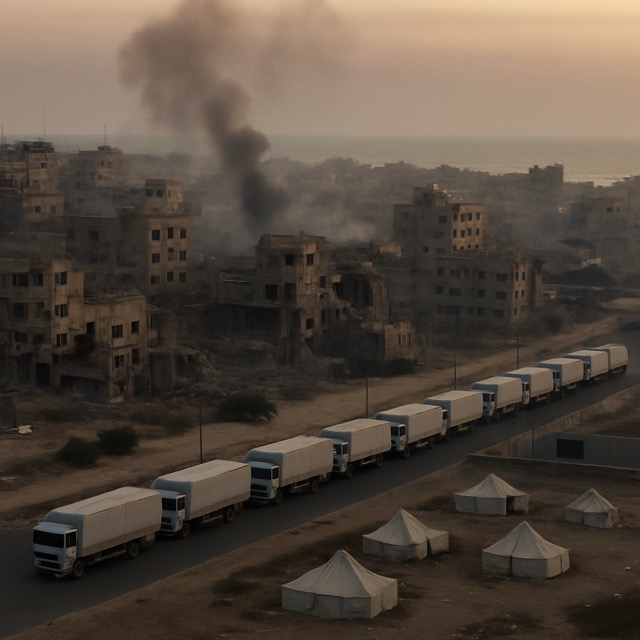
The human cost continues to mount. The Gaza Health Ministry reported that 571 Palestinians were killed between August 27 and September 3, bringing its tally since October 7, 2023 to 63,746 dead and more than 161,000 injured. U.N. agencies warn of a narrowing window to stop famine from spreading beyond Gaza City to Deir al‑Balah and Khan Younis. The World Health Organization says famine conditions have already been confirmed in parts of the Strip, with more than half a million people trapped in catastrophic hunger. Aid groups add that delivery remains hostage to insecurity and inspection bottlenecks at crossings; the modest uptick in convoy numbers has not matched the scale of need.
BORDERS AND BOTTLENECKS
Egypt reiterated that the Rafah crossing will not be used to permanently displace Palestinians from Gaza, calling forced displacement a red line. At the same time, Cairo has quietly worked with Washington and Jerusalem on options to reopen and staff the crossing for humanitarian flows if a truce takes hold. Any deal will need a durable mechanism to move aid in volume—fuel, food, medicine and shelter materials—without collapsing under renewed fighting or political mistrust.
HOSTAGES, PRISONERS AND PUBLIC PRESSURE
Israeli society’s pressure cooker is hissing. Weekly protests have swelled again outside the prime minister’s residence and in central squares, with families of captives pleading for a deal that brings their relatives home. Officials estimate that of the 48 remaining hostages, roughly twenty are believed to be alive, though the figure fluctuates and is disputed. For Palestinians, prisoner releases—likely numbering in the low thousands—touch nearly every extended family and would be a core measure of whether a truce changes daily life.
LAW, ACCOUNTABILITY AND THE BATTLE OF NARRATIVES
International legal and diplomatic pressures continue to shape the margins of the conflict. The International Criminal Court’s warrants for senior Israeli officials, challenged and litigated over the past year, remain a combustible backdrop to Western capitals’ support; Israel rejects the court’s jurisdiction. At the International Court of Justice, judges have issued a series of orders reminding parties of obligations to prevent genocidal acts and facilitate humanitarian aid. Regardless of legal outcomes, both sides prosecute the information war daily: casualty figures, video from strikes, and claims of military necessity versus indiscriminate harm.
WHAT A CEASEFIRE WOULD HAVE TO SOLVE
Even if Hamas accepts the proposal and Israel signs on, implementation will be a gantlet. Sequencing the release of all captives—living and deceased—will require neutral monitors, secure corridors and triage for the most vulnerable. Scaling aid from thousands to tens of thousands of daily truckloads demands simplified inspections, deconfliction across multiple front lines, and fuel guarantees to run bakeries, hospitals and desalination plants. Reconstruction—beginning with rubble removal and emergency shelter—cannot wait for a final-status political deal, but it cannot proceed at scale without one.
THE NEXT 72 HOURS
Diplomats say the next three days are pivotal. If Hamas formally accepts the American outline, negotiators would try to lock in modalities for day‑one releases and a verified stand‑down. If it balks, Israeli leaders have signaled that intensified operations in Gaza City will follow. Either way, the humanitarian clock ticks: the longer aid is throttled and displacement multiplies, the narrower the path back from famine and the harder it becomes to stitch a broken society back together.
REPORTER’S NOTE
This article draws on on‑the‑record statements by U.S., Israeli and Hamas officials; field reporting from Gaza City and central Gaza; and briefings and situation updates from the United Nations and major humanitarian agencies. All casualty and displacement figures reflect the most recent tallies available at the time of publication and may be updated as new information emerges.
SOURCES
• Reuters: Trump issues ‘last warning’ to Hamas to accept hostage deal; UN warns time is short to stop famine spreading (Sept. 7–8, 2025).
• Axios: White House envoy sends new proposal to Hamas through Israeli peace activist (Sept. 7, 2025).
• UN OCHA: Humanitarian Situation Update #319 — Gaza Strip (Sept. 4, 2025).
• WHO: Famine confirmed for the first time in Gaza (Aug. 22, 2025).
• Al Jazeera live updates: Israeli attacks continue across Gaza City (Sept. 8, 2025).
• Times of Israel: Details on new ceasefire/hostage proposal and guarantees (Sept. 7–8, 2025).
• The Guardian/WSJ live and field reports on Gaza City offensive and evacuations (Sept. 8, 2025).
• Egypt MFA statements via local press on Rafah crossing and displacement (Sept. 6, 2025).
• ICC filings and background documents (July 16, 2025 filing; Nov. 2024 warrants).