European Council chief António Costa says the EU and the United States have moved past years of rancor, forging a pragmatic—if fragile—trade truce while coordinating on defense and Ukraine.

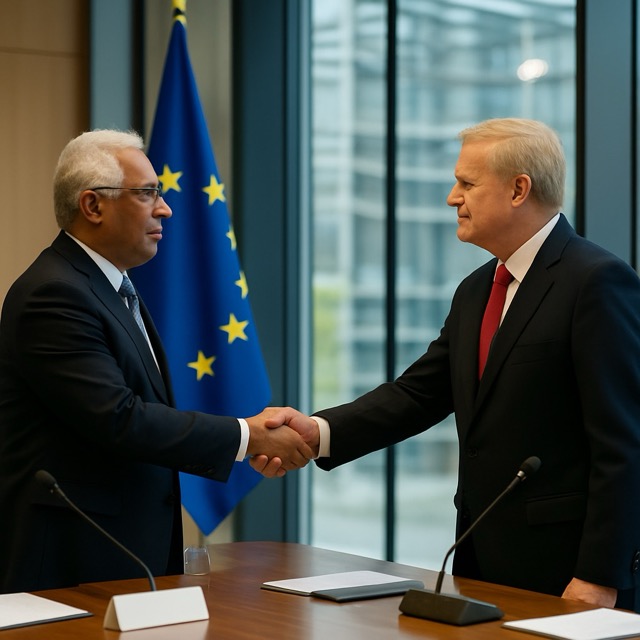
The European Union and the United States have “turned the page” on their once rocky relationship, European Council President António Costa said this week, signaling a shift from acrimony to hard‑nosed pragmatism. His assessment follows a summer of frenetic shuttle diplomacy and a new joint framework on transatlantic trade that aims to cap tensions—without pretending that all the arguments are over.
Costa’s words mark a notable change in tone from the start of the year, when many European capitals braced for another cycle of transatlantic tariff feuds and regulatory flare‑ups under President Donald Trump. The Council chief now casts the relationship as entering a realistic phase: fewer public fights, more compartmentalized cooperation, and a tight focus on shared security, even as political storms gather on both sides of the Atlantic.
What changed? In August, Brussels and Washington unveiled a joint statement sketching a framework for “fair and balanced” trade. While it stops short of a comprehensive free‑trade pact, the deal creates breathing space. The United States agreed to apply only its most‑favored‑nation (MFN) tariff to a short list of EU products—ranging from aircraft components to certain pharmaceuticals—from the start of September. EU officials, for their part, signaled they would park a series of retaliatory measures while both sides explore whether further sectors can be folded into the MFN basket over the coming months.
Behind closed doors, negotiators also hashed out a working assumption for the rest: a tariff regime that is higher than the zero‑for‑zero world of the 2010s, yet predictable enough for companies to price into contracts. In plain English, that means lower risk of overnight tariff shocks, but no return to the frictionless transatlantic marketplace that many exporters had taken for granted. For multinationals shipping cars, machinery and chemicals across the Atlantic, regulatory certainty is as valuable as headline rates—and that, Brussels believes, is what the new understanding delivers.
Yet the reset comes with caveats. A looming U.S. court fight over the president’s tariff powers has cast a legal shadow over parts of the trade agenda. If the Supreme Court were to uphold a ruling that curbs those powers, Washington could be forced to revisit the architecture of recent deals—a scenario that European diplomats say would inject fresh uncertainty. The White House insists the arrangements will stand, but the legal cloud is one reason EU trade officials are pushing to codify as much as possible in the months ahead.
In Brussels, political scrutiny is intensifying, too. Lawmakers in the European Parliament’s trade committee are preparing hearings on the new framework, and national capitals are running their own impact assessments. Some center‑left and green parties argue the EU should have extracted deeper concessions on industrial goods and climate‑related measures; conservatives caution that picking a fight with Washington while Russia’s war grinds on would be strategically reckless. For now, the deal’s appeal is its modesty: it lowers the temperature without asking either side to swallow a wholesale rewrite of their economic models.
Security is where the transatlantic reset looks most durable. Costa has repeatedly framed the heart of the conversation with Washington as Europe’s capacity to carry more of the defense burden—both within NATO and through EU instruments. Over the summer, he convened and joined multiple coordination calls with U.S. officials and President Volodymyr Zelenskyy to keep ammunition pipelines open, tighten sanctions enforcement, and plan for Ukraine’s reconstruction. The message to allies is blunt: Europe must be able to back up its diplomacy with real capabilities.
This is not mere rhetoric. A growing number of EU governments are pushing defense budgets above the long‑standing 2 percent of GDP benchmark, ordering air‑defense systems, drones and artillery shells, and building joint procurement pipelines that would have been politically unthinkable a few years ago. The war has also accelerated efforts to protect critical infrastructure—from undersea cables to LNG terminals—and to secure supply chains for ammunition and semiconductors. Washington’s strategic pivot toward the Indo‑Pacific reinforces the logic: if the United States wants to concentrate more firepower on China, Europe will have to shoulder more of its own neighborhood.
The tech file remains a pressure point. Brussels is pressing ahead with its digital rulebook—competition cases, data protection, and new obligations for the largest platforms—while U.S. officials warn of spillovers for American firms. Both sides say they can manage the frictions. Trade lawyers note that adjudicating disputes through existing channels will be crucial to prevent a policy clash from bleeding into the broader relationship. That is another reason why the MFN carve‑outs and the tariff framework matter: they insert guardrails while the regulatory debates continue.
Europe’s business lobby, chastened by years of unpredictability, is reacting cautiously. Automotive and machinery exporters welcome the promise of fewer surprises, but warn that even mid‑teens tariffs can erode thin margins and push investment decisions toward the domestic U.S. market. Airlines and aerospace suppliers see the MFN pledge on aircraft parts as a genuine win, while pharmaceutical makers say smoother customs and certification processes would do more to cut costs than headline duties alone. Cross‑Atlantic tech firms, for their part, are focused on data‑transfer rules and liability regimes, areas where the trade truce changes little.
The politics of durability are delicate. Trump’s warning that he could unwind agreements if courts strike down key tariff authorities underscores how much of the reset relies on executive discretion. In Europe, the deal’s endurance will hinge on Parliament and national governments deciding that a pragmatic truce is better than a return to brinkmanship. Costa’s calculation is that European unity on Ukraine, coupled with a methodical expansion of the MFN list, can create facts on the ground—incremental steps that are harder to reverse than headline promises.
What to watch next: first, whether Brussels and Washington can expand the list of products covered by MFN treatment before year’s end. Second, how they handle disputes over electric‑vehicle rules of origin and industrial subsidies in clean‑tech supply chains—flashpoints that have torpedoed previous attempts at detente. Third, the pace of Europe’s defense build‑up and its ability to translate spending pledges into deployable forces. If those three tracks move in tandem, the “page turn” that Costa describes could become something closer to a settled chapter.
For now, the balance is familiar to seasoned transatlantic hands: a partnership too big to fail and too complicated to be simple. The EU and the United States are not re‑enacting the soaring rhetoric of past eras. They are, instead, attempting something more prosaic but arguably more sustainable—managing a dense agenda of tradeoffs, keeping sight of shared security, and insulating inevitable disputes from spiraling into full‑blown crises. If that sounds unglamorous, it is. It is also how real resets stick.