Washington’s tariff gambit targets Russia’s oil lifelines by pressuring its biggest buyers — testing Europe’s appetite for risk and the limits of global trade rules.
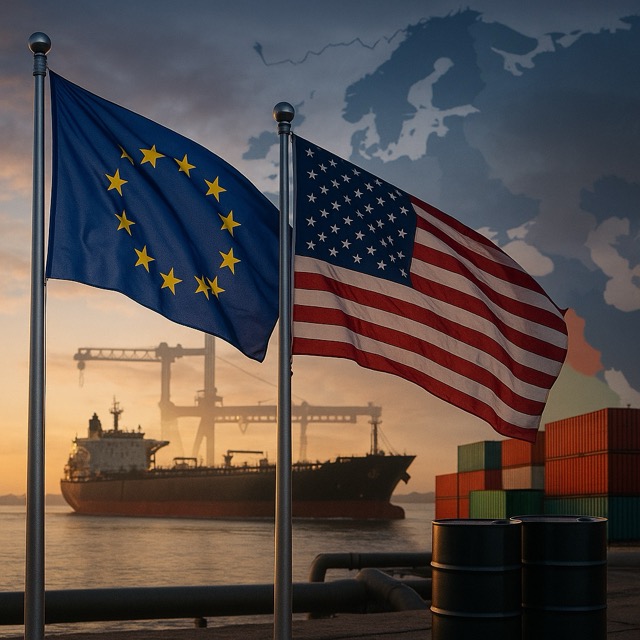
U.S. President Donald Trump has urged the European Union to levy tariffs of up to 100% on imports from China and India — a dramatic escalation intended to force Moscow toward a negotiated end to its war in Ukraine. The appeal, delivered to EU officials in Washington during sanctions consultations this week, reflects the White House’s mounting frustration that a “peace deal” remains out of reach even as Russia steps up missile and drone strikes across Ukrainian cities and infrastructure.
The logic in Washington is blunt. Beijing and New Delhi have become lifelines for the Kremlin’s wartime economy by purchasing steeply discounted Russian crude and refined products. Punitive duties on goods from those two countries, the thinking goes, would raise the cost of maintaining those energy flows and starve Russia’s war machine of hard currency. U.S. officials indicated that Washington would be prepared to mirror the same tariff levels — but only in lockstep with Europe — turning trade policy into an instrument of wartime coercion rather than a purely commercial tool.
For Brussels, the request cuts across familiar grain. Since 2022, the EU’s preferred tools against Russia have been asset freezes, export controls and financial sanctions — not tariffs against third countries. Measures with extraterritorial bite are politically fraught inside the bloc, where governments have juggled support for Kyiv with fears of blowback to fragile growth. Several officials privately acknowledge that targeting China and India would entail qualitatively different risks: retaliation from two of Europe’s largest trading partners and a fresh wave of uncertainty for manufacturers already hit by high energy costs.
Those risks are not theoretical. EU–China tensions have spilled into tit‑for‑tat moves, from Brussels’ new duties on Chinese electric vehicles to Beijing’s anti‑dumping tariffs on European pork. European agribusinesses and automakers — especially in Spain, France, Germany and the Netherlands — warn that further escalation could hammer exports and jobs. India, meanwhile, is a coveted growth market for European manufacturers and services firms; a sweeping tariff fight could bury another decade of negotiations toward a trade pact that Brussels has repeatedly tried to revive.
Trump’s gambit also lands amid mixed signals in his own approach. Over the summer, the administration raised duties on a range of Indian imports by 25 percentage points, citing Delhi’s purchases of Russian oil. Yet the White House has simultaneously signaled a desire to reset ties with India, with Trump touting progress on trade talks and praising Prime Minister Narendra Modi as a “very good friend.” Beijing’s reaction was swift and negative: China’s foreign ministry publicly rejected what it called coercive economics and pushed back at being linked to Russia’s war.
Inside the EU, the first instinct is caution, not rejection. Officials involved in sanctions coordination say they will analyze the U.S. proposal but emphasize that any move of this magnitude requires unanimity among member states and, in practice, painstaking product‑by‑product design. Several capitals argue that Europe should first tighten enforcement of existing measures and curb sanctions evasion through intermediaries — from the Caucasus to the Gulf — before opening a new front against other major economies. Advocates of the tariff gambit counter that without hitting Russia’s biggest oil buyers, the financial pressure on the Kremlin will continue to erode.
Economists are divided on likely impact. In theory, 100% duties applied by both the U.S. and EU would make targeted imports from China and India prohibitively expensive, diverting trade to other suppliers and shrinking the two countries’ export earnings. In practice, trans‑shipment through third countries, corporate restructuring to claim preferences under existing trade agreements, and currency and pricing adjustments could blunt the effect. China could respond by further squeezing European companies operating in its market or by ratcheting up existing counter‑measures, while India could slow‑roll market‑opening steps that European companies have long sought.
The strategic question is whether any of this would move the Kremlin. Russian oil now flows through a complex web of ships and brokers beyond the reach of Western jurisdiction. China and India have benefited from discounts that reflect the risks of this ecosystem; even if tariffs bite, both may calculate that continued access to cheaper energy outweighs the cost of losing some export preferences in Europe and America. Moreover, Moscow has adapted by routing exports via friendly hubs and by expanding domestic alternatives for sanctioned inputs, reducing the bite of each successive Western measure.
Yet politics are part of the point. Trump’s gambit seeks to recast the Ukraine conflict as a test of the world’s largest democracies and their willingness to act in concert. For Washington, inviting Europe to share the burden also answers a long‑standing complaint in EU capitals — that the U.S. makes demands while the EU bears disproportionate economic pain. The calculation is that a joint move would be far harder for Beijing and New Delhi to counter without real costs at home, and that it would signal to Moscow that time is not on its side.
Ukraine is watching closely. Kyiv has pressed Western partners to close loopholes and to tackle the ecosystem that keeps Russian oil moving. A coordinated tariff wall around the transatlantic market would not be a silver bullet — Ukrainian officials stress that air defenses and ammunition remain the most urgent needs — but it would mark a step toward measures that reach beyond Russia’s borders and into the calculus of its enablers.
If Europe does explore the tariff path, expect hard bargaining about scope and carve‑outs. Should duties be blanket or targeted at sectors with high value or strategic importance — chemicals, machinery, advanced electronics? Would there be exemptions for developing‑country supply chains that run through India? How would the EU keep pressure on without undermining its clean‑industry push, which still relies on Chinese inputs from batteries to rare earths? And crucially, how would any tariff regime be coordinated with the bloc’s expanding toolkit to curb sanctions evasion?
The legal underpinnings would be contested. Any EU tariff against specific third countries framed as leverage over Russia would almost certainly be justified under the national‑security exception in global trade rules — a path Washington traveled often in the last round of tariff wars. Recent World Trade Organization panel rulings have narrowed the space for such claims even as major powers increasingly ignore adverse findings. Europe presents itself as a guardian of the rules‑based order; invoking sweeping security exceptions to hit India and China would be a costly reputational choice unless the measure is tightly tailored and clearly linked to war‑related conduct.
The choice facing Brussels is thus less about whether to support Ukraine and more about how to calibrate pressure. After more than two and a half years of war, the sanctions‑only toolbox is running up against diminishing returns. Trump’s tariff ultimatum forces a wider debate: does accelerating the endgame in Ukraine require confronting those who bankroll the Kremlin, even at the risk of a trade conflagration? Or does it make more sense to grind away at enforcement and financial channels, counting on steady attrition of Russia’s capacity to wage war?
For now, European leaders are buying time. They will weigh the proposal against domestic economic headwinds, the need to manage relations with two populous Asian powers and the imperative to keep NATO unity intact as winter nears. Whatever Brussels decides, the episode signals a new phase in the West’s effort to coerce Russia — one that reaches beyond sanctions to the broader architecture of global commerce. And it lays bare a larger reality of the post‑2022 order: the politics of peace in Europe now run through trade routes as much as through trenches.
 The Tower Post