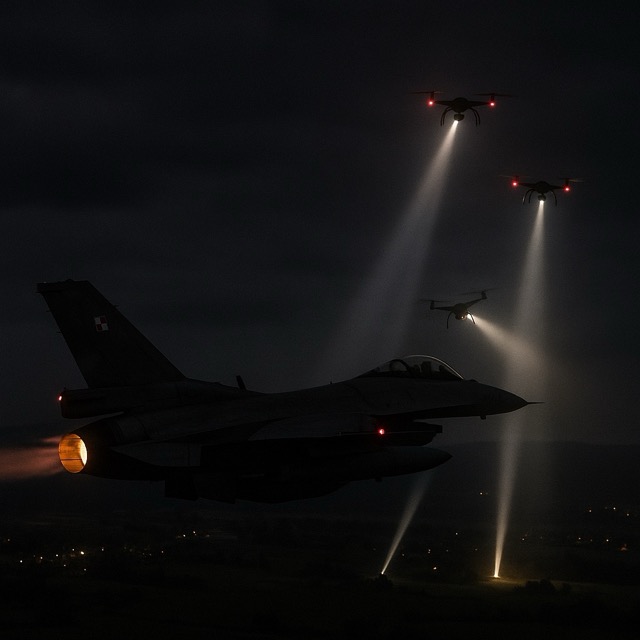
Warsaw scrambles allied jets, shuts airports and invokes Article 4 after 19 airspace violations; Tusk calls it an “act of aggression” but says war is not imminent.

In the predawn hours of Wednesday, Poland said it shot down multiple drones that violated its airspace amid Russia’s largest wave of drone and missile strikes on Ukraine in months, forcing the NATO member to scramble fighter jets and temporarily close several airports. “An operation is under way related to multiple violations of Polish airspace. The military has used weapons against the objects,” Prime Minister Donald Tusk wrote on X.
Poland’s Operational Command said “drone-type objects” repeatedly crossed into Polish territory overnight, primarily over the eastern Lublin, Podlaskie and Masovian regions. By mid-morning, the military reported at least three drones had been destroyed and a fourth likely downed, with ground teams fanning out to secure debris. Searches yielded wreckage as far west as Łódź province, underscoring the breadth of the spillover.
Addressing parliament later in the morning, Tusk said authorities registered 19 airspace violations between about 11:30 p.m. Tuesday and 6:30 a.m. Wednesday, calling the incursions a “large-scale provocation” and an “act of aggression.” He said some drones entered directly from Belarus, a Russian ally, in addition to flights spilling over from Ukraine’s western border.
Poland activated NATO’s consultative mechanism under Article 4 and raised its air defenses to their highest readiness. Allied aircraft joined the hunt: Polish F‑16s flew combat air patrols while Dutch F‑35s, an Italian AWACS and NATO tanker assets helped track and prosecute targets, according to officials.
Civil aviation was halted across swaths of the east. Notices to airmen showed Poland temporarily shut Warsaw’s Chopin and Modlin airports as well as Rzeszów–Jasionka—a logistics hub for military aid to Ukraine—and Lublin. The operational command urged residents to stay indoors and avoid filming active defenses.
The overnight operation unfolded as Russia unleashed roughly 415 Shahed‑type drones and more than 40 missiles at 15 Ukrainian regions, according to Kyiv. Ukraine’s air defenders said they downed the vast majority, but blasts still struck industrial sites and energy infrastructure. President Volodymyr Zelensky said at least eight drones had been aimed toward Poland, calling the spillover “an extremely dangerous precedent for Europe.”
NATO Secretary General Mark Rutte said the alliance was consulting closely with Warsaw. “Whether it was intentional or not, it is absolutely reckless, it is absolutely dangerous,” he said, while declining to say whether the episode would trigger further allied actions beyond Article 4 talks. EU foreign policy chief Kaja Kallas said the incursion showed “Russia’s war is escalating, not ending,” urging tighter sanctions.
Moscow denied that its forces had violated Polish airspace. Andrei Ordash, Russia’s chargé d’affaires in Warsaw, said Poland had provided “no evidence” the downed drones were of Russian origin and suggested the aircraft had come from the direction of Ukraine. The Kremlin accused Western leaders of “provocations” and refused further comment.
Polish officials said there were no confirmed casualties from the incident. Local authorities in the Lublin region reported a drone struck a residential building’s roof in the village of Wyryki; no injuries were reported. Emergency services cordoned off several sites where debris fell in agricultural fields and woodlands.
For Poland, the incident is the most serious airspace breach since the start of Russia’s full‑scale invasion in 2022, when a stray Ukrainian air‑defense missile killed two people in the border village of Przewodów. Neighboring Slovakia, Romania and Moldova have previously reported cross‑border incursions or debris, but until now NATO members had not publicly acknowledged firing at airborne targets linked to the war.
The incursion also highlights how Russia’s low‑cost, long‑range drones challenge Europe’s air defenses. Poland and Baltic states have pushed a plan to build a “drone wall” of sensors and counter‑UAV systems along NATO’s eastern flank. The government in Warsaw has accelerated purchases of short‑range air defenses and electronic warfare, and has urged allies to deploy more surveillance aircraft.
While warning that “we are closer to open conflict than at any time since World War Two,” Tusk stressed Poland was “not on the brink of war.” After an emergency cabinet meeting at 8 a.m., he vowed to pursue a measured response to avoid escalation while ensuring any further violations are “prosecuted and neutralized.”
By late morning, the Operational Command said active air operations had ceased, and civil aviation began to resume. Investigators from the military prosecutor’s office and police explosives units collected fragments for forensic analysis, including guidance modules and engine parts that may indicate the drones’ provenance.
The risk of spillover remains acute. Russia and Belarus are set to hold joint military exercises this week near NATO borders, and Polish officials say further provocations are possible. Warsaw has summoned Russia’s envoy and demanded explanations while reinforcing border units.
The incident is likely to feature prominently at NATO and EU meetings in the coming days, where allies will debate whether to expand air‑defense coverage deeper into Ukrainian airspace to intercept drones before they reach NATO territory. Ukrainian officials are pressing for such support, arguing it would be an extension of collective self‑defense rather than direct participation in the war.
For residents of eastern Poland, Wednesday’s alerts—accompanied by the wail of sirens, buzzing engines overhead and the flash of interceptors streaking through the night—were a bracing reminder that a war next door can ignore lines on a map. “We’re prepared for provocations,” Tusk said. “And we will respond.”