Within 24 hours of a blaze aboard the flagship Family, activists say an incendiary device ignited a fire on the British‑flagged Alma. No injuries reported; Tunisian authorities dispute the drone claim.
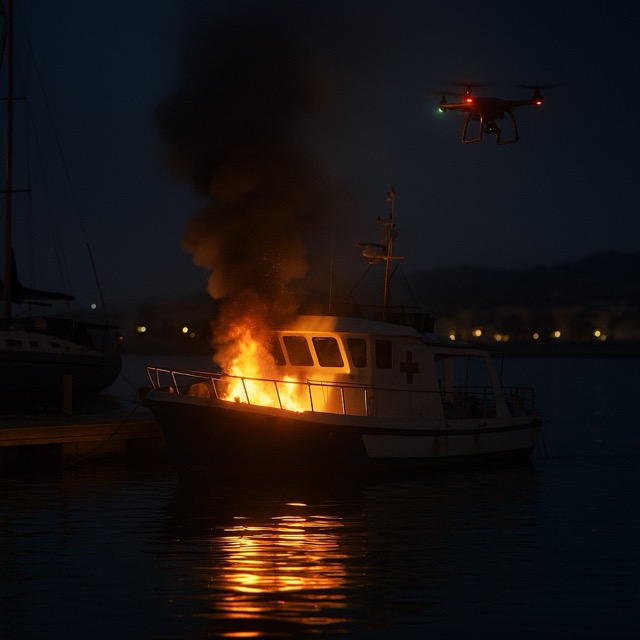
Sidi Bou Said, Tunisia
A second vessel in the Global Sumud Flotilla was struck overnight by what organizers describe as a drone‑dropped incendiary device, igniting a fire on deck but causing no injuries. The incident, which the group says unfolded while the boat was berthed off the Tunisian port of Sidi Bou Said, came less than 24 hours after a blaze aboard the flotilla’s flagship, the Family, stoked fears of a coordinated campaign to derail the mission to reach Gaza.
In video posted by the flotilla, a luminous object appears to fall onto the upper deck of the Alma, a British‑flagged support vessel, followed seconds later by flames. Crew members extinguished the fire before it spread below deck, according to organizers. The footage, which does not clearly show a drone, resembles imagery shared a day earlier from the Family, when activists likewise alleged an aerial device had dropped an incendiary on board.
Tunisian authorities, who are investigating, have publicly challenged the claim of a drone strike on the first vessel. Officials said the initial blaze appeared to have started among equipment stored aboard and that no aerial intrusion had been detected. As of Wednesday afternoon, they had not commented in detail on the Alma incident. No group has claimed responsibility for either event, and Israel—long critical of blockade‑breaking sailings—has not responded to requests for comment on the latest allegations.
“I heard the buzzing and then saw a small device above the stern just before the flash,” said Portuguese activist Miguel Duarte, who was aboard the Family when the first fire broke out. Other participants described hearing a high‑pitched whir moments before the Alma blaze, but said they could not verify the craft’s origin.
Organizers said both vessels had been under intermittent aerial surveillance since the flotilla left Barcelona on September 1. The Alma, one of several support hubs in the convoy, hosts logistics staff and visiting public figures. The Global Sumud Flotilla brings together crews and delegates from dozens of countries in a bid to sail symbolic humanitarian supplies toward Gaza and to challenge Israel’s 18‑year blockade, tightened during the current war.
Among the public figures backing the voyage are climate campaigner Greta Thunberg and former Barcelona mayor Ada Colau, who have appeared at send‑off events and briefings. The mission’s leadership says it expects additional European lawmakers and municipal leaders to join at later stops, while consular officials from several countries are tracking the convoy’s safety arrangements with Tunisian authorities.
At the marina Wednesday morning, char marks were visible on the Alma’s aft deck where the small blaze was contained. Crew described a rapid response—portable extinguishers, a bucket chain, and the quick isolation of fuel lines—rehearsed since the first incident. By midday, mechanics had replaced melted cabling and checked the vessel’s radios and navigation lights.
Maritime‑security specialists said the video evidence warrants a careful forensic review but offered few firm conclusions. “Small quadcopters can carry improvised incendiaries over short distances, but proving attribution at sea is hard,” said a European security analyst with experience in port‑side incidents, noting that high winds, reflections, and gaps in CCTV coverage complicate analysis. “What is clear is that even a small device can trigger a serious fire risk on a crowded deck.”
The flotilla’s immediate challenge is whether to press on. Captains met aboard the coordination vessel late Tuesday and agreed to pause for 24 hours while divers inspected hulls and electricians assessed damage. “We will continue,” said a spokesperson, “but we will not be reckless.” The group has installed additional fire watch rotations, shifted flammable gear below deck into lockable bins, and requested enhanced patrols in the anchorage.
The incidents echo previous confrontations at sea. Since 2007, activist sailings have been intercepted, towed, or turned back by Israeli forces in the eastern Mediterranean. Organizers say more than three dozen boats have been stopped or attacked over the years. In June, a separate convoy attempting to reach Gaza was boarded by Israeli naval units and escorted to the port of Ashdod after what the military described as repeated warnings.
Legal experts say the competing narratives—deliberate sabotage versus accidental fire—underscore the murky jurisdictional realities of a mission that skates between protest and humanitarianism. Under international maritime law, port states are responsible for safety within their waters and can restrict movements on security grounds. Yet open‑water interdictions raise separate questions that often end up in diplomatic channels rather than courtrooms.
Wednesday’s events also reverberated far beyond the marina. In European capitals, supporters framed the attacks as an attempt to intimidate civil society. Critics called the mission naïve or provocative in a war zone. The UN special rapporteur on human rights in the Palestinian territories condemned any targeting of civilian vessels and urged authorities to safeguard peaceful navigation. In Tunis, crowds gathered along the quay to wave flags and pass food and bottled water to crews as they carried out repairs.
By late afternoon, engineers had signed off on the Alma’s electrical systems, while the Family remained moored with a temporary cover over the scorched section of deck. Insurance assessors were seen photographing damage as harbor police took statements. Organizers said they would publish a technical report compiling witness accounts, video timestamps, and recovered fragments of what they believe was an incendiary device.
For now, the flotilla’s course depends as much on politics as on repairs. Captains say they intend to test the limits of the blockade through presence and publicity even if they never reach Gaza’s shores. “Every mile we sail safely, every port that hosts us, chips away at the idea that civilians have no agency in this war,” one organizer said. “If someone is trying to frighten us away, we need to show the opposite.”
Whether the fires were caused by sabotage or accident, the stakes are unmistakable: a handful of small boats, and a global debate over the costs—and the conduct—of solidarity at sea.


 The Tower Post