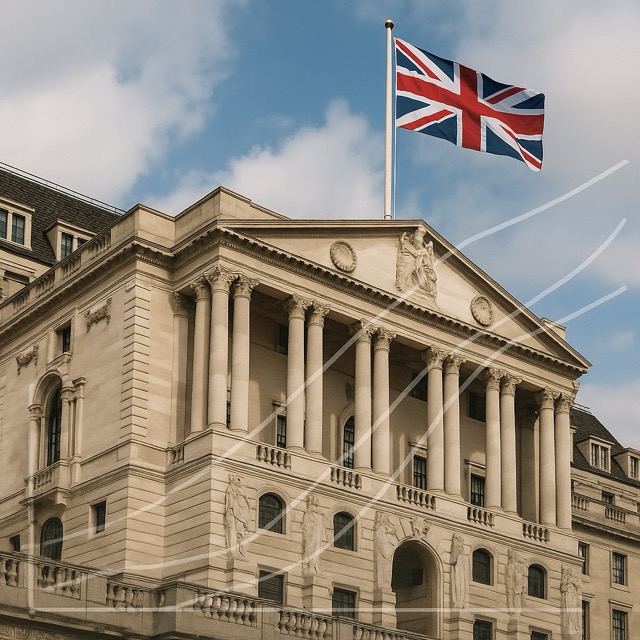
With the economy at an inflection point and the state’s balance sheet under strain, Whitehall and Threadneedle Street must refresh the rules of engagement.

London
The United Kingdom is entering a period of historic transition. Inflation has fallen sharply from its post‑pandemic peak, Bank Rate now sits at 4%, and a new government has bound itself to strict fiscal rules even as it confronts anaemic growth and threadbare public services. The macro headline looks calmer than a year ago, but the institutional wiring that connects monetary policy, fiscal choices and the state’s balance sheet is under unprecedented stress. To steer the country through the next phase, the government and the Bank of England need something more explicit than good intentions and ad‑hoc letters: a new concordat that updates the post‑1997 settlement for a world of large central‑bank balance sheets, persistent supply shocks and tighter fiscal space.
That word—concordat—invites caution. Independence is not up for renegotiation. The Bank’s task is to hit a 2% inflation target and safeguard financial stability; ministers own taxation, spending and the distributional trade‑offs those imply. But independence has always sat atop a practical partnership. In 1997, the framework focused on interest‑rate setting and lender‑of‑last‑resort operations. In 2025, the frontier issues are different: who pays for the legacy of quantitative easing (QE), how fast the balance sheet should shrink, how the Treasury indemnifies crisis facilities, what information is shared in real time, and how the Debt Management Office’s (DMO) issuance plan lines up with the Bank’s asset sales and reserve management. These are not theoretical questions. They shape gilt yields, mortgage costs and the credibility of the state itself.
The immediate context is stark. Over the past two years the Monetary Policy Committee (MPC) has pivoted from tightening to easing as inflation cooled, trimming rates to 4% and holding there while assessing the glidepath back to target. At the same time, the Bank has accelerated quantitative tightening (QT), selling and redeeming gilts acquired during the QE era. The APF—the special‑purpose vehicle that holds those assets—now delivers cash losses as low‑coupon bonds are financed by higher‑yielding reserves. Under the existing indemnity, the Treasury makes the APF whole. The cheques are large and will remain so for years. Meanwhile, the government’s fiscal rules require the current budget to balance and debt to be falling on a five‑year horizon. Taken together, all of this means that policy choices on Threadneedle Street and in Whitehall interact far more directly than the 1997 framework ever envisaged.
To their credit, the authorities have acknowledged the problem. In February they updated the Memorandum of Understanding (MoU) on their financial relationship, clarifying how the Bank’s capital is set and how information flows as the balance sheet transitions to a steady state. The Bank has also improved transparency around QT and the remaining stock of gilts. But the MoU remains a patch on yesterday’s scaffolding. What the UK needs now is a published, rules‑based concordat that tackles five practical questions.
First, integrate gilt management, reserves and QT. QT shrinks the Bank’s balance sheet just as the DMO must sell more debt to finance deficits and rollovers. Without a joined‑up plan, the state can find itself issuing with one hand while selling with the other, pushing up term premia and confusing investors. The concordat should require joint scenario planning—stress‑testing issuance, APF run‑off and reserve balances under different rate paths—and a “whole‑of‑state” funding map published at least twice a year. No one is asking the MPC to subordinate policy to the DMO; rather, the goal is to remove unforced errors and give markets a clear picture of net supply.
Second, reform the APF indemnity to make its fiscal footprint more predictable. The principle that the Treasury bears QE’s gains and losses is sound: the state as a whole made the decision to insure against depression, and taxpayers ultimately benefit from avoided unemployment and bankruptcies. But volatility in indemnity transfers tightens already‑hard fiscal constraints and risks politicising monetary policy. A concordat could smooth the flows with a clear rule—say, capping annual net transfers with the balance carried forward; or allocating a portion of future positive carry (when it returns) to rebuild buffers; or levying a small, rules‑based contribution from the Bank’s non‑QE income. The design test is simple: preserve the MPC’s freedom to set rates to hit the target, while reducing fiscal noise that undermines planning.
Third, pre‑authorise crisis backstops with transparent guardrails. The 2022 LDI episode demonstrated how fast market plumbing can clog and how little daylight there is between financial stability and monetary transmission. The Bank’s temporary gilt‑buying facility worked because it was targeted and time‑limited, but the public debate confused it with QE. A new concordat should publish a menu of standing facilities—eligibility, collateral, pricing, sunset clauses—and the indemnities that accompany them. It should also commit both sides to rapid, joint communication when such tools are activated. In a world of algorithmic trading and leveraged funds, hours matter.
Fourth, hard‑wire richer information‑sharing. The updated MoU sketches this, but a more ambitious architecture is achievable: a permanent, joint macro‑balance‑sheet unit staffed by Bank, Treasury and DMO officials, charged with mapping the state’s consolidated exposures—interest‑rate, rollover and counterparty—across the APF, reserves, the DMO’s book and contingent liabilities. Its dashboards should be briefed to the Chancellor and the Governor quarterly and summarised publicly. The goal is not to micromanage either side but to ensure common situational awareness and to reduce the risk of contradictory actions.
Fifth, establish a narrow channel for conditional coordination during large supply shocks. When inflation stems from energy spikes or import bottlenecks, rate hikes alone can be a blunt instrument. A published protocol could allow the government to deploy temporary, targeted fiscal measures at source—funded within the rules—while the MPC conditions its forecast on those measures and communicates the implications for the path back to 2%. The concordat would not reopen the door to fine‑tuned ‘go‑for‑growth’ bargains; it would simply recognise that the transmission of policy in supply shocks is different and that clarity helps.
Sceptics will see a trap. Mightn’t ministers be tempted to lean on the Bank to slow QT when gilt auctions are heavy? Or to tweak indemnity flows for budgetary convenience? The answer is to make the concordat deliberately boring: rules‑based, published in full, subject to fixed‑date reviews, and overseen by Parliament’s Treasury Committee. Where discretion is unavoidable, the default should be to err on the side of monetary control—with any deviations explained, quantified and time‑limited.
The alternative to reform is drift. Without a concordat, the Treasury continues to send large, lumpy transfers to the APF while departments are asked to squeeze programmes to meet the fiscal rules. The Bank proceeds with QT to a timetable that may or may not mesh with the DMO’s issuance needs. Markets price the coordination risk through a higher term premium, households face stickier mortgage rates, and the credibility dividend from Bank independence is eroded by confusion over who bears which risks. That is not a recipe for growth, confidence or fairness.
A refreshed settlement would help lower borrowing costs at the margin by clarifying net supply and the state’s risk posture. It would make budgeting more predictable. And it would protect the Bank’s independence by removing the temptation to fight today’s political fire with tomorrow’s monetary policy. Independence, after all, is a means to an end: stable prices and a resilient economy. It does not absolve elected politicians of responsibility for the state’s consolidated balance sheet.
None of this will substitute for the UK’s deeper tasks: raising productivity, reforming planning, investing in skills, modernising public services and committing to a credible, long‑term growth strategy. But institutional clarity is a cheap macro stabiliser. The experience of the past three years—energy shock, inflation surge, gilt volatility, rapid policy pivots—has shown how quickly confidence can fray when roles blur. The next shock will be different, but the need for clean lines will be the same.
“Whatever it takes” has become a cliché of crisis management. In 2025, it should be the motto for institutional maintenance. A new concordat would not decide tax rates or set interest rates. It would do something humbler and more valuable: make the plumbing strong enough that those choices can be made on their merits and communicated without confusion. In a country that still pays a premium for credibility, that is the cheapest reform available.