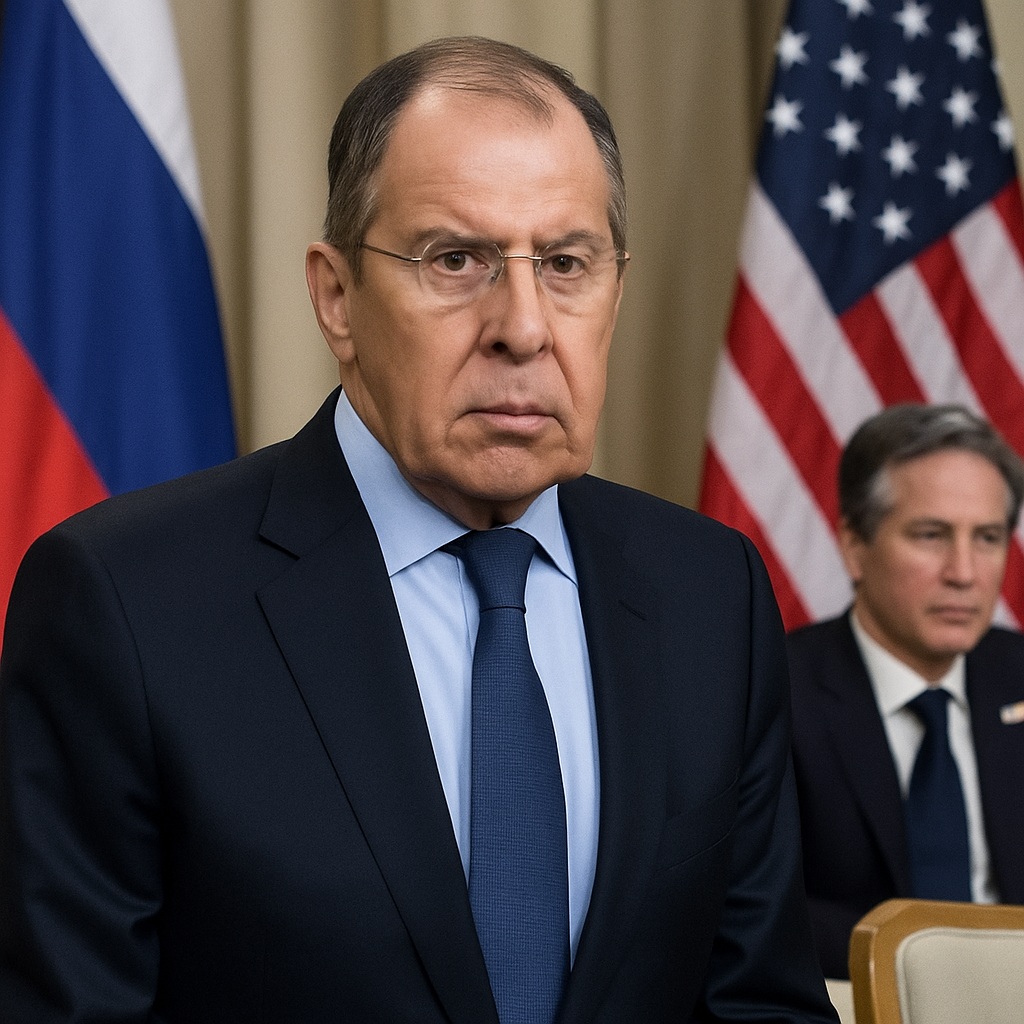
Russia’s foreign minister expresses willingness to meet American officials amid reports of internal fractures in Moscow’s decision-making circles.

In a development that could mark a subtle but significant shift in Russia–U.S. relations, Russian Foreign Minister Sergei Lavrov indicated this week that he is “ready” to meet his American counterpart, responding to questions about a reported breakdown in communication channels between Washington and the Kremlin. The overture comes amid revelations from diplomatic sources that Vladimir Putin has increasingly limited direct engagement with foreign leaders, raising concerns about strategic opacity at a moment of heightened global tension.
Lavrov’s remarks, delivered during a press briefing in Moscow, were measured but unmistakably calibrated for international audiences. When asked about U.S. attempts to re-establish high-level diplomatic contact, he noted that Moscow “has never closed the door to dialogue” and that discussions between foreign ministers remain “a functional tool for managing global risks.” This stands in contrast to recent months, during which Russian officials have responded coolly to American requests for direct talks.
U.S. State Department representatives have so far refrained from confirming whether a formal meeting is being arranged, citing ongoing “working-level consultations.” However, senior administration figures have privately described Lavrov’s statement as an “unexpected opening” given the hardened posture Russia has adopted since the latest escalation of security tensions across Europe and the Middle East.
Signals of internal discord
The apparent shift occurs against a backdrop of increasing speculation about fissures within Moscow’s elite political circle. Western intelligence assessments leaked in recent weeks suggest that Putin has grown more isolated from his diplomatic corps, relying heavily on military and intelligence advisers while sidelining voices advocating pragmatic engagement with the West. According to several European officials, this dynamic has contributed to delayed or inconsistent diplomatic responses from Moscow.
One senior EU diplomat described the Kremlin’s foreign policy machinery as “fragmented,” with Lavrov reduced at times to a “messenger without a message.” The diplomat added that Lavrov’s public willingness to meet U.S. representatives may reflect an attempt to preserve institutional relevance at a time when the influence of Russia’s Foreign Ministry is perceived to be waning.
Inside Russia, political analysts similarly note an observable recalibration in Lavrov’s tone. Known for his uncompromising rhetoric in past disputes with the United States, the foreign minister appeared notably more restrained this week, emphasizing the need for “predictable channels of communication” and “responsible diplomacy.” Analysts interpret this as a signal that at least part of Moscow’s governing apparatus recognizes the strategic risks of prolonged disengagement with Washington.
The U.S. view: cautious but curious
In Washington, officials remain wary. While the Biden administration continues to advocate for diplomatic mechanisms to manage crises, U.S. strategists have long viewed Russian signaling with skepticism. “We welcome dialogue, but not theatrics,” one senior U.S. official said. “Any discussion with Foreign Minister Lavrov must be grounded in clarity and accountability.”
Still, the U.S. position has evolved in recent months as global security pressures have intensified. Longstanding disputes over cyber operations, nuclear posture, and territorial deployments have converged with new concerns surrounding energy markets and strategic partnerships. A meeting between Lavrov and the U.S. Secretary of State, if it proceeds, could serve as a test of whether Moscow is prepared to adopt a more consistent diplomatic approach.
Regional implications
The prospect of renewed dialogue comes at a sensitive moment for regional security frameworks. European governments, grappling with escalating military exercises along Russia’s western border, have pressed both Moscow and Washington to restore predictable diplomatic channels. “Even limited ministerial engagement would be stabilizing,” said a senior NATO official, noting that Moscow’s internal fragmentation has made it increasingly difficult to interpret Russian intentions.
Meanwhile, countries in the Middle East and Central Asia—regions where Russia and the United States often compete for influence—have expressed concern that a lack of dialogue could accelerate miscalculations. Diplomats from Turkey and Kazakhstan in particular have encouraged both sides to “re-establish mechanisms of confidence,” warning that regional crises risk becoming entangled with broader geopolitical competition.
A calculated move?
Whether Lavrov’s remarks represent a genuine policy shift or a tactical maneuver remains uncertain. Some analysts argue that Russia may be attempting to relieve diplomatic pressure ahead of key economic discussions with Asian partners, while others suggest that Moscow is seeking to avoid further isolation as Western sanctions continue to strain its fiscal flexibility.
“Lavrov is a seasoned diplomat. He does not make statements like this lightly,” said Natalia Chernenko, a Moscow-based political analyst. “But we must consider the possibility that this is more about optics than substance. The Foreign Ministry is trying to project normalcy at a time when policymaking authority is increasingly centralized elsewhere.”
Nonetheless, the willingness to meet with American officials—even symbolically—may carry inherent value. Diplomatic encounters, even brief ones, can create openings for incremental de-escalation. Observers note that previous periods of U.S.–Russia tension have often been punctuated by short-lived windows for dialogue, some of which have yielded unexpectedly durable agreements.
Looking ahead
As of this week, neither Washington nor Moscow has published a timetable or location for a potential bilateral meeting. However, diplomatic sources indicate that European intermediaries have floated several neutral venues. These proposals reportedly emphasize not only symbolic balance but also the need for secure communications infrastructure and a controlled media environment.
For now, Lavrov’s overture underscores a broader recalibration occurring within global diplomacy. With traditional alliances being reassessed and new regional blocs emerging, even small signals from major powers can carry outsized significance.
Whether this moment serves as a turning point—or merely a fleeting diplomatic gesture—will depend on the willingness of both sides to engage with seriousness and clarity. But for the first time in several months, Washington and Moscow appear to be considering the possibility of structured dialogue rather than mutual silence.
That subtle shift, in a season marked by geopolitical turbulence, may prove consequential in ways that are not yet visible—but are keenly felt across the international system.