UK Prime Minister asserts unwavering European unity behind Ukraine amid sharp rhetoric from Washington

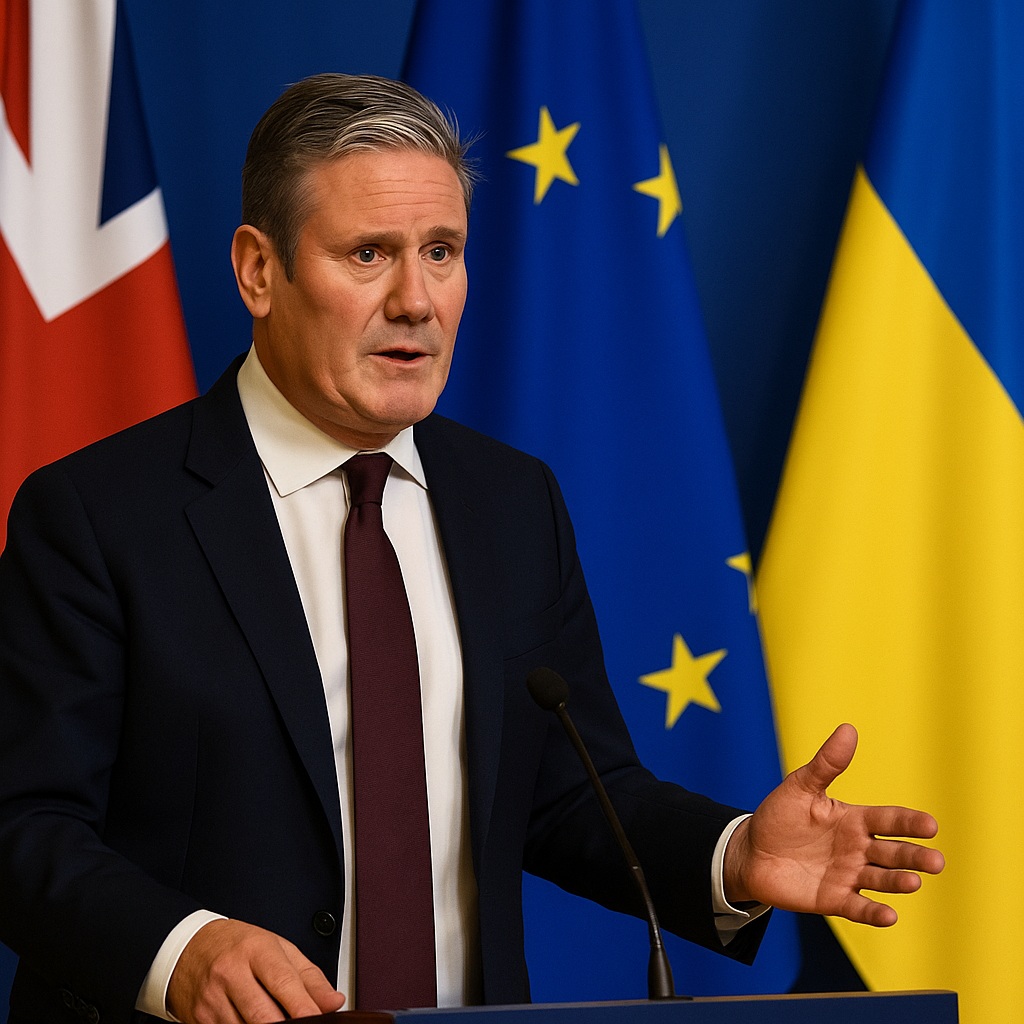
In a forceful response to a new wave of pointed remarks from the U.S. leadership, UK Prime Minister Keir Starmer reaffirmed that Europe remains united in its support for Ukraine and in its broader defense of democratic values. Speaking to reporters during a round of diplomatic consultations, Starmer emphasized that Europe’s position had not wavered, even as political tensions in Washington continue to generate uncertainty over the future of American involvement in the conflict.
Starmer’s comments came at a moment when questions about transatlantic alignment have returned to the forefront of diplomatic debate. Senior figures in the U.S. administration have delivered unusually blunt critiques of Europe’s defense posture, prompting concerns that the previously solid Western consensus on Ukraine could begin to fracture. European officials, however, have responded with a coordinated show of solidarity — a message Starmer amplified with particular clarity.
According to Starmer, European governments “understand what is at stake,” describing the war as a pivotal struggle over the survival of a democratic nation under assault. He noted that recent conversations with European counterparts, from across both EU and non‑EU states, reflected a common determination to maintain economic, military, and humanitarian support for Kyiv. While he acknowledged the political pressures building inside Washington, he insisted that Europe’s commitments were rooted in long‑term strategic thinking rather than in short political cycles.
Diplomats in Brussels and other European capitals have echoed Starmer’s sentiment, pointing to an ongoing stream of joint initiatives aimed at reinforcing Ukraine’s defenses and stabilizing its economy. Several officials privately expressed frustration at what they viewed as mischaracterizations of Europe’s efforts coming from the U.S., noting that European contributions — though sometimes slower to materialize — have grown steadily and now represent a cornerstone of Ukraine’s resilience.
Starmer also used the moment to push back against narratives suggesting Europe might seek to distance itself from Ukraine if American support faltered. “We are not spectators,” he said. “We are active partners in defending a free nation and the security architecture that has protected our continent for generations.” The Prime Minister added that Europe’s unity had been tested repeatedly since the invasion began, but that each challenge had ultimately strengthened, rather than weakened, collective resolve.
Analysts say the renewed focus on Europe’s role underscores a broader recalibration within Western alliances. With political polarization shaping U.S. foreign policy debates, European leaders have increasingly recognized the need to demonstrate both capability and cohesion. Starmer’s sharp, confident tone, they argue, reflects a new phase in which Europe is positioning itself not merely as a supporter of U.S. leadership, but as a stable, independent pillar of the international response to the war.
Despite tensions, officials stress that transatlantic cooperation remains essential. Starmer himself noted that disagreements among allies are “inevitable,” but that the fundamental goals remain aligned. What matters now, he added, is maintaining clarity of purpose and ensuring that Ukraine receives sustained support at a moment when Russia continues to test the resolve of the international community.
As winter sets in and diplomatic maneuvering intensifies, Europe’s message — delivered by Starmer with unmistakable intent — is that its commitment to Ukraine is neither symbolic nor conditional. It is, rather, a defining obligation of a continent determined to uphold democratic principles in the face of escalating authoritarian aggression.