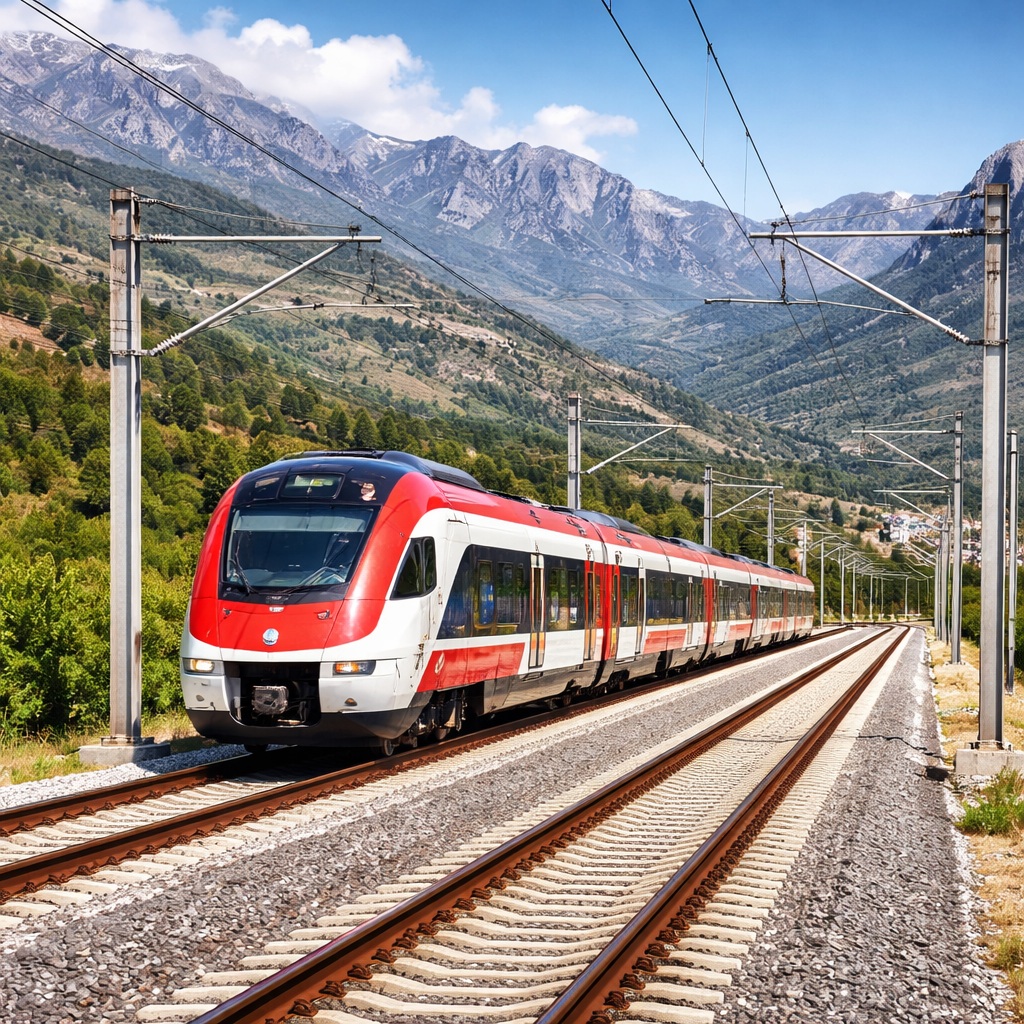
A major investment signals Brussels’ renewed focus on infrastructure, resilience, and regional integration in the Western Balkans.

As Europe turns the page into a new year, the European Union has reinforced its long-term commitment to the Western Balkans with the approval of a substantial investment aimed at modernizing Montenegro’s railway network. The funding package, valued at €175.6 million, targets one of the country’s most strategic transport corridors and underscores the EU’s broader ambition to improve connectivity, sustainability, and economic resilience across Southeast Europe.
The project focuses on upgrading key sections of Montenegro’s rail infrastructure, much of which dates back several decades and has struggled to keep pace with modern safety, speed, and capacity standards. By supporting rehabilitation works, signaling systems, and technical modernization, the EU aims to transform the railway into a more reliable backbone for both passenger and freight transport.
For Montenegro, railways are more than a domestic concern. The country sits at a crossroads between Adriatic ports and inland Balkan markets, making efficient rail links essential for regional trade. Modern infrastructure is expected to reduce travel times, improve safety, and enhance interoperability with neighboring rail networks, allowing smoother cross-border movement of goods and people.
European officials have framed the investment as part of a wider strategy to close the infrastructure gap between EU member states and candidate countries. Railways, in particular, are seen as a cornerstone of sustainable mobility, offering a lower-carbon alternative to road transport while supporting economic growth. In the context of rising energy costs and environmental pressures, shifting freight and passenger traffic to rail has become a policy priority in Brussels.
The Montenegro railway upgrade also aligns with the EU’s broader geopolitical goals in the Western Balkans. Infrastructure investment has increasingly been used as a tool to promote stability, economic convergence, and institutional reform in the region. By tying funding to technical standards and governance requirements, the EU seeks to anchor Montenegro more firmly to European norms and practices.
Local authorities have welcomed the funding as a catalyst for long-awaited improvements. Railway bottlenecks and aging equipment have long limited Montenegro’s transport potential, discouraging investment and constraining tourism and industry alike. Upgraded lines are expected to support port activity, facilitate exports, and strengthen links between coastal areas and the interior.
The project is also expected to generate employment during the construction phase and to stimulate related sectors such as engineering, logistics, and maintenance. Over the longer term, improved rail services could help reverse population decline in some regions by making commuting and regional mobility more attractive.
From a regional perspective, the investment sends a signal that Southeast Europe remains firmly on the EU’s strategic agenda. As global supply chains are re-evaluated and nearshoring gains traction, efficient transport corridors in the Balkans are increasingly viewed as an asset rather than a peripheral concern. Montenegro’s rail upgrade fits into emerging trans-European transport networks designed to enhance resilience and competitiveness.
Challenges remain, including complex terrain, the need for careful environmental management, and the requirement for strong project oversight. However, EU-backed infrastructure projects in the region have increasingly emphasized transparency, technical assistance, and long-term planning to mitigate such risks.
As the new year begins, the Montenegro railway investment stands as a tangible example of how infrastructure policy, climate objectives, and enlargement strategy intersect. While tracks and signals may seem like technical details, their modernization carries broader implications: tighter regional integration, greener transport, and a renewed sense of momentum for Southeast Europe’s European path.