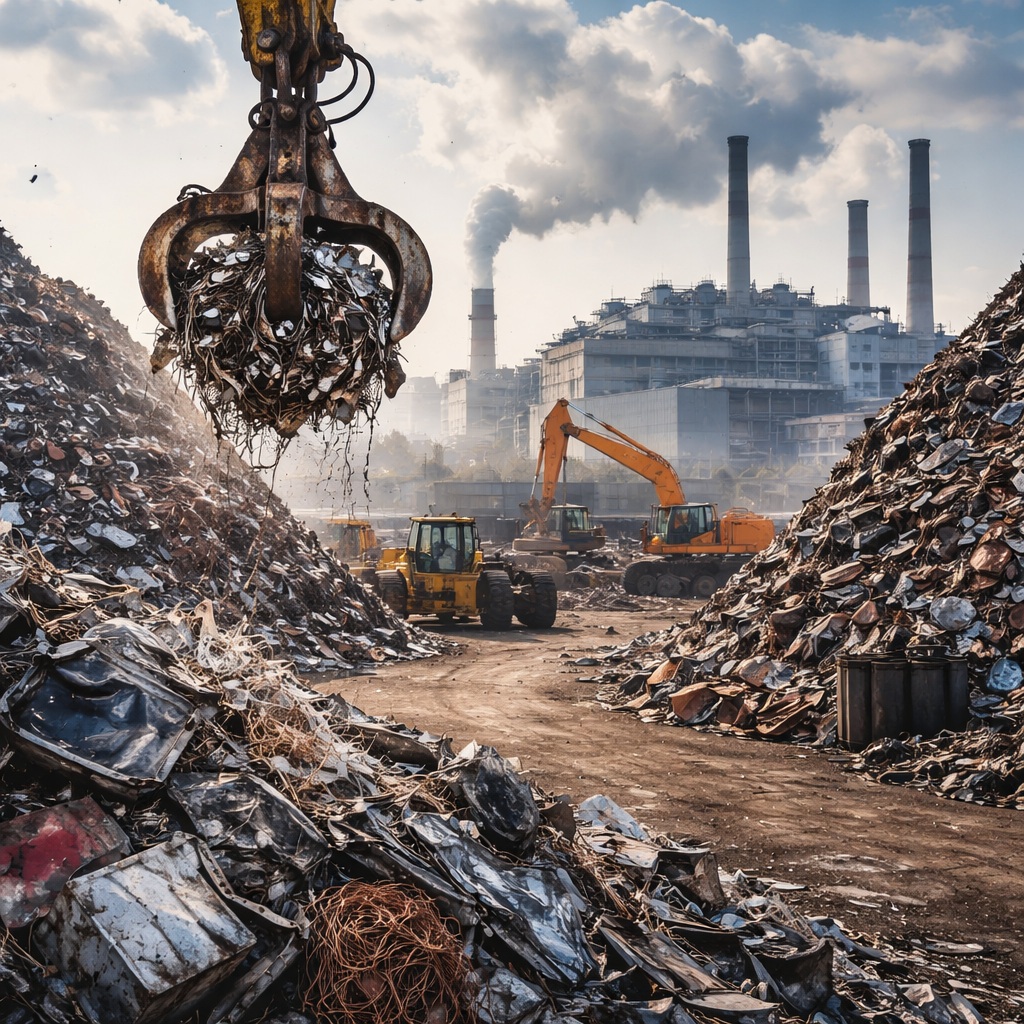
Executives warn that structural pressures are hollowing out the EU metal sector, even as households pay more for recycled materials
January 2026 — Europe’s metal sector is entering what industry leaders describe as a period of structural decline, marked by shrinking recycling capacity, rising consumer costs, and mounting pressure from global competitors. Senior executives across the industry warn that without urgent policy recalibration, the European Union risks losing a cornerstone of its industrial ecosystem.
At the heart of the concern is the metal recycling industry, long promoted as a pillar of Europe’s green transition. Despite strong political backing and consumer demand for sustainable products, executives say the sector is contracting. Facilities are closing, investment is slowing, and Europe is increasingly dependent on imported primary metals and semi-finished products.
“We are recycling less in Europe, not because demand is weak, but because operating conditions are becoming unviable,” said one senior executive at a major European metal group. “This is a structural issue, not a temporary downturn.”
Rising costs, shrinking capacity
Industry leaders point to a convergence of pressures. Energy costs remain volatile and structurally higher than in competing regions. Environmental compliance rules, while aligned with climate goals, add layers of cost that are not always matched by support mechanisms. At the same time, cheaper metal products from outside the EU are entering the market, often produced under looser environmental and labor standards.
Recycling, traditionally more resilient than primary production, is no longer insulated. Executives report that several secondary aluminum, copper, and steel plants have reduced output or shut down altogether. Collection volumes are also under strain, as fragmented waste systems and export of scrap materials limit domestic supply.
Paradoxically, consumers are paying more for products labeled as recycled. From construction materials to household goods, prices have risen even as local recycling capacity declines. Industry representatives argue this reflects inefficiencies and the growing reliance on imported recycled content.
A strategic contradiction
The situation exposes what executives describe as a strategic contradiction at the core of EU industrial policy. Europe aims to lead in circular economy practices while allowing key industrial enablers to erode.
Metal is foundational to sectors ranging from renewable energy and electric mobility to defense and infrastructure. Recycling is critical not only for emissions reduction but also for security of supply. Yet, according to industry leaders, current frameworks fail to adequately protect or incentivize domestic recyclers.
“There is a gap between ambition and reality,” said another executive. “We are told to decarbonize, to invest, to innovate—but the business case is being undercut by imports and regulatory asymmetry.”
Global competition intensifies
Outside Europe, competitors are moving quickly. The United States is deploying aggressive industrial incentives, while Asian producers continue to expand capacity at scale. Executives warn that Europe’s metal sector, once a global benchmark, risks becoming structurally uncompetitive.
The loss is not only economic. Recycling plants support skilled jobs, regional economies, and technological know-how. Once dismantled, executives caution, such industrial ecosystems are difficult to rebuild.
Calls for recalibration
Industry leaders are not calling for a rollback of climate goals. Instead, they urge policymakers to align environmental ambition with industrial realism. Proposals include stricter enforcement of carbon border measures, incentives for domestic scrap retention, and targeted energy relief for recyclers.
Without such measures, executives warn, Europe may continue to consume “green” metal in name only—produced elsewhere, under different standards, and at greater strategic risk.
As one executive put it, “If recycling disappears from Europe, the circular economy becomes a slogan, not a system.”


 The Tower Post