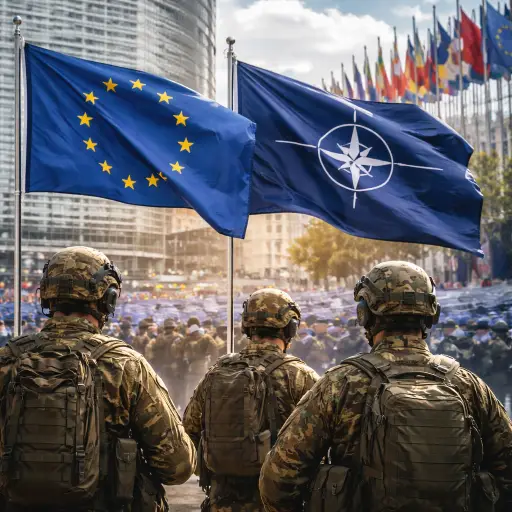
As global power balances shift, the European Union is redefining its foreign and security posture beyond automatic alignment with the United States.

Europe is no longer content to orbit unquestioningly around Washington. That was the clear message emerging from Brussels this week, where European Union foreign policy chief Kaja Kallas outlined a vision of Europe that is more strategically autonomous, more cohesive in defence, and more realistic about a world no longer shaped by a single dominant power.
For decades, the transatlantic relationship has been the cornerstone of Europe’s security and foreign policy. The United States acted as guarantor, anchor and, in many cases, decision-maker. That model, Kallas suggested, is no longer sufficient. The geopolitical environment has changed, and Europe must change with it.
Speaking against the backdrop of intensifying global competition, Kallas emphasised that Europe’s interests cannot be fully safeguarded if they are permanently filtered through Washington. This does not imply a rupture with the United States, but rather a recalibration. Europe, she argued, must be capable of acting independently when its priorities diverge, while remaining a credible and reliable partner to its allies.
This shift reflects a broader awareness within European capitals that the post-Cold War order has faded. Power is more fragmented, alliances more transactional, and security threats more complex. The war in Ukraine, instability in the Middle East, tensions in the Indo-Pacific and economic coercion through trade and technology have all underscored Europe’s vulnerabilities.
At the heart of Kallas’s message lies defence. Europe, she reiterated, cannot continue to rely predominantly on American military capabilities while aspiring to geopolitical relevance. Fragmented procurement, overlapping systems and underinvestment have long plagued European defence efforts. In a world where crises can erupt simultaneously across regions, these shortcomings are no longer tolerable.
Stronger defence collaboration, according to Kallas, is not an abstract ambition but a strategic necessity. Joint procurement, shared capabilities and a more integrated industrial base are essential if Europe is to deter threats and respond rapidly when deterrence fails. The objective is not to duplicate NATO, but to ensure that Europe can shoulder a far greater share of its own security burden.
The call for strategic autonomy is also economic and political. Supply chain disruptions, energy dependence and technological competition have revealed how exposed Europe can be when global systems fracture. A foreign policy anchored exclusively to Washington risks limiting Europe’s room for maneuver, particularly when American priorities shift due to domestic politics or strategic focus elsewhere.
Kallas was careful to stress that autonomy does not mean isolation. The transatlantic bond remains vital, but it must be a partnership of equals rather than a relationship of dependence. Europe’s credibility, she implied, will grow not by distancing itself rhetorically from the United States, but by becoming stronger, more coherent and more predictable in its actions.
This evolution is not without internal resistance. Member states still differ on threat perceptions, defence spending and the pace of integration. Some remain wary of any language that could be interpreted as weakening NATO or antagonising Washington. Yet the direction of travel is increasingly clear.
Europe’s centre of gravity in foreign policy is shifting. Washington is no longer the sole reference point, nor can it be. As global power dynamics evolve, Europe faces a choice: adapt and assert itself, or risk strategic marginalisation. Kallas’s message suggests that, at least in Brussels, the choice has already been made.
In a world defined by uncertainty, Europe is learning that sovereignty is not declared, but built. And building it requires the courage to stand on its own feet, even while walking alongside old allies.