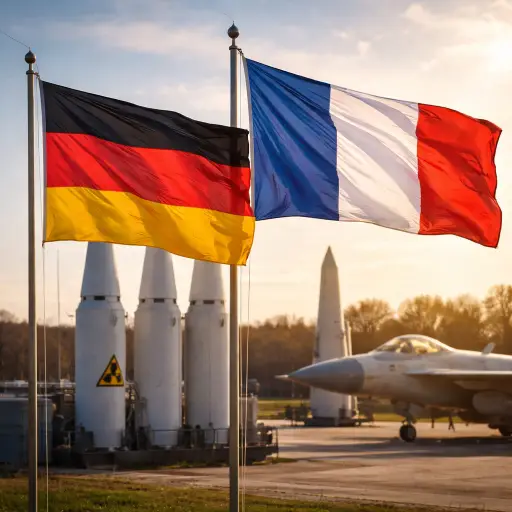
As economic pressures and defense imperatives converge, Germany and France open early talks on joint deterrence strategy with far-reaching industrial and budgetary consequences.

In a move that signals a profound shift in Europe’s strategic landscape, Germany and France have begun preliminary discussions on closer coordination around nuclear deterrence, reflecting a growing convergence between economic policy and defense planning at the heart of the European Union.
Officials in both capitals describe the talks as exploratory, yet their very existence underscores mounting concerns about long-term security guarantees and the sustainability of Europe’s defense posture in an era of geopolitical volatility. The dialogue remains at an early stage, but it touches on issues that were once politically untouchable in Berlin and jealously guarded in Paris.
France, the European Union’s only nuclear-armed state, has traditionally framed its deterrent as a sovereign instrument designed to protect vital national interests. Germany, long reliant on NATO’s nuclear umbrella and constrained by its postwar strategic culture, has until recently avoided public debate on any deeper role in nuclear matters beyond participation in alliance structures.
What has shifted is not a single dramatic event but an accumulation of pressures: persistent instability on Europe’s eastern flank, uncertainty in transatlantic politics, and the recognition that defense industrial capacity cannot be separated from macroeconomic strategy. Policymakers increasingly view deterrence not merely as a military doctrine but as a pillar of economic resilience and technological sovereignty.
The emerging Franco-German exchange is therefore less about immediate operational integration and more about strategic architecture. German officials are examining how financial contributions, industrial partnerships, and shared research initiatives might complement France’s existing force without formally altering its command structure or sovereign control.
For Paris, the discussions offer an opportunity to anchor its deterrent more firmly within a broader European political framework, potentially strengthening legitimacy while securing long-term investment in critical technologies. For Berlin, even limited involvement would represent a historic recalibration, requiring careful navigation of constitutional sensitivities, coalition politics, and public opinion.
Economic considerations loom large in both capitals. Governments are under pressure to balance climate transitions, social spending commitments, industrial competitiveness, and rising defense budgets, and any deeper cooperation on nuclear deterrence would inevitably shape fiscal planning by locking in multi-decade expenditure cycles tied to modernization and advanced systems development.
Defense industry executives in both countries are watching closely as policymakers test the contours of cooperation. A more structured partnership could channel funds toward joint projects in missile systems, space-based surveillance, cybersecurity, secure communications, and next-generation propulsion, while potentially accelerating consolidation in Europe’s fragmented defense sector.
Critics warn that blurring the line between economic policy and nuclear strategy risks normalizing deterrence as an industrial growth engine. They argue that presenting modernization programs as drivers of innovation and employment may obscure ethical considerations and complicate Europe’s diplomatic positioning in global non-proliferation debates.
Supporters counter that deterrence credibility depends on technological sophistication and industrial depth, both of which require predictable investment and strategic coordination. In their view, failing to adapt could leave Europe strategically exposed and economically disadvantaged in high-technology domains with significant civilian spillover effects.
The talks also intersect with broader debates about European strategic autonomy and burden sharing within the Atlantic alliance. While neither Berlin nor Paris is proposing a fully Europeanized nuclear force in the near term, the willingness to explore shared frameworks signals a reassessment of long-standing assumptions about sovereignty and collective defense responsibilities.
Diplomats emphasize that consultations are proceeding in close dialogue with allies and remain anchored in existing treaty commitments. Yet the subtext is unmistakable: Europe’s two largest economies are quietly probing what a more self-reliant security architecture might look like in a world where guarantees can no longer be taken for granted.
Public opinion remains a decisive variable in shaping the pace and scope of any arrangement. In Germany, memories of Cold War deployments and enduring anti-nuclear sentiments require leaders to frame cooperation as reinforcing deterrence stability rather than expanding nuclear roles, while in France policymakers must ensure that any European dimension does not dilute sovereign authority over ultimate decision-making.
As discussions continue, practical questions multiply over cost-sharing mechanisms, industrial workshare arrangements, research collaboration models, and the implications for future arms control initiatives. Each element carries budgetary, political, and strategic consequences that will demand careful calibration.
For now, the negotiations are cautious and largely exploratory, but the direction of travel is evident. By bringing nuclear deterrence into the realm of economic and industrial strategy, Germany and France are redefining the parameters of European defense policy at a moment of heightened uncertainty.
Whether the initiative evolves into a formalized framework or remains a structured dialogue, it marks a significant inflection point. In an environment defined by geopolitical strain and fiscal constraint, Berlin and Paris appear determined to weave together fiscal prudence, industrial ambition, and the enduring logic of deterrence into a single, if delicate, strategic conversation.