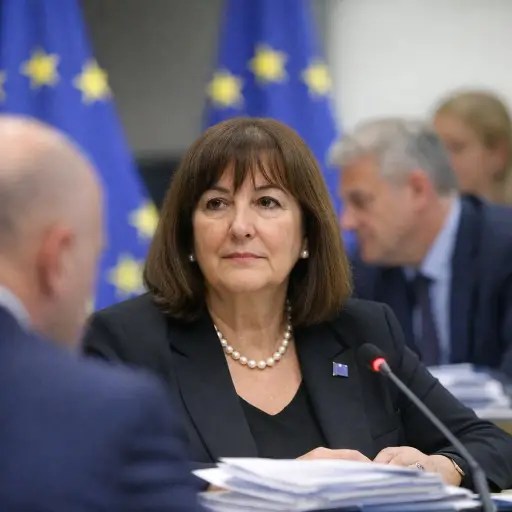
Dubravka Šuica under scrutiny as participation in Donald Trump’s “Board of Peace” triggers diplomatic unease and reignites debate over external influence within the European Union
A fresh political storm is gathering in the European quarter as European Commissioner Dubravka Šuica prepares to face ministers over her participation in former U.S. President Donald Trump’s newly announced “Board of Peace,” an initiative that has stirred unease across European capitals and reopened sensitive questions about foreign influence in Union affairs.
Šuica, one of the Commission’s most senior figures and long associated with the Union’s democratic outreach portfolio, has defended her involvement as a dialogue platform aimed at strengthening transatlantic cooperation, yet critics inside the Council and the European Parliament argue that the optics of a sitting EU Commissioner serving on a body closely tied to Trump’s political orbit risk undermining the bloc’s institutional neutrality at a time of delicate geopolitical recalibration.
The controversy comes at a pivotal juncture for the European Union, as security tensions persist on its eastern flank and the Middle East remains fragile after successive ceasefire efforts, prompting Brussels to project unity and strategic autonomy while the appearance of an EU executive participating in a forum branded and promoted by a polarizing American political figure complicates that message.
According to officials familiar with internal discussions, several foreign ministers have requested clarifications on the scope of Šuica’s role, noting that while there is no formal prohibition against Commissioners participating in external advisory initiatives, the Commission’s code of conduct requires members to avoid situations that could create conflicts of interest or compromise the perception of independence.
Supporters of Šuica argue that engagement does not equal endorsement and insist that the transatlantic relationship remains the backbone of European security, warning that refusing dialogue would be a strategic mistake and pointing out that previous Commissioners have participated in global forums sponsored by U.S. foundations and policy networks without triggering similar backlash.
Others see a difference in this case, contending that Trump’s “Board of Peace,” unveiled with considerable fanfare in Washington, is widely viewed as part of a broader effort to shape international discourse ahead of renewed electoral dynamics in the United States, and that even if the initiative is framed around conflict mediation and humanitarian dialogue, its political branding cannot be separated from its sponsor.
Inside the Berlaymont headquarters, officials have moved quickly to contain the fallout, and although Commission President Ursula von der Leyen has refrained from public criticism, aides confirm that the issue will be discussed at the next College meeting, with diplomats stressing that the matter is less about legality and more about political judgment.
This is about perception, noted a senior official from a founding member state, arguing that at a moment when the Union emphasizes strategic autonomy, participation in a body so closely associated with a single U.S. political actor raises legitimate questions about coherence and independence.
The episode has reignited a broader debate within the Union about how to manage relations with external power centers without blurring institutional boundaries, especially after years in which Brussels strengthened transparency registers, ethics rules and cooling-off periods for former officials to shield policymaking from undue lobbying or third-country pressure.
The Šuica controversy illustrates the grey zones that remain, as Commissioners are bound by collective responsibility but also operate within a global ecosystem of think tanks, advisory councils and multilateral initiatives where drawing the line between constructive engagement and reputational risk is often subjective and politically charged.
Political groups in the European Parliament are sharpening their positions, with lawmakers from the Greens and parts of the Socialists calling for a formal hearing to clarify not only Šuica’s mandate but also how such engagements are vetted, while members of the center-right European People’s Party urge caution, emphasize due process and warn against politicizing transatlantic ties.
The debate resonates beyond Brussels, where in several member states opposition parties have seized on the issue as evidence of what they describe as double standards in the Union’s approach to external influence, and governments that have previously faced scrutiny over ties to foreign actors now point to the Commissioner’s role as proof that the rules should apply evenly at all levels.
For her part, Šuica has signaled willingness to address concerns directly, underscoring in a brief statement that her participation is unpaid and advisory in nature and focused on promoting dialogue, de-escalation and humanitarian principles, while adding that she informed the Commission’s ethics committee prior to accepting the invitation.
The political temperature continues to rise ahead of the ministers’ meeting in Brussels, where pointed questions are expected regarding whether the Commissioner sought explicit authorization from the College and whether her engagement falls within her portfolio’s remit, at a time when maintaining a coherent external posture is seen as essential for upcoming summits with global partners.
Whether the “Board of Peace” episode will have lasting institutional consequences remains uncertain, as much will depend on how Šuica frames her involvement and whether ministers are satisfied with her explanations, but the controversy has already evolved into a broader reflection on how the European Union navigates partnerships in an era of shifting alliances and intensified scrutiny, with the outcome likely to signal the evolving contours of transatlantic diplomacy.

 The Tower Post