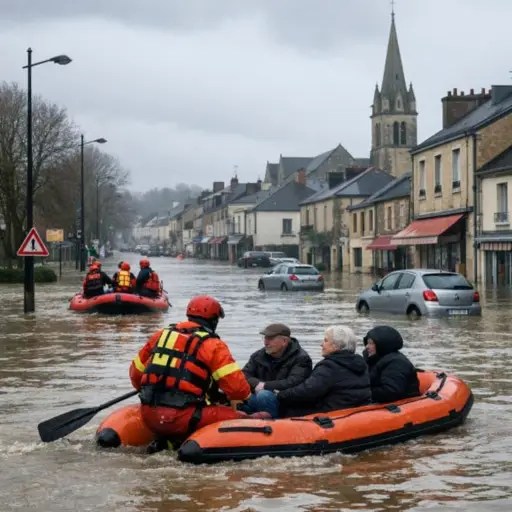
Authorities warn that swollen waterways remain a grave threat despite clearer skies as thousands flee submerged towns and emergency crews brace for further surges
Western France is confronting one of its most serious flood emergencies in recent memory as days of exceptional rainfall have driven river levels sharply higher, forcing the evacuation of thousands of residents and submerging homes, businesses and critical infrastructure across several departments.
Red and orange flood alerts remain in effect across wide areas, reflecting what officials describe as a volatile and evolving situation in which saturated ground and swollen tributaries continue to feed major rivers already straining against their banks.
Although rainfall has eased and brighter skies have returned to parts of the region, authorities stress that the apparent improvement should not be mistaken for safety because water levels remain dangerously high and runoff from upstream catchments is still moving through river systems.
In historic town centres known for their stone façades and riverside promenades, muddy water now fills streets that only days ago were busy with weekend activity, while shopkeepers stack sandbags at entrances and residents wade through floodwater to retrieve belongings from ground floors coated in silt.
Emergency services have carried out large scale evacuations in low lying neighbourhoods, going door to door to reach elderly residents and families caught off guard by the speed at which waters rose after relentless downpours earlier in the week.
Temporary shelters have been opened in sports halls and community centres where evacuees are receiving hot meals, blankets and medical assistance as volunteers and local charities mobilise to support those displaced from their homes.
Firefighters and gendarmes have deployed inflatable boats in the hardest hit districts to reach people stranded on upper floors, while helicopters remain on standby should further rescues become necessary in isolated communities.
Hydrologists say the crisis stems from a convergence of factors including already saturated soils from earlier winter storms and a prolonged spell of heavy rain that left the ground unable to absorb additional water, sending vast quantities directly into rivers and streams.
River gauges in several basins have recorded levels well above seasonal norms, prompting comparisons with some of the most severe flood episodes experienced in the region over past decades, even as specialists caution that each event unfolds under distinct conditions.
Rural areas have been particularly affected, with farmland disappearing beneath opaque brown water and access roads cut off, raising concerns about crop damage, livestock safety and the longer term economic consequences for agricultural producers.
Farmers have scrambled to move animals to higher ground where possible, yet in some locations submerged tracks and weakened bridges have complicated efforts to secure herds and transport essential supplies.
Transport networks across western France have suffered significant disruption, with sections of regional rail lines suspended over fears of unstable embankments and road closures multiplying as authorities seek to prevent motorists from attempting to cross flooded routes.
Officials have repeatedly urged the public to respect barricades and avoid unnecessary travel, warning that even shallow water on roadways can conceal strong currents capable of sweeping vehicles away within moments.
Engineers are closely monitoring dykes and flood control infrastructure, conducting inspections and reinforcing vulnerable points as sustained pressure from high water levels tests defences designed to withstand extreme conditions.
Local leaders have underscored that the emergency is not over, emphasising that river crests may yet be reached in certain areas and that further rises cannot be ruled out if additional rainfall occurs over the coming days.
Residents describe a mixture of shock and resilience as they confront the prospect of costly repairs and prolonged disruption, with some business owners facing a second round of flooding after having only recently restored premises damaged in earlier storms.
Insurance assessors have begun preliminary evaluations, though comprehensive damage assessments are expected to take time given the breadth of the inundation and the difficulty of accessing some neighbourhoods.
National authorities have pledged financial assistance for affected households and businesses, mobilising emergency funds to support immediate relief efforts and signalling that broader recovery packages will follow once the full scale of losses becomes clear.
Climate specialists note that episodes of intense rainfall are becoming more frequent in parts of Europe, increasing the likelihood of flash floods and prolonged inundation, and while no single event can be attributed solely to wider climatic trends, warmer atmospheric conditions are known to intensify precipitation.
As the region moves into the weekend, attention remains fixed on river forecasts and embankment stability, with civil protection services advising residents in at risk zones to stay alert, monitor official updates and prepare for possible further evacuations.
For communities along western France’s rivers, the slow churn of swollen waters pressing against barriers serves as a stark reminder that even as the rainclouds disperse, the crisis continues beneath the surface and the path to recovery may prove long and uncertain.


 The Tower Post