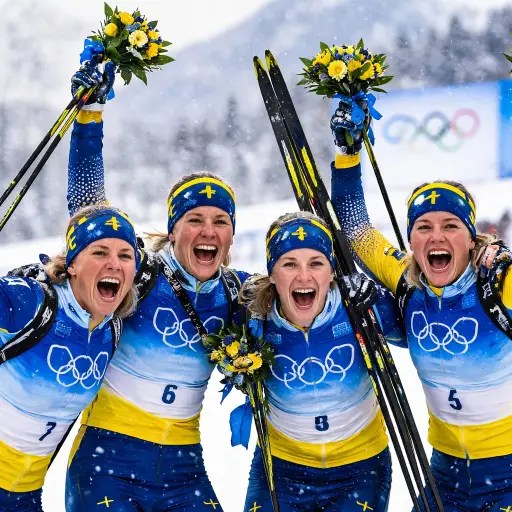
Nordic depth and endurance prevail in a dramatic showdown on the Winter Games trails
Sweden secured the women’s cross-country skiing relay gold at the Winter Games in a performance defined by tactical discipline, relentless endurance and collective precision, reaffirming the nation’s authority in one of the most physically punishing events on the Olympic program.
Raced under biting cold and on snow hardened by shifting winter winds, the relay unfolded at an unforgiving tempo from the opening exchange, with traditional Nordic rivals pressing the pace and immediately stretching the field in a test of both technique and nerve.
The Swedish lead skier resisted early surges from Norway and Finland, choosing instead to maintain close contact through sweeping descents and grinding climbs, preserving energy while ensuring the team remained firmly embedded within the leading pack.
As the second leg developed, the intensity sharpened and gaps began to open, yet Sweden revealed the depth that has become the backbone of its program, increasing cadence on a sustained uphill section and forcing visible strain among competitors who had committed heavily in the opening kilometers.
Spectators lining the course, wrapped in layers against the cold, sensed the shift in momentum as the Swedish skier methodically reeled in a narrow deficit, her rhythm steady and efficient against a backdrop of cowbells and rising commentary.
Finland responded with a daring downhill push that briefly reshaped the leaderboard, while Norway attempted to dictate tempo through sustained pressure on technical sections, but Sweden’s third skier absorbed each challenge with controlled composure and fluid precision.
By the final exchange the contest had tightened into a gripping Scandinavian duel, the three leading teams separated by little more than strides as they surged into the concluding leg amid a crescendo of noise from the stadium.
Sweden’s anchor approached the decisive stage with measured restraint, shadowing her rivals before launching a calculated surge midway through the final circuit on a climb that had already drained the reserves of several contenders.
The attack was not explosive in spectacle but relentless in execution, a gradual escalation of pace that steadily stretched the elastic binding the leaders and exposed the accumulated fatigue in the chasing athletes.
Behind her, Norway attempted to respond but struggled to match the sustained increase in cadence, while Finland fought to limit the damage as the Swedish lead expanded meter by meter across compacted snow.
Over the final descent the Swedish skier maintained impeccable balance and technical clarity despite visible exhaustion, driving each pole plant with determination as the finish line came into view.
Crossing the line with arms raised and breath visible in the frigid air, the quartet sealed a victory that resonated beyond a single race result, embodying a national system built on depth, scientific preparation and a culture shaped by winter.
The relay format demands more than individual brilliance, requiring seamless transitions and unwavering consistency across four legs, and Sweden delivered precisely that balance when margins were at their narrowest.
The triumph also reinforced Scandinavia’s broader legacy in elite winter sport performance, where rivalry fuels innovation and generations of athletes are shaped by community clubs and snowbound training grounds.
For Sweden, the gold medal stands as both culmination and continuation, a reward for sustained investment in youth development and high-performance science, and a signal that its relay strength remains formidable on the world stage.
In the larger narrative of these Winter Games, the women’s cross-country relay will be remembered for its tension, its tactical nuance and the quiet authority with which Sweden seized control when the decisive moment arrived.
As medals were presented beneath fluttering flags and a pale winter sun, the Swedish athletes stood not only as champions of the day but as representatives of a tradition that measures success in teamwork as much as in speed.
The result leaves rivals recalibrating and reinforces the enduring truth of Olympic cross-country skiing that resilience, patience and collective depth remain the ultimate currencies of gold.



 The Tower Post