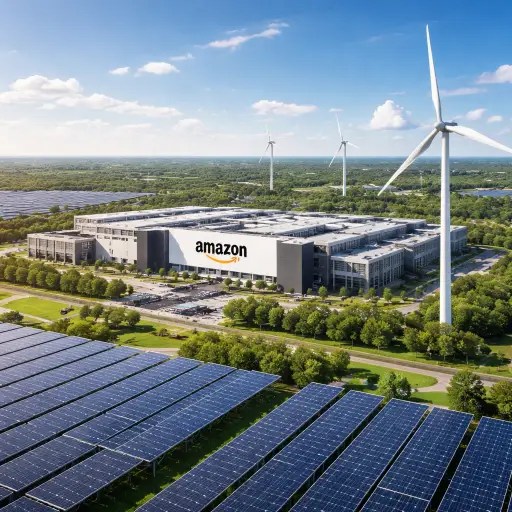
A major infrastructure commitment links hyperscale cloud growth with enforceable environmental accountability

In early March, Amazon announced a sweeping $12 billion investment designed to expand its global data center network while embedding climate accountability into the structural foundation of its cloud operations.
The initiative reflects a decisive shift in how large technology companies approach infrastructure, acknowledging that exponential growth in artificial intelligence and enterprise computing must now align with intensifying environmental expectations.
Executives framed the expansion not merely as a capacity upgrade but as a long-term recalibration of how hyperscale facilities are financed, engineered, and powered in an era increasingly defined by carbon transparency.
The new projects will prioritize energy efficiency at the architectural level, incorporating advanced liquid cooling systems, optimized airflow management, and hardware configurations tailored to AI-intensive workloads.
At the same time, Amazon is scaling renewable energy procurement to match the anticipated surge in electricity demand, deepening its portfolio of wind and solar agreements while integrating battery storage to stabilize supply.
Analysts view the investment as both defensive and strategic, positioning the company to manage regulatory tightening across North America and Europe while strengthening its appeal to sustainability-focused institutional investors.
The rapid expansion of generative AI platforms has placed extraordinary strain on global data infrastructure, prompting cloud providers to accelerate capital deployment at a pace rarely seen outside previous digital transformation cycles.
By embedding renewable sourcing and carbon-aware workload management directly into its infrastructure blueprint, Amazon is seeking to reduce exposure to energy market volatility and potential carbon pricing mechanisms.
Engineers involved in the program are testing adaptive software capable of shifting compute-heavy tasks to regions where renewable generation is abundant, effectively aligning digital demand with cleaner supply in near real time.
Environmental advocacy groups have long scrutinized the water intensity and land use patterns associated with hyperscale campuses, making transparency and measurable efficiency gains central to the credibility of this initiative.
Amazon has indicated that standardized emissions reporting, improved water stewardship, and closer coordination with regional utilities will form part of the governance structure accompanying the buildout.
For host communities, the investment promises construction employment and technical job creation while raising familiar questions about grid capacity and long-term resource allocation.
Market reaction has been measured, with investors weighing short-term capital expenditure pressure against the long-term insulation that integrated sustainability planning may provide.
The competitive implications are equally significant, as rival cloud providers are pursuing their own clean energy innovations in a race that now extends beyond computing power into environmental performance.
The broader message emerging this March is unmistakable: the economics of cloud infrastructure are being reshaped by climate accountability, and companies that fail to integrate sustainability into core design risk falling behind.
Amazon’s $12 billion commitment signals that hyperscale growth and environmental discipline are no longer parallel ambitions but interdependent pillars of digital expansion.
If executed as outlined, the initiative could redefine industry benchmarks for responsible infrastructure, establishing a template in which technological scale is inseparable from ecological stewardship.