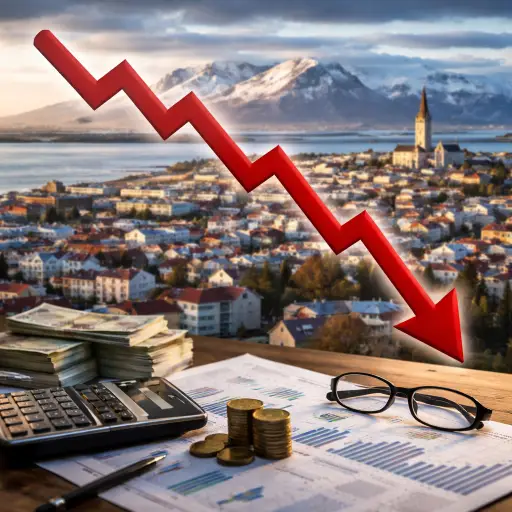
Fourth-quarter reversal highlights the fragility and volatility of smaller European economies

As March begins, newly released national accounts confirm that Iceland’s economy contracted by 0.6% in the final quarter of last year, abruptly reversing earlier growth and renewing scrutiny of the structural vulnerabilities that often shape smaller, highly open European economies.
The downturn followed a period of solid expansion driven by tourism, energy-intensive industry, and resilient domestic demand, making the late-year decline a surprise for many analysts who had expected momentum to carry into the winter months.
Economists say the contraction, while moderate in scale, is significant in timing and composition, as it reflects a simultaneous cooling in household spending, investment activity, and segments of the export sector that had previously underpinned growth.
Household consumption softened after several quarters of strength, as elevated borrowing costs and lingering price pressures eroded purchasing power and prompted consumers to scale back discretionary spending across retail and services.
Business investment also slowed, particularly in construction and infrastructure, sectors that had benefited from rapid post-pandemic expansion but are now feeling the weight of tighter financial conditions and greater uncertainty about external demand.
On the external front, Iceland’s concentrated export base amplified the impact of weaker global conditions, with softer demand for marine products and energy-intensive manufacturing output weighing on overall trade performance.
Tourism, long a central pillar of Icelandic growth, showed signs of normalization after years of extraordinary expansion, with visitor flows remaining healthy by historical standards but no longer delivering the exceptional gains that characterized earlier quarters.
Financial conditions have played a central role in the slowdown, as the Central Bank of Iceland has maintained a restrictive stance to contain inflationary pressures, supporting currency stability but constraining credit growth and investment appetite.
Analysts caution that volatility is a recurring feature of smaller economies with narrow production bases, noting that fluctuations in global commodity prices, travel patterns, or external demand can quickly transmit into domestic output data.
Despite the contraction, Iceland retains several structural strengths, including relatively sound public finances, low unemployment compared with much of Europe, and abundant renewable energy resources that continue to attract foreign interest in data infrastructure and green technology.
Market reactions have so far been measured rather than alarmed, with currency and bond markets reflecting caution but not signaling acute stress, suggesting investors view the downturn as a cyclical adjustment rather than the start of a deep recession.
Government officials have indicated readiness to support economic activity if conditions deteriorate further, though policymakers remain mindful of the risk that premature stimulus could rekindle inflation and complicate monetary policy objectives.
The broader European backdrop adds complexity, as uneven growth across the continent and shifting global trade dynamics create an uncertain environment for export-oriented economies that depend heavily on external demand.
Looking ahead, much will hinge on whether export markets stabilize and domestic price pressures ease, developments that could restore confidence among households and businesses and set the stage for renewed expansion.
For now, the fourth-quarter contraction stands as a reminder that Iceland’s economic trajectory is rarely linear, and that in a small but dynamic economy positioned between Europe and North America, shifts in momentum can be swift, both on the way down and on the rebound.