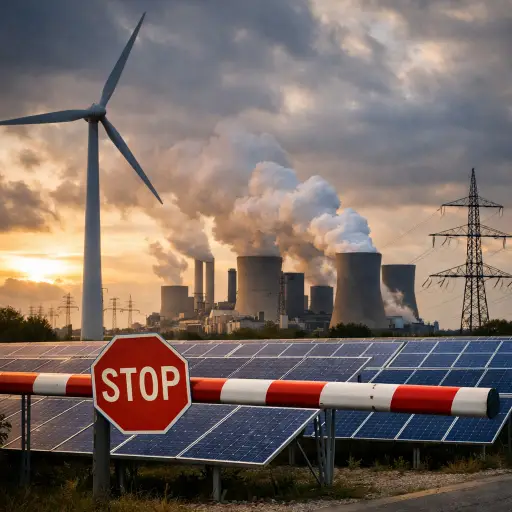
A rapid shift toward renewables meets financial headwinds, regulatory bottlenecks, and investor hesitation, leaving Europe caught between ambition and reality.

Europe’s race toward a cleaner energy future was once framed as inevitable — a coordinated push powered by political will, public support, and urgent climate targets. But as the continent moves deeper into its transition, a more complicated picture is emerging. The expansion of renewable energy, once seen as a straightforward solution, is now encountering mounting obstacles that threaten to slow progress at a critical moment.
At the heart of the issue lies a paradox. Europe urgently needs to accelerate its rollout of renewable energy to reduce emissions, secure energy independence, and stabilize long-term costs. Yet the very conditions shaping today’s economic environment are making it harder to build the infrastructure required to achieve those goals.
One of the most immediate pressures comes from the financial landscape. High interest rates have significantly altered the economics of clean energy projects. Wind farms, solar parks, and grid upgrades all rely heavily on upfront capital investment. As borrowing costs rise, so too does the overall expense of building these projects. For developers, margins are tightening; for investors, the risks are becoming harder to justify.
This shift is already visible in investment behavior. Large-scale renewable projects that once attracted aggressive bidding are now facing delays, renegotiations, or outright cancellations. Developers are increasingly cautious, recalculating expected returns in a market where financing is no longer cheap and predictable. The result is a noticeable slowdown in project pipelines across several European markets.
Compounding the financial strain is a persistent structural issue: permitting. Despite years of policy discussion around streamlining approvals, the process of securing permits for renewable energy projects remains slow and complex. Projects can spend years navigating environmental assessments, local opposition, and administrative procedures before construction even begins.
This delay is not merely bureaucratic inconvenience — it directly undermines the economic viability of projects. The longer a project remains in limbo, the more exposed it becomes to changing market conditions, cost inflation, and policy uncertainty. In an environment already shaped by rising interest rates, time itself becomes a financial risk.
The grid presents another challenge. Europe’s existing electricity infrastructure was not designed for a system dominated by decentralized, intermittent renewable sources. Integrating large volumes of wind and solar power requires extensive upgrades, new transmission lines, and smarter grid management systems. These upgrades are costly, slow to implement, and often face the same permitting hurdles as generation projects.
Meanwhile, the supply chain pressures that intensified in recent years continue to ripple through the sector. The cost of key components — from turbines to cables — remains volatile. Manufacturers, facing their own cost increases, have pushed for higher prices, further squeezing developers already grappling with tighter financing conditions.
All of this is unfolding against a backdrop of strong political commitment. European governments remain firmly aligned on the need to expand renewable energy capacity. Policy frameworks continue to emphasize decarbonization, and long-term targets remain unchanged. Yet there is a growing disconnect between ambition and execution.
For policymakers, the challenge is becoming increasingly clear: ambition alone is not enough. The success of the energy transition now depends on addressing the practical constraints that are slowing it down. This includes reforming permitting systems, stabilizing investment conditions, and accelerating grid development — all while maintaining public support.
Investors, for their part, are recalibrating rather than retreating entirely. While some capital is being pulled back in the short term, the long-term fundamentals of renewable energy remain strong. Demand for clean energy is not diminishing; if anything, it is intensifying. What is changing is the timeline and the risk profile.
There are also signs of adaptation within the industry. Developers are exploring new financing models, including partnerships and hybrid projects that combine different energy sources. Governments are beginning to revisit auction designs and subsidy mechanisms to better reflect current market conditions. These adjustments suggest that the slowdown may be temporary rather than structural.
Still, the present moment represents a critical juncture. Europe’s energy transition is no longer just a question of political will — it is a test of economic resilience and institutional efficiency. The gap between targets and delivery is becoming more visible, and closing that gap will require more than incremental changes.
In the near term, the paradox remains unresolved. Europe needs renewable energy more than ever, yet building it has become more difficult. Projects are slowing at a time when acceleration is essential. Investors are hesitating just as capital is most needed.
Whether this phase becomes a temporary setback or a longer-term bottleneck will depend on how quickly Europe can adapt. If reforms can unlock permitting, stabilize financing, and modernize infrastructure, the current slowdown may prove to be a transitional phase — a necessary adjustment in a rapidly evolving system.
If not, the risk is that Europe’s clean energy ambitions will continue to outpace its ability to deliver on them, leaving the continent caught between urgency and inertia at a moment when time is increasingly in short supply.