Around 30,000 Iranians are expected to take part in this year’s Hajj, turning one of Islam’s holiest journeys into a delicate test of diplomacy, security and restraint between two regional rivals.

Thousands of Iranian pilgrims are traveling to Saudi Arabia for the Hajj at a moment of extraordinary regional tension, as war-time hostility between Tehran and Riyadh casts a long shadow over one of the world’s largest annual religious gatherings.
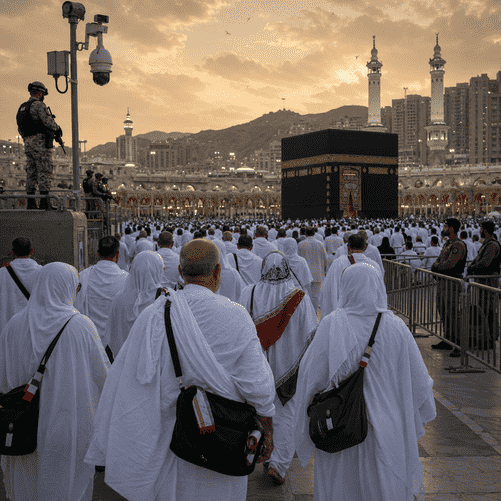
According to recent reporting, about 30,000 Iranian pilgrims have made the journey this year, a sharp reduction from Iran’s expected quota of more than 80,000. The lower number reflects the risks and logistical complications surrounding the pilgrimage, as Saudi Arabia hosts more than a million Muslims while navigating direct security threats and a fragile regional environment.
The Hajj, which is expected to run from May 25 to May 29, 2026, is a religious obligation for Muslims who are physically and financially able to perform it. But this year’s pilgrimage is unfolding in conditions unlike any in recent memory: Saudi Arabia has been struck by missiles and drones during the wider Iran conflict, while regional airspace disruptions and security fears have complicated travel across the Middle East.
For Saudi authorities, the arrival of Iranian pilgrims represents both a religious responsibility and a diplomatic challenge. Riyadh must guarantee the safety of foreign pilgrims while maintaining political neutrality inside the sacred sites, where overt political demonstrations are tightly restricted. That balancing act is especially sensitive because Hajj has previously become a flashpoint in Saudi-Iranian relations, including past episodes of unrest and deadly clashes involving Iranian visitors.
The pilgrimage also places Iranian citizens in an unusual position: entering the territory of a rival state during a period of open hostility. For many pilgrims, however, the spiritual duty of Hajj outweighs the geopolitical risk. Their presence in Mecca is a reminder that religious obligations can continue even when diplomatic channels are strained and military confrontation dominates regional politics.
The security dimension is significant. Pakistan has reportedly deployed thousands of troops, aircraft and air-defense systems to Saudi Arabia under a defense arrangement, reinforcing the kingdom’s posture amid fears of renewed escalation. The deployment underscores how the Hajj is taking place not only under religious and logistical pressure, but also under the weight of a broader regional security architecture shaped by the Iran conflict.
Saudi officials have sought to keep the pilgrimage focused on worship rather than war. But the presence of Iranian pilgrims makes the event a visible test of restraint for both governments. Any incident involving pilgrims, security forces or political demonstrations could quickly become a diplomatic crisis, especially with regional tensions already high.
For now, the journey of thousands of Iranians to Mecca signals a fragile compromise: Saudi Arabia has not closed the door to Iranian worshippers, and Iran has not withdrawn completely from one of Islam’s most important rituals. Yet the reduced numbers, heightened security and tense atmosphere show how deeply the region’s conflict has entered even its most sacred spaces.
As pilgrims gather at Mecca and prepare for the rituals at Arafat, Mina and the Grand Mosque, this year’s Hajj has become more than a spiritual passage. It is also a quiet but powerful measure of whether two adversaries can preserve a zone of religious order while the politics of the region move dangerously close to further confrontation.