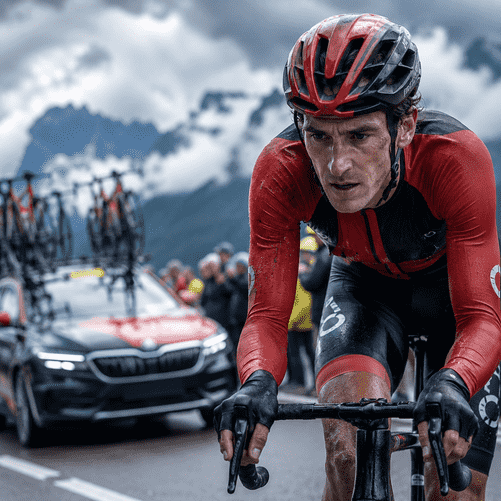
Geraint Thomas’ first Tour in a leadership role ended without a stage win, exposing the scale of the rebuilding job facing a once-dominant team now chasing the sport’s new powers.

For Netcompany Ineos, the 2026 Tour de France was supposed to mark the beginning of a renewed era. Instead, it became a hard lesson in how far the former rulers of the race have fallen behind cycling’s new hierarchy.
The British team arrived at the Tour under a rebranded identity, with fresh ambition and a five-year plan to return to yellow-jersey contention. Geraint Thomas, the 2018 Tour winner, was no longer in the saddle as team leader but in the car as director of racing, charged with guiding a squad that wanted to race aggressively, win stages, and show that Ineos still belonged among the sport’s elite.
By Paris, however, there was little to celebrate. Netcompany Ineos left the race without a stage victory, without a serious general classification challenge, and with a long list of missed opportunities, crashes, mechanical problems, and tactical frustrations. Thomas admitted the team “wanted to get a bit more out of it,” a restrained assessment of three weeks that underlined the difficulty of his new job.
The problems began before the race even started. Oscar Onley, the young Scottish rider signed to give Ineos a new grand-tour future, was ruled out after a crash at the Tour Auvergne-Rhône-Alpes left him with a dislocated shoulder and a knee injury. His absence forced the team to rethink its objectives before the opening stage, abandoning hopes of a meaningful general classification campaign and turning instead toward stage hunting.
That change of plan shaped the entire Tour. Ineos selected a squad built around attacking potential rather than one clear leader, with riders including Thymen Arensman, Egan Bernal, Tobias Foss, Filippo Ganna, Dorian Godon, Michał Kwiatkowski, Josh Tarling, and Kévin Vauquelin. On paper, it was a strong and experienced group. On the road, it never quite converted promise into results.
There were flashes of quality. Ganna, Tarling and Arensman all showed strength in time-trial terrain, while Bernal and Arensman offered glimpses of climbing ability. But the decisive breakthrough never came. Even when the team placed riders in promising positions, the race slipped away through bad luck, miscommunication, stronger rivals, or simply the brutal standard of the modern Tour.
One episode captured the wider frustration. Arensman arrived late for his individual time-trial start after what was described as a communication mishap, yet still produced a strong ride to finish seventh. Thomas said the Dutchman had “got lost in his own world,” praising the performance while acknowledging the avoidable error. It was a small moment, but symbolic: Ineos still had talent, but not the precision that once defined the team.
The contrast with the team’s golden era is stark. Under its previous identities, the squad built a Tour dynasty around Bradley Wiggins, Chris Froome, Thomas and Bernal. It controlled races with discipline, resources and tactical authority. Now, the Tour is dominated by a different kind of power. Tadej Pogačar and UAE Team Emirates have raised the competitive bar, while teams such as Visma-Lease a Bike and Red Bull-Bora-Hansgrohe have become stronger, deeper, and more aggressive.
Ineos is no longer the team everyone else must solve. It is now a team trying to solve itself.
That reality makes Thomas’ transition especially significant. As a rider, he was known for resilience, calm and an ability to absorb pressure. As a director, he is discovering a different kind of stress: shaping tactics, managing morale, judging risk, and rebuilding confidence while the race unfolds at unforgiving speed. He has insisted that the team is still moving in the right direction, but the Tour showed that optimism alone will not close the gap.
Onley remains central to the future. His fourth-place finish at the 2025 Tour de France made him one of Britain’s most exciting grand-tour prospects, and his move to Ineos was seen as a major statement of intent. His injury before this year’s race did not just remove a contender; it exposed the lack of a reliable Plan B for overall classification.
The team’s challenge now is strategic as much as athletic. It must decide whether to build around Onley as a long-term Tour leader, continue chasing stage wins with versatile riders, or make the kind of marquee signing that could immediately restore its status. Missing out on Remco Evenepoel, who instead joined Red Bull-Bora-Hansgrohe and finished second at the Tour, only sharpened the sense that Ineos is no longer the automatic destination for cycling’s biggest stars.
The 2027 Tour de France, with its Grand Départ in Britain, already looms as a major target. For Ineos, it offers both opportunity and pressure: a home-stage platform for a British-backed team trying to prove that its decline is not permanent. Thomas has described that race as a major goal, but this year’s Tour made clear how much work must be done before then.
The misery of 2026 does not mean Ineos is finished. The team still has resources, history, experienced riders, young talent and a leadership figure in Thomas who understands better than most what winning the Tour demands. But the old formula no longer applies. Control has been replaced by chaos, dominance by adaptation, and expectation by uncertainty.
For Geraint Thomas and the rebranded Ineos project, this Tour was not just a disappointment. It was a warning. The road back to the top of cycling will require more than reputation, ambition and nostalgia. It will require a sharper identity, better execution, and a squad capable of surviving the modern Tour at its fastest and most ruthless.