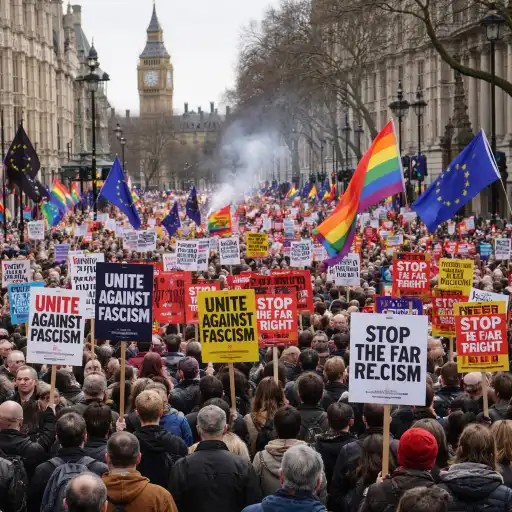
A sweeping wave of demonstrators filled the streets of London in a powerful show of resistance against the rise of far-right politics, marking one of the largest mobilizations of its kind in the United Kingdom’s recent history.
Tens of thousands of people, representing a wide cross-section of society, marched through the capital in a coordinated display of solidarity, signaling a renewed grassroots pushback against extremism.
From early morning, central London transformed into a sea of movement and voices. Protesters gathered in dense crowds, carrying banners, flags, and handmade placards that conveyed a unified message: rejection of intolerance and the normalization of far-right rhetoric. The atmosphere was charged yet largely peaceful, with participants chanting, singing, and engaging in spontaneous speeches as they advanced along key routes.
Organizers reported that nearly five hundred organizations took part in coordinating the demonstration. These included trade unions, community groups, student networks, anti-racism coalitions, and faith-based organizations. The scale of participation reflected a rare convergence of different sectors of civil society, each bringing its own concerns but united by a shared sense of urgency.
The protest did not emerge in isolation. It followed months of growing unease over political developments both within the United Kingdom and across Europe. Analysts have pointed to a steady rise in nationalist rhetoric, anti-immigration sentiment, and the electoral gains of far-right parties in several countries. For many participants, the march represented not only a response to domestic issues but also a statement of solidarity with broader European movements resisting similar trends.
Voices from within the crowd revealed a deep concern about the direction of political discourse. Many protesters expressed fears that extremist ideas, once confined to the margins, are increasingly entering mainstream debates. Others emphasized the importance of defending democratic values, warning that complacency could allow divisive narratives to take root.
At the same time, the demonstration highlighted the enduring strength of grassroots organizing. The ability to mobilize such a large and diverse crowd underscored the capacity of civil society to respond rapidly and effectively to perceived threats. Social media networks, local organizing committees, and long-established advocacy groups all played a role in bringing people together, illustrating how modern protest movements blend traditional activism with digital coordination.
Authorities maintained a visible but restrained presence throughout the march. Police monitored the event closely, facilitating road closures and ensuring that the demonstration proceeded without major disruption. While there were isolated moments of tension at the fringes, the overall tone remained orderly, with organizers repeatedly calling for calm and discipline among participants.
Political reactions to the protest were swift and varied. Some leaders acknowledged the demonstration as a legitimate expression of democratic engagement, emphasizing the right to peaceful assembly. Others, however, cautioned against what they described as growing polarization, arguing that large-scale protests risk deepening divisions rather than fostering dialogue.
Yet for many of those who took part, the very act of gathering was itself a form of dialogue. The march served as a visible reminder that public space remains a critical arena for political expression. In an era increasingly defined by online discourse, the physical presence of tens of thousands of people conveyed a level of commitment that digital activism alone cannot replicate.
Observers noted that the demonstration may signal a broader shift in public sentiment. While far-right movements have gained traction in certain contexts, the scale of the response in London suggests that opposition to such ideologies remains both widespread and deeply rooted. The protest’s organizers framed it as part of an ongoing effort rather than a single event, indicating that further actions are likely in the coming months.
Across Europe, similar mobilizations have begun to take shape, pointing to a transnational pattern of resistance. Activists are increasingly sharing strategies, coordinating messaging, and building alliances that extend beyond national borders. This interconnected approach reflects the recognition that political currents do not stop at geographic boundaries, and that responses must be equally expansive.
The demonstration in London thus stands as both a local and continental moment. It captures a snapshot of a society grappling with competing visions of its future, while also contributing to a wider narrative unfolding across Europe. Whether it marks a turning point or a continuation of an already intensifying trend remains to be seen.
What is clear, however, is that the streets have once again become a focal point for political engagement. In the face of rising tensions and ideological divides, the sight of tens of thousands marching together offers a powerful image of collective action. For supporters, it represents hope and determination. For critics, it raises questions about the path forward.
As the crowds dispersed and the city returned to its routine rhythms, the echoes of the march lingered. The messages carried through London’s avenues are unlikely to fade quickly, as debates over identity, democracy, and the limits of political expression continue to shape the public sphere.
In this context, the demonstration may be remembered not only for its size but for what it reveals about the current moment: a society actively negotiating its values, with citizens willing to step into the streets to make their voices heard.

 The Tower Post