Escalating aerial assaults and shifting ground positions underscore a conflict entering a more volatile and unpredictable phase

As the war between Ukraine and Russia grinds on with no clear resolution in sight, recent developments point to a renewed intensity both on the battlefield and far beyond it. Russian authorities have claimed the capture of another small village in eastern Ukraine, signaling incremental territorial advances, even as Ukraine demonstrates growing capacity to strike targets deep inside Russian territory.
The announcement from Moscow comes amid a broader push along contested frontlines, where Russian forces have been attempting to consolidate gains through sustained pressure rather than rapid breakthroughs. While the strategic value of individual villages remains limited, analysts suggest these movements are part of a larger effort to stretch Ukrainian defenses and exploit vulnerabilities created by months of attritional warfare.
On the same night, Ukraine faced one of the largest waves of aerial attacks in recent weeks. According to Ukrainian military officials, more than two hundred drones were launched across multiple regions, overwhelming air defenses in several areas and leading to civilian casualties. At least five people were reported killed, with damage to residential buildings and infrastructure in multiple cities.
The scale of the assault reflects a growing reliance on drone warfare by both sides. These systems, often cheaper and more difficult to intercept than traditional missiles, have become central to the evolving dynamics of the conflict. For Ukraine, drones serve as both defensive tools and instruments of long-range retaliation. For Russia, they offer a way to maintain pressure on Ukrainian cities and logistics networks while conserving more expensive weaponry.
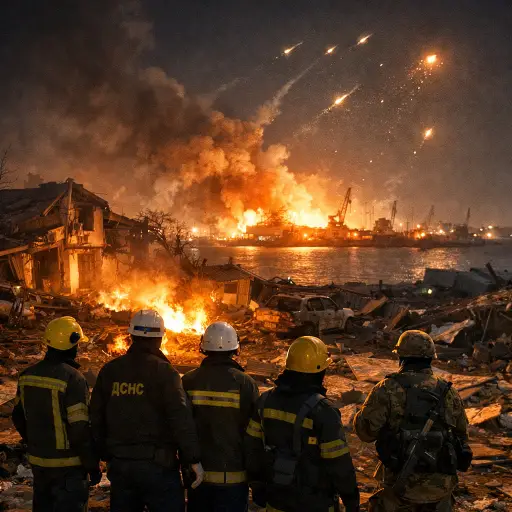
In a parallel development, Ukrainian forces reportedly struck a Russian port facility using drones, triggering explosions and fires visible from surrounding areas. While details remain limited, the incident marks another example of Kyiv’s expanding reach into Russian-controlled or mainland territory. Such strikes are increasingly viewed as part of Ukraine’s strategy to disrupt supply chains, undermine military infrastructure, and shift the psychological balance of the war.
The targeting of ports and logistical hubs carries particular significance. These locations play a critical role in sustaining military operations, facilitating the movement of equipment, fuel, and personnel. By striking them, Ukraine aims not only to inflict material damage but also to complicate Russia’s ability to maintain operational momentum along the frontlines.
Meanwhile, the humanitarian toll continues to mount. The latest drone barrage underscores the persistent vulnerability of civilians, even far from active combat zones. Emergency services across Ukraine have been stretched thin, responding to fires, structural collapses, and casualties in the aftermath of repeated strikes. The psychological strain on the population is also evident, with nightly air raid sirens becoming an enduring feature of daily life.
On the ground, conditions remain harsh and fluid. Soldiers on both sides are operating in increasingly difficult environments, with muddy terrain, damaged infrastructure, and limited visibility shaping engagements. The slow pace of territorial change contrasts with the intensity of combat, as artillery exchanges, drone surveillance, and small-unit assaults dominate the battlefield.
Internationally, the conflict continues to draw close attention, though signs of fatigue are emerging among some of Ukraine’s allies. Discussions around military aid, economic support, and long-term strategy remain ongoing, with debates intensifying over how best to sustain Ukraine’s defense capabilities without escalating the conflict further.
At the same time, diplomatic efforts remain largely stalled. While occasional proposals for negotiations surface, fundamental differences between the parties have prevented any meaningful progress. Both sides appear committed to pursuing their objectives through continued military action, despite the mounting costs.
The latest developments illustrate a war that is not only enduring but evolving. The increasing prominence of drone warfare, the expansion of strike ranges, and the continued contest for even small patches of territory all point to a conflict that is adapting in real time.
For civilians caught in the middle, the consequences are immediate and severe. For military planners, the challenge lies in anticipating the next phase of a war that has repeatedly defied expectations. And for the international community, the question remains how to respond to a conflict that shows little sign of de-escalation.
As both sides continue to test each other’s defenses and resolve, the situation remains precarious. The capture of another village may represent a tactical gain for Russia, but the broader picture is one of ongoing instability, where each development carries implications far beyond the immediate battlefield.
In this evolving landscape, the balance between offense and defense, innovation and endurance, will likely shape the trajectory of the conflict in the months ahead. For now, the war continues to unfold with a relentless rhythm, marked by destruction, resilience, and an uncertain future.