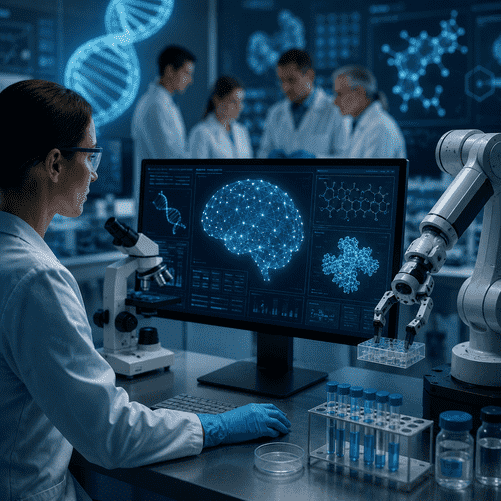
Bristol Myers Squibb and Novo Nordisk are expanding the use of artificial intelligence across drug discovery, clinical data analysis and regulatory filings, signaling a deeper shift in how medicines are developed and brought to market.

Artificial intelligence is moving from the margins of medical innovation into the operating core of the pharmaceutical industry.
In one of the latest signs of this acceleration, Bristol Myers Squibb has announced a partnership with Anthropic to deploy the Claude AI model across its global workforce. The system will be made available to more than 30,000 employees and is expected to support work across drug discovery, research, clinical development and medicine delivery.
The move reflects a broader transformation in pharmaceutical research. For decades, bringing a new drug to market has been one of the most expensive and time-consuming processes in modern science. Researchers must identify biological targets, test compounds, run clinical trials, analyze safety data and prepare extensive regulatory submissions before a medicine can reach patients. AI is now being positioned as a tool to compress parts of that timeline.
Bristol Myers is not alone. Danish drugmaker Novo Nordisk is also using AI to accelerate drug launches, particularly in the fast-growing obesity-treatment market. The company is applying artificial intelligence to regulatory document drafting, safety-data analysis and commercial planning, with the goal of reducing the time between late-stage clinical trials and regulatory filing by several months.
The pharmaceutical industry’s interest in AI has intensified as companies search for faster and more efficient ways to turn scientific discoveries into approved treatments. AI systems can scan large biological datasets, identify patterns in patient responses, assist researchers in selecting promising molecules and help prepare technical documents that once required long manual workflows.
Regulators are also adapting to the shift. The U.S. Food and Drug Administration has acknowledged a significant increase in drug submissions involving AI components across the product life cycle, including nonclinical research, clinical development, manufacturing and post-market monitoring.
For patients, the promise is clear: faster research could mean quicker access to new treatments, especially in areas such as cancer, metabolic disease, rare disorders and autoimmune conditions. For companies, the incentive is equally strong. Shortening development timelines can reduce costs, extend the commercial life of successful medicines and improve competitiveness in crowded therapeutic markets.
But the growing use of AI in medicine also raises difficult questions. Drug development depends on evidence, transparency and patient safety. If AI tools help analyze clinical data or draft regulatory material, companies and regulators must ensure that the results remain explainable, auditable and scientifically reliable. The risk is not simply that AI could make mistakes, but that errors could be hidden inside complex models or accepted too quickly in the race for speed.
The tension is already visible across healthcare. AI is being tested in diagnostics, hospital workflows, medical imaging and even surgical technologies. Supporters argue that it can reduce human error and ease pressure on health systems. Critics warn that medical AI must be held to stricter standards than consumer technology, because failures can affect treatment decisions and patient outcomes.
That is why the latest wave of pharmaceutical AI partnerships marks more than a technological upgrade. It signals a strategic reorganization of medicine itself. Drugmakers are no longer treating AI as a research experiment, but as infrastructure — a layer embedded across laboratories, clinical operations and regulatory departments.
The question now is whether artificial intelligence can deliver on its promise without weakening the safeguards that make modern medicine trustworthy. If it succeeds, the next generation of drugs may arrive faster, backed by deeper data analysis and more efficient development systems. If it fails, the industry could face a new kind of risk: medical decisions shaped by tools that move faster than the institutions meant to govern them.