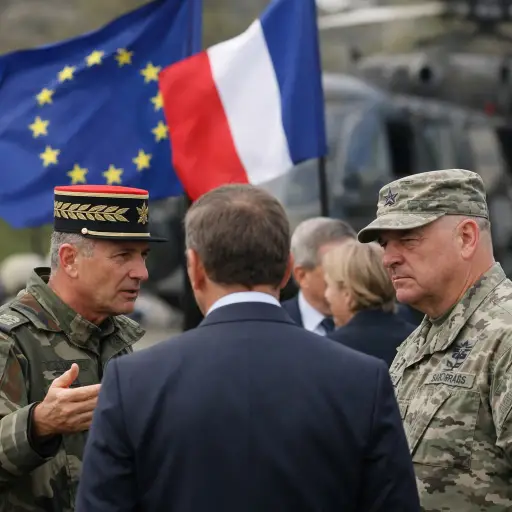
Growing unease over Washington’s shifting military posture pushes Europe toward a more autonomous defense strategy

As geopolitical tensions continue to evolve across multiple regions, France has issued a pointed warning: increasing unpredictability in United States military decision-making is beginning to undermine European security. The message, delivered by senior French military leadership, reflects a broader shift in tone across Europe, where confidence in long-standing transatlantic coordination appears to be eroding.
At the center of the concern is a perceived lack of consistency in Washington’s strategic posture. French defense officials have expressed frustration over what they describe as abrupt or insufficiently coordinated decisions by the United States in key operational theaters. While the transatlantic alliance remains intact, the underlying assumption of seamless cooperation is now being openly questioned.
France’s army chief, speaking in recent briefings, emphasized that European partners are increasingly finding themselves reacting to U.S. moves rather than shaping them collaboratively. This dynamic, he suggested, risks weakening the effectiveness of joint operations and complicates long-term defense planning across the continent.
The issue is not rooted in a single decision or policy shift, but rather in a pattern that European leaders say has become more noticeable over time. From sudden recalibrations in military engagement to shifting priorities in global conflict zones, the United States has demonstrated a level of flexibility that, while strategic in intent, is perceived in Europe as unpredictability.
For European nations—many of which rely heavily on U.S. capabilities within NATO frameworks—this unpredictability introduces a new layer of strategic uncertainty. Defense planners must now account for scenarios in which American support may not align as closely or as quickly as expected. This recalibration is prompting discussions that were once considered politically sensitive: how to ensure European security with greater independence.
France has long been an advocate for strategic autonomy in Europe, and current developments appear to be accelerating that agenda. Officials in Paris are urging European partners to invest more heavily in their own defense infrastructure, enhance joint capabilities, and reduce reliance on external decision-making. The goal is not to replace the transatlantic alliance, but to rebalance it.
Across European capitals, this message is gaining traction. Policymakers are increasingly acknowledging that global security dynamics are shifting, and that Europe must be prepared to act decisively on its own when necessary. This includes not only military readiness but also the ability to coordinate intelligence, logistics, and rapid deployment without overdependence on U.S. leadership.
However, the path toward greater European defense autonomy is complex. It requires significant financial investment, political consensus, and institutional coordination among diverse member states with varying strategic priorities. While some countries strongly support deeper integration, others remain cautious, wary of duplicating existing NATO structures or straining relations with Washington.
Despite these challenges, momentum appears to be building. Recent defense discussions within the European Union have increasingly focused on joint procurement, shared capabilities, and the development of a more cohesive military framework. France, in particular, has positioned itself as a leading voice in shaping this vision, advocating for a Europe that is both a reliable partner to the United States and a capable actor in its own right.
The United States, for its part, continues to emphasize its commitment to European security and the broader alliance. American officials have reiterated the importance of NATO and the enduring strategic partnership with Europe. Yet, the evolving global landscape—marked by multiple simultaneous crises and shifting priorities—means that U.S. attention is often divided, reinforcing European concerns about reliability and focus.
What is emerging is not a rupture, but a recalibration. The transatlantic relationship is entering a new phase, one defined by more assertive European participation and a recognition that shared security responsibilities must be more evenly distributed. France’s warning serves as both a critique and a catalyst, highlighting vulnerabilities while pushing for structural change.
As Europe navigates this transition, the balance between autonomy and alliance will be critical. The challenge lies in strengthening independent capabilities without undermining the collective security framework that has defined the region for decades. Whether this shift ultimately leads to a more resilient and balanced partnership remains to be seen, but one thing is clear: Europe is beginning to rethink its role in its own defense.
In this evolving security environment, predictability is becoming as valuable as power. And for European leaders, ensuring both may require a fundamental redefinition of how security is managed across the Atlantic.