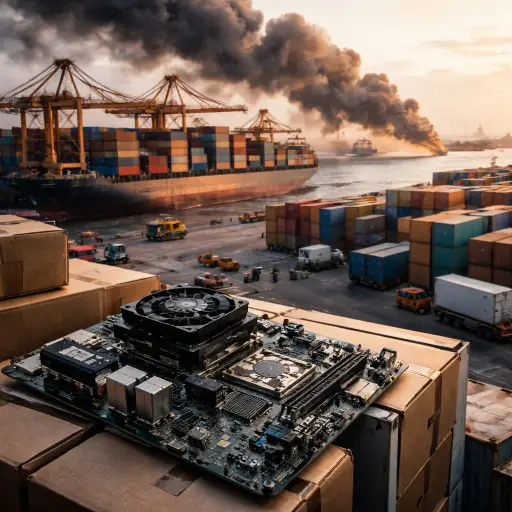
Conflict Disrupts Global Shipping and Semiconductor Flows, Forcing Industry to Brace for Delays and Rising Costs

A renewed wave of geopolitical tension is sending shockwaves through the global technology hardware sector, exposing once again the fragility of supply chains that underpin everything from smartphones to data centers. As shipping lanes face disruption and semiconductor flows tighten, manufacturers are bracing for production slowdowns, logistical bottlenecks, and a likely increase in consumer prices.
At the heart of the issue lies a convergence of risk factors that have steadily intensified. Maritime routes critical to global trade have become increasingly unpredictable, with rerouting, insurance surcharges, and port congestion adding time and cost to already complex logistics networks. For technology companies that rely on tightly synchronized supply chains, even minor disruptions can cascade into significant delays.
Semiconductors remain a focal point of concern. Despite efforts over recent years to diversify manufacturing and reduce dependency on concentrated production hubs, the chip supply chain remains highly sensitive to geopolitical instability. Fabrication plants operate on long lead times and require consistent inputs, meaning that interruptions in raw materials, energy supply, or transportation can ripple across the entire ecosystem.
Industry executives are now recalibrating expectations. Several major hardware manufacturers have indicated that product timelines may slip as component availability becomes less predictable. In some cases, companies are prioritizing high-margin products or scaling back output in lower-demand segments to manage constrained resources more effectively.
Logistics providers are also under pressure. Shipping firms are adjusting routes to avoid high-risk areas, leading to longer transit times and increased fuel costs. Air freight, often used as a fallback for high-value components, has seen rising demand, pushing up rates and further straining supply chains.
The financial implications are beginning to surface. Analysts warn that sustained disruption could lead to a new cycle of cost inflation across the tech sector. While companies absorbed some of the earlier shocks through efficiency gains and inventory strategies, the current environment leaves less room for maneuver. As a result, price increases for consumer electronics, enterprise hardware, and critical infrastructure components are becoming more likely.
Retailers and distributors are already preparing for shifts in demand patterns. Anticipating potential shortages, some are increasing inventory levels where possible, while others are adjusting pricing strategies to reflect higher procurement costs. However, stockpiling carries its own risks, particularly in a market where technology products can quickly become obsolete.
Governments and industry groups are closely monitoring the situation. Efforts to strengthen supply chain resilience, including incentives for domestic manufacturing and regional partnerships, have gained renewed urgency. Yet such measures require time to take effect, and in the near term, companies remain exposed to external shocks.
For consumers, the impact may become visible in subtle ways at first. Longer wait times for certain devices, limited availability of specific models, and gradual price increases could define the coming months. Businesses dependent on hardware upgrades or infrastructure expansion may also face delays that affect broader operational plans.
The current disruption underscores a broader structural challenge for the technology sector. Globalization has enabled unprecedented efficiency and scale, but it has also created dependencies that are difficult to unwind. As companies navigate this evolving landscape, the balance between cost efficiency and resilience is likely to become a defining strategic priority.
In the meantime, the industry is entering a period of heightened uncertainty. With supply chains under strain and no immediate resolution in sight, technology companies are being forced to adapt quickly, reassess risk, and prepare for a more volatile operating environment.