Despite government efforts, the Czech Republic struggles to compete with lower fuel prices in neighboring countries as cross-border refueling patterns shift

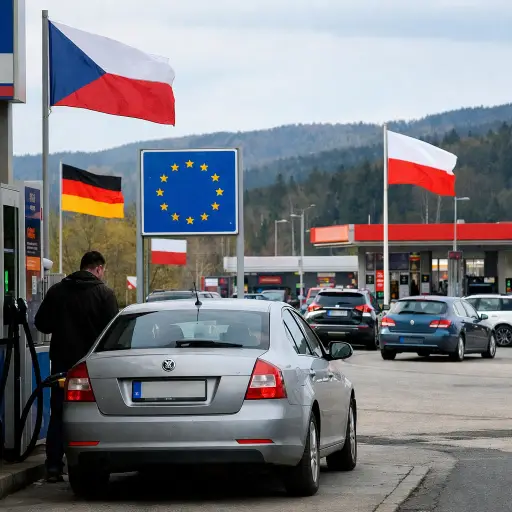
As the spring travel season gathers pace, expectations that cheaper fuel in the Czech Republic would attract drivers from neighboring countries are proving unfounded. Despite measures aimed at easing prices at the pump, motorists from Poland, Slovakia and Germany are largely staying away, guided instead by a simple calculation: fuel remains cheaper at home or just across a different border.
The Czech government’s attempt to make petrol and diesel more affordable was intended not only to ease pressure on domestic consumers but also to encourage cross-border demand. In practice, however, the regional fuel market has moved in a different direction. Price differences, though sometimes modest on paper, are significant enough to influence behavior in border regions where drivers are accustomed to comparing costs across countries.
In northern Bohemia, near the tri-border area where the Czech Republic meets Germany and Poland, the pattern is particularly clear. German drivers, who once routinely crossed into Czech territory to fill their tanks, are now bypassing local stations in favor of Polish pumps. The shift is visible in reduced traffic at Czech filling stations and longer queues just a few kilometers away across the Polish border.
For many drivers, the decision is purely economic. Even small per-liter savings accumulate quickly for regular commuters or long-distance travelers. With fuel prices in Poland and Slovakia often undercutting those in the Czech Republic, the incentive to travel slightly farther for a cheaper refill remains strong.
Station operators in Czech border regions say the change has been gradual but noticeable. While domestic demand has remained relatively stable, the expected influx of foreign drivers has not materialized. Some operators report that foreign license plates are now less frequent than in previous years, particularly those from Germany.
The reasons behind the price gap are complex. Tax policies, currency differences and supply chain dynamics all play a role in shaping final retail prices. While the Czech government has taken steps to reduce the burden on consumers, neighboring countries have either maintained lower baseline costs or introduced their own measures that keep prices competitive.
In Slovakia, for example, a combination of market conditions and policy decisions has helped keep fuel prices relatively low. Poland, meanwhile, continues to benefit from pricing strategies that make it one of the more attractive destinations for motorists seeking cheaper petrol and diesel in Central Europe.
German drivers, facing higher domestic fuel costs, remain highly sensitive to price differences. Yet rather than turning south into the Czech Republic, many in the northern regions are opting to head east into Poland, where savings are often greater. The result is a redirection of cross-border fuel tourism that leaves Czech stations at a disadvantage.
The broader implications extend beyond individual drivers. Fuel stations in border areas rely heavily on cross-border traffic, and reduced foreign demand can impact revenues, staffing and long-term viability. Local economies, particularly in smaller towns near the borders, may also feel the effects as fewer visitors stop to refuel and make additional purchases.
For Czech policymakers, the situation highlights the limits of national measures in a tightly interconnected regional market. Even well-intentioned interventions can be offset by conditions beyond national control. As long as neighboring countries maintain lower prices, the Czech Republic faces an uphill battle in attracting foreign motorists.
Looking ahead, the dynamics of cross-border fuel purchasing are unlikely to change dramatically in the near term. Drivers remain pragmatic, willing to adjust routes and routines for even modest savings. Unless price differences narrow significantly, the flow of motorists will continue to favor the most economical option, regardless of national boundaries.
In the meantime, Czech drivers themselves are becoming more aware of regional price disparities. For those living near borders, refueling abroad is increasingly seen as a practical choice rather than an occasional convenience. What began as a strategy to attract foreign customers may ultimately encourage more domestic drivers to look beyond their own borders.
The result is a paradox for the Czech fuel market: efforts to make fuel cheaper at home have not translated into greater foreign demand, while simultaneously reinforcing the habit of cross-border comparison. In a region where distances are short and price awareness is high, the competition for drivers’ wallets remains intense.