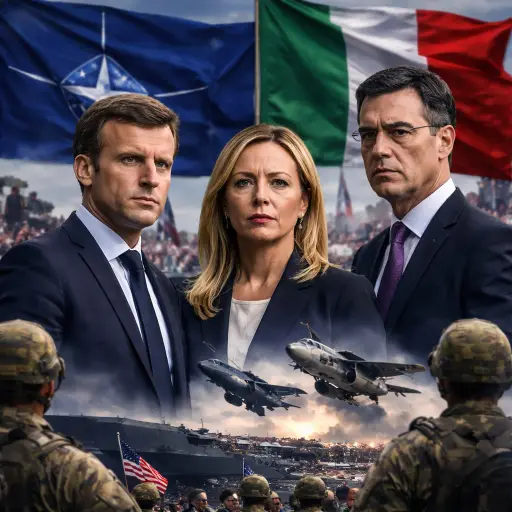
Key European allies reject U.S. military requests, signaling a decisive shift toward strategic independence and raising questions about the future of transatlantic defense cooperation

A widening rift between the United States and its European allies has come sharply into focus as tensions surrounding Iran escalate, revealing deep fractures within NATO that had long been simmering beneath the surface. In a move that underscores a growing divergence in strategic priorities, several leading European powers have refused U.S. requests to utilize their military bases and airspace for operations linked to a potential confrontation with Tehran.
The decisions by France, Italy, and Spain mark a significant departure from the traditional alignment that has defined NATO’s posture for decades. While Washington has sought to consolidate allied support in response to rising instability in the Middle East, European leaders have instead emphasized restraint, diplomacy, and a recalibration of their security commitments.
At the heart of the disagreement lies a fundamental difference in how the transatlantic partners perceive both the immediacy of the threat and the appropriate response. U.S. officials have framed the situation as requiring rapid and coordinated military readiness, citing concerns over regional security and deterrence. European governments, however, have expressed skepticism about the effectiveness and risks of further militarization, warning that such actions could trigger unintended escalation.
France has taken one of the most assertive positions, reaffirming its long-standing commitment to strategic autonomy. Officials in Paris have made clear that French territory and infrastructure will not be used to facilitate operations that could deepen the crisis. The stance reflects a broader doctrine that prioritizes independent decision-making in defense and foreign policy, even within the framework of alliance obligations.
Italy has followed a similarly cautious path. While maintaining its role as a key NATO member, Rome has signaled reluctance to become directly entangled in a conflict that it views as both geographically distant and politically complex. Italian policymakers have stressed the importance of diplomatic engagement and have called for renewed efforts to revive multilateral negotiations with Iran.
Spain has also aligned with this approach, declining to grant access to its bases for potential U.S. operations. Spanish leaders have highlighted domestic concerns, including public opposition to military involvement, as well as the broader implications for regional stability. Madrid’s position reinforces a growing consensus among parts of Europe that the costs of intervention may outweigh the perceived benefits.
The implications of these decisions extend far beyond the immediate crisis. Analysts note that the refusal to support U.S. operational requests represents one of the clearest signs in recent years of a shifting balance within NATO. The alliance, long anchored by a shared commitment to collective defense, now faces a more fragmented landscape in which national interests increasingly shape policy choices.
This divergence is not entirely new, but it has become more pronounced in the current context. Previous disagreements over defense spending, strategic priorities, and global engagement have hinted at underlying tensions. The present situation, however, brings those tensions into stark relief, raising questions about the alliance’s cohesion in moments of crisis.
For Washington, the lack of European backing complicates both logistical planning and broader strategic calculations. Access to bases and airspace in Europe has historically been a cornerstone of U.S. military operations, enabling rapid deployment and sustained presence. The absence of such support may require a reassessment of operational frameworks and a search for alternative arrangements.
For Europe, the stance reflects a broader effort to assert greater control over its foreign policy direction. The concept of strategic autonomy, once viewed as aspirational, is increasingly being translated into concrete decisions. By resisting U.S. pressure, European leaders are signaling a willingness to prioritize their own assessments and to navigate complex geopolitical challenges on their own terms.
At the same time, the situation exposes the delicate balance that NATO must maintain between unity and diversity. While the alliance has always accommodated differing perspectives among its members, the current divide raises concerns about its ability to act cohesively when faced with urgent security challenges.
Diplomatic efforts are ongoing, with both sides seeking to prevent the disagreement from escalating into a broader rupture. Officials have emphasized the enduring importance of transatlantic cooperation and the shared values that underpin the alliance. Yet the reality of diverging strategies suggests that NATO is entering a new phase, one characterized by greater complexity and less automatic alignment.
As the crisis evolves, the decisions made by European nations will continue to shape not only the immediate response to Iran but also the future trajectory of NATO itself. Whether the alliance can adapt to these shifting dynamics without losing its core sense of purpose remains an open question.
What is clear is that the era of unquestioned unity is giving way to a more nuanced and, at times, uncertain partnership. In this emerging landscape, the ability of allies to reconcile their differences while maintaining collective strength will be a defining test of NATO’s resilience.