European Leaders Reject U.S.-Led Military Action as NATO Unity Faces Renewed Strain

A widening divide between the United States and its European allies is exposing fresh fractures within the transatlantic alliance, as key European governments refuse to align with Washington’s increasingly assertive posture toward Iran.
In recent days, senior officials across Europe have made clear that they will not participate in any U.S.-led military action targeting Iran, signaling a decisive shift away from the coordinated responses that once defined NATO’s strategic posture. The divergence is not merely rhetorical. It has begun to manifest in concrete policy decisions that underscore a growing reluctance among European capitals to be drawn into another Middle Eastern conflict.
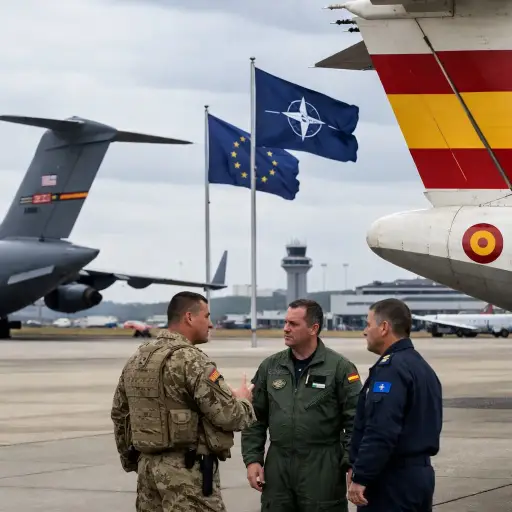
Spain has emerged as one of the most visible symbols of this resistance. In a move that has reverberated across diplomatic channels, Madrid has denied authorization for certain U.S. military flights to transit its airspace when linked to potential operations in the region. The decision, while framed as a matter of national sovereignty and legal caution, has been interpreted in Washington as a pointed political signal.
European leaders argue that the current trajectory risks escalating an already volatile regional situation without a clear strategic endgame. Officials in Berlin, Paris, and Brussels have emphasized the importance of de-escalation, diplomacy, and renewed engagement with Tehran, rather than military confrontation. Behind closed doors, diplomats express concern that unilateral action could undermine long-term stability and further strain already fragile international frameworks.
The disagreement reflects deeper philosophical differences that have been building over time. While the United States continues to prioritize deterrence and military readiness, many European governments are increasingly focused on conflict prevention and multilateral negotiation. These contrasting approaches have been sharpened by recent geopolitical developments, including ongoing tensions in Eastern Europe and shifting security priorities within the European Union.
At the heart of the dispute lies a broader question about the future of NATO and the cohesion of Western alliances. For decades, the alliance has relied on a shared perception of threats and a willingness to act collectively. The current impasse, however, suggests that consensus can no longer be taken for granted.
Analysts note that public opinion within Europe also plays a significant role. War fatigue, economic pressures, and political fragmentation have made governments more cautious about committing to overseas military engagements. Leaders are acutely aware that domestic support for such actions is limited, particularly in the absence of a direct and immediate threat.
Washington, for its part, has expressed frustration with what it perceives as a lack of solidarity. U.S. officials argue that Iran’s activities warrant a firm and coordinated response, and they have urged allies to uphold their commitments within the alliance. Yet the response from Europe indicates that traditional expectations of alignment are being reassessed.
The implications extend beyond the immediate crisis. A prolonged rift could weaken NATO’s ability to respond effectively to future challenges and embolden adversaries seeking to exploit divisions within the alliance. It may also accelerate ongoing debates within Europe about strategic autonomy and the need for independent defense capabilities.
Despite the tensions, diplomatic channels remain open. Efforts are underway to bridge differences and find common ground, though expectations for a unified position appear limited in the near term. The situation underscores the complexity of maintaining alliance cohesion in an era marked by diverging priorities and shifting geopolitical realities.
As the crisis unfolds, the transatlantic relationship faces a critical test. Whether it can adapt to these new dynamics without compromising its core principles will shape the future of Western cooperation in an increasingly uncertain world.