More than a century after Les Demoiselles d’Avignon scandalized modern art, American artist Henry Taylor has reimagined the work — forcing a new conversation about beauty, violence, race and artistic inheritance.

Few paintings in modern art have provoked as much discomfort as Pablo Picasso’s Les Demoiselles d’Avignon. Created in 1907, the work broke violently with traditional ideas of beauty, perspective and the female body. Its sharp angles, fractured faces and confrontational gaze shocked even Picasso’s closest artistic circle and helped open the path toward Cubism.
Now, more than a century later, the painting’s legacy is being challenged again — this time through the work of acclaimed American artist Henry Taylor, whose reinterpretation stands at the center of a major exhibition at the Musée Picasso in Paris.
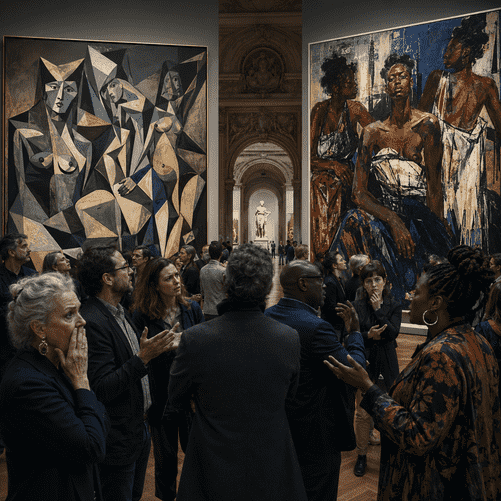
Taylor’s painting, From Congo to the Capitol, and black again, was created in 2007 after his first visit to Paris. The work directly echoes Picasso’s Les Demoiselles d’Avignon, but reverses some of its historical weight. Picasso’s original drew partly on African sculpture, using its forms to transform European painting. Taylor’s version brings Black figures back into the image, turning the painting into a conversation about influence, appropriation and who gets to control the visual language of modern art.
The Musée Picasso exhibition, Henry Taylor: Where Thoughts Provoke, runs from 8 April to 6 September 2026 and marks the artist’s first major retrospective in France. Spread across two floors and thirteen rooms, it brings together about 100 works, including paintings, sculptures and installations.
For the museum, Taylor is not simply responding to Picasso; he is confronting him. His reinterpretation does not reject the Spanish master’s importance, but it refuses to treat him as untouchable. Instead, Taylor places Picasso inside a broader story of Black experience, American history and the unresolved relationship between European modernism and African visual culture.
That makes the exhibition especially charged. Les Demoiselles d’Avignon has always been a painting people argued over. When it was first seen by Picasso’s friends, many found it ugly, aggressive or incomprehensible. Its five female figures were not idealized or passive. They stared back at the viewer with hard, mask-like faces and distorted bodies. What later generations celebrated as revolutionary was initially experienced by many as a visual assault.
The controversy has never fully disappeared. Today, the painting is no longer shocking only because of its style. It also raises questions about gender, power and cultural borrowing. Picasso used African-inspired forms to break European art apart, but the women in the image remain anonymous, objectified and exposed. Taylor’s version revisits that unresolved tension from a different position, asking what happens when the subjects of modernism’s borrowed language are no longer silent.
Taylor, born in California in 1958, has built a career around portraits and scenes that combine intimacy with political force. His work often portrays friends, family, strangers, public figures and victims of racial violence, using a direct style that can appear spontaneous while carrying deep emotional and historical weight. The Paris retrospective presents him as a major contemporary painter whose work moves between personal memory, social critique and art history.
By placing Taylor inside the Musée Picasso, the exhibition turns the museum itself into part of the argument. It asks whether Picasso’s legacy should be preserved as a monument or reopened as a living field of debate. Taylor’s answer seems clear: the past is not fixed. It can be admired, challenged, corrected and reimagined.
That is why Les Demoiselles d’Avignon continues to matter. Its power lies not only in what it changed in 1907, but in the disputes it still creates today. The painting remains beautiful to some, hideous to others, and troubling to many. Taylor’s response does not resolve that contradiction. It intensifies it.
In Paris, Picasso’s most shocking painting is not simply being remembered. It is being questioned — and through Henry Taylor’s eyes, its unfinished history is being made visible again.