US Allies Under Fire as Trump Accuses EU Nations of Undermining Western Unity

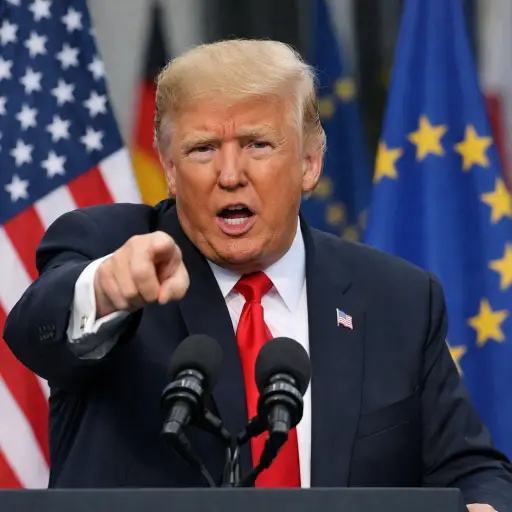
In a sharply worded public address that is already reverberating across diplomatic circles, Donald Trump has launched a forceful critique of European governments, accusing them of failing to support United States military efforts during a moment of heightened global tension. His remarks have reignited longstanding debates over burden-sharing, alliance loyalty, and the future cohesion of the Western bloc.
Speaking before a domestic audience but clearly aiming his message across the Atlantic, Trump argued that European nations have grown complacent in their reliance on American defense commitments while resisting calls for deeper military involvement in a conflict that Washington considers strategically critical. He framed the issue not only as a matter of policy disagreement, but as a fundamental test of alliance credibility.
According to Trump, the refusal of several European Union member states to commit troops or expand direct military engagement reflects what he described as a “one-sided partnership,” in which the United States bears disproportionate risk and responsibility. He questioned whether traditional alliances still function as intended, suggesting that the current imbalance undermines both deterrence and trust.
The reaction from European capitals has been swift but measured. Officials across the continent have reiterated their commitment to collective security while emphasizing the importance of strategic restraint. Several leaders have pointed to ongoing diplomatic and humanitarian contributions, arguing that military escalation is not the only or most effective path toward stability.
Behind the scenes, European policymakers express concern that Trump’s rhetoric risks oversimplifying a complex geopolitical landscape. Many argue that domestic political constraints, economic considerations, and differing threat assessments shape their decisions. Publicly, however, leaders have avoided direct confrontation, instead stressing unity and the need for continued dialogue.
The dispute highlights deeper structural tensions within the transatlantic alliance. For years, Washington has urged European partners to increase defense spending and take on greater responsibility for regional security. While some progress has been made, disagreements persist over how and when to deploy military force, particularly in conflicts with global implications.
Trump’s remarks have also intensified political divisions within Europe itself. In several countries, nationalist and populist factions have seized on the comments to argue against deeper integration with US-led strategies. These groups often advocate for greater strategic autonomy, warning that alignment with Washington could draw Europe into conflicts that do not directly serve its interests.
At the same time, more traditional Atlanticist voices caution that weakening ties with the United States could have long-term consequences for European security. They argue that despite disagreements, the alliance remains a cornerstone of stability, and that public disputes risk emboldening adversaries.
In Washington, reactions have been mixed. Some policymakers have echoed Trump’s concerns, emphasizing the need for more equitable burden-sharing among allies. Others worry that the tone and timing of his statements could complicate ongoing diplomatic efforts and strain relationships at a critical juncture.
Military analysts note that alliance cohesion often depends as much on perception as on capability. Public criticism between partners can create uncertainty, potentially affecting coordination and long-term planning. In this context, Trump’s intervention is seen not only as a political statement but as a factor that could influence strategic calculations on multiple sides.
The broader implications of the dispute remain uncertain. While disagreements within alliances are not new, the current exchange underscores the fragility of consensus in an increasingly multipolar world. As global tensions continue to evolve, the ability of Western nations to maintain a unified approach may prove decisive.
For now, both sides appear to be navigating a delicate balance between asserting their positions and preserving the underlying partnership. Whether this episode leads to renewed negotiations, deeper divisions, or a recalibration of roles within the alliance will likely become clearer in the weeks ahead.
What is already evident, however, is that the debate over responsibility, sovereignty, and strategic priorities is far from settled—and that voices on both sides of the Atlantic are preparing for a prolonged and consequential conversation.