A proposal calling for professional attire, neat facial hair and closed-toe shoes exposed a familiar tension inside the Libertarian Party: how to look serious without telling people what to do.

The Libertarian National Convention was supposed to be a gathering about party leadership, platform reforms and the future direction of America’s most prominent third party. Instead, one of the loudest disputes began with a question that sounded almost absurdly simple: should delegates be required to dress professionally?
A proposal to mandate business-casual attire, neat facial hair and closed-toe shoes at the convention triggered a fierce internal debate, according to reporting by The Wall Street Journal. The dispute quickly became more than a fight over shirts, shoes or grooming. It became a miniature ideological war over authority, image and the limits of personal freedom inside a party built on resistance to rules.
The 2026 Libertarian National Convention is taking place in Grand Rapids, Michigan, from May 21 to May 25, with delegates gathering to elect members of the Libertarian National Committee and vote on party business. The official convention site describes the event as the party’s major biennial national gathering, while state Libertarian organizations have framed it as a crucial moment for deciding the party’s future direction.
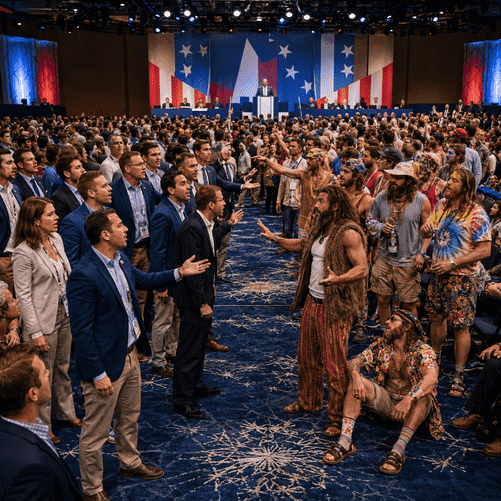
The dress-code proposal reportedly came from Ben Weir, a 36-year-old libertarian from New Hampshire, who urged the party’s national committee to adopt what he called a basic professional standard for official proceedings. His concern was that the party’s public image had become too chaotic, too unserious and too easy for critics to mock. In one widely shared description of the debate, past convention scenes were recalled as a “sartorial freak show,” including attendees in unusual costumes or provocative outfits.
For supporters of the proposal, the issue was not fashion. It was credibility. They argued that a political party seeking influence in national life cannot afford to look like a permanent protest movement. In their view, professional dress would help the Libertarian Party present itself as a serious political organization capable of winning offices, attracting donors and speaking to voters beyond its activist base.
But for many libertarians, the proposal sounded like everything the party exists to oppose. A mandatory dress code, even a mild one, was seen as an unnecessary rule imposed by party insiders on free individuals. The backlash was predictable but intense: in a movement where personal autonomy is not merely a preference but a governing principle, telling adults what shoes to wear became a symbolic violation.
That is why the controversy spread so quickly. The party’s internal critics saw the dress-code plan as a contradiction: a libertarian organization attempting to regulate personal expression in the name of professionalism. The conflict turned business casual into a philosophical test.
The episode also revealed a deeper divide inside the Libertarian Party. One side wants the party to become more disciplined, electable and respectable to mainstream voters. The other side fears that respectability politics will dilute the party’s identity and turn libertarianism into just another managed political brand.
This tension is not new. Libertarian conventions have long mixed serious policy debate with theatrical expressions of individualism. The party has historically attracted fiscal conservatives, anti-war activists, cryptocurrency advocates, civil-liberties campaigners, radical decentralists and eccentric political outsiders. That diversity is part of its energy, but also part of its difficulty.
The dress-code argument therefore became a proxy battle over what kind of party libertarians want to be. Is the party a vehicle for governing, requiring discipline and public credibility? Or is it a movement of radical individual freedom, where even looking strange is part of the message?
The stakes are larger than they appear. Third parties in the United States already face enormous structural obstacles, from ballot-access fights to limited media attention and a winner-take-all electoral system. For the Libertarian Party, public perception matters. A convention that looks disorderly can reinforce stereotypes that libertarians are more interested in rebellion than governance.
At the same time, imposing conformity risks alienating the very activists who sustain the party. Libertarian politics depends heavily on volunteers, delegates and long-time members who value the party precisely because it does not resemble the polished machinery of Republicans or Democrats.
That contradiction explains why a debate over closed-toe shoes could become so explosive. The proposal touched the nerve center of libertarian identity: the tension between freedom and organization.
The party’s official messaging describes libertarianism as centered on personal liberty, responsibility and opportunity. It calls itself “The Party of Principle,” a phrase that makes internal disputes over rules especially charged. If the principle is maximum individual freedom, even a dress code can become a philosophical problem.
The Grand Rapids convention is also taking place two years after the 2024 Libertarian National Convention in Washington, D.C., where Donald Trump’s appearance produced a raucous response of boos, cheers and heckling. That event showed how fiercely independent and unpredictable Libertarian audiences can be, even when major national figures try to court them.
In that context, the business-casual uproar is not just comic relief. It is a revealing political moment. The Libertarian Party wants to be taken seriously, but it also wants to remain defiantly anti-authoritarian. It wants order without control, credibility without conformity and a national profile without sacrificing its countercultural edge.
That is a difficult balance for any political movement. For libertarians, it may be the central challenge.
The dress-code proposal may fade after the convention, but the argument behind it will remain. Every political party must eventually decide how much discipline it is willing to impose in pursuit of power. For the Libertarian Party, even that question can feel like a betrayal.
In the end, business casual did not simply “blow up” the convention because people disagreed about clothing. It blew up because the proposal forced libertarians to confront an uncomfortable truth: even a party devoted to freedom must decide whether it wants to look like a movement, a protest — or a government-in-waiting.