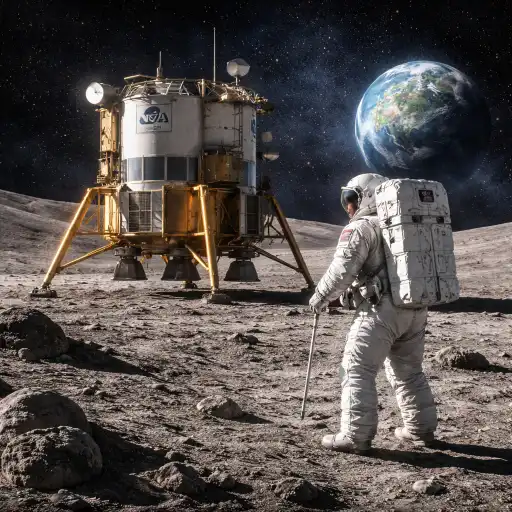
A renewed push to the lunar surface highlights strategic urgency and international collaboration in a new era of space exploration

As momentum builds in the global race to return humans to the Moon, NASA is reaffirming its commitment to the Artemis program, signaling steady progress despite earlier technical and scheduling challenges. The initiative, widely seen as the cornerstone of the United States’ deep-space ambitions, is now entering a decisive phase as geopolitical competition intensifies and international partnerships deepen.
Officials have emphasized that while setbacks have reshaped aspects of the timeline, the broader mission remains firmly on track. Artemis is designed not only to land astronauts on the lunar surface again, but also to establish a sustained human presence that could serve as a stepping stone toward future missions to Mars. The stakes are high, both scientifically and politically.
At the heart of the urgency lies a growing sense of competition, particularly with China’s advancing lunar plans. Beijing has accelerated its own efforts to land astronauts on the Moon, positioning its program as a symbol of technological leadership and national prestige. This parallel trajectory has injected a renewed sense of purpose into NASA’s roadmap, with officials keen to ensure that Artemis achieves its milestones ahead of rival missions.
Despite the pressure, NASA leaders have sought to strike a balance between ambition and caution. Recent updates point to continued testing and refinement of critical systems, including the spacecraft and lunar landing technologies that will be central to crewed missions. Engineers are focusing on ensuring reliability and safety, lessons underscored by past delays that were often tied to the complexity of integrating new systems.
One of the defining features of Artemis is its collaborative framework. The program is not solely an American endeavor, but a multinational effort that brings together expertise and resources from across the globe. Among the most significant contributors is the European Space Agency, whose role has become increasingly prominent in recent developments.
European engineers are deeply involved in the construction of key modules that will support both lunar orbit operations and surface missions. Their work includes vital components for habitation and service systems, underscoring Europe’s growing influence in human spaceflight. This partnership reflects a broader shift in how space exploration is conducted, moving away from isolated national programs toward shared ventures with distributed responsibilities.
The collaboration also carries symbolic weight. By integrating international partners into the architecture of Artemis, NASA is reinforcing a model of cooperation that contrasts with the more unilateral approaches seen elsewhere. This dynamic has implications beyond engineering, shaping alliances and reinforcing diplomatic ties in an era where space is increasingly viewed as a strategic domain.
On the technical front, progress has been described as steady, if measured. Recent testing milestones have demonstrated improvements in launch systems and mission integration, while ongoing work on lunar landers continues to refine capabilities for sustained surface operations. The goal is not merely to replicate past achievements, but to expand them—enabling longer stays, more complex experiments, and the gradual development of infrastructure that could support future crews.
Industry partners are also playing a critical role, contributing innovations in propulsion, landing systems, and mission logistics. This public-private collaboration has introduced new efficiencies, but it has also added layers of coordination that require careful management. NASA officials have acknowledged these challenges while expressing confidence in the program’s trajectory.
Meanwhile, the broader context of space exploration is evolving rapidly. Advances in technology, coupled with increased investment from both governments and private entities, are reshaping what is possible. The Moon, once a distant and symbolic target, is now being reimagined as a hub for scientific discovery and a proving ground for technologies that will enable deeper exploration of the solar system.
For NASA, Artemis represents more than a return to the lunar surface. It is a statement of intent in a new space age—one defined by competition, collaboration, and the pursuit of long-term presence beyond Earth. As the program moves forward, each milestone carries both technical significance and geopolitical resonance.
With rival missions advancing and partnerships strengthening, the coming period is set to be pivotal. The success of Artemis will depend not only on engineering precision, but also on the ability to navigate a complex landscape of international cooperation and strategic competition. In that balance, the future of human exploration beyond Earth is taking shape.