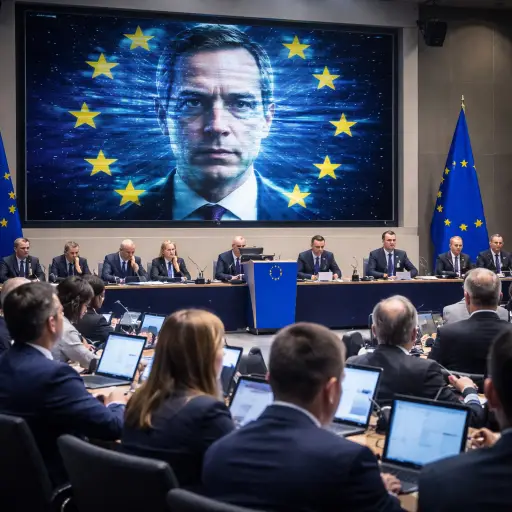
Brussels seeks to safeguard elections and public trust as AI-driven misinformation accelerates, but critics warn of unintended consequences for innovation

As Europe approaches a new electoral cycle, policymakers in Brussels are intensifying efforts to confront one of the most disruptive byproducts of artificial intelligence: deepfakes. The European Union is advancing a proposal that would restrict the use of AI-generated images, audio, and video in official government communications, a move designed to reinforce public trust at a time when misinformation risks are escalating rapidly.
The initiative reflects growing alarm among European institutions over the capacity of synthetic media to distort political reality. Deepfakes—hyper-realistic but fabricated digital content—have evolved from a niche technological curiosity into a potent tool capable of influencing public opinion, undermining democratic processes, and eroding confidence in institutions.
Under the emerging framework, EU institutions and member state governments would be prohibited from using AI-generated or heavily manipulated audiovisual content in official messaging, unless it is clearly labeled and meets strict transparency requirements. The goal is not only to prevent intentional deception but also to eliminate ambiguity in public communications, ensuring that citizens can trust what they see and hear from their leaders.
Officials involved in the discussions describe the proposal as a preemptive safeguard rather than a reaction to a specific incident. However, the urgency is unmistakable. Across Europe, concerns have mounted over the potential for deepfakes to be deployed during election campaigns, particularly through social media platforms where content can spread rapidly and verification often lags behind virality.
“Trust is the foundation of democratic governance,” one senior EU policymaker said in a recent briefing. “If citizens begin to question whether official messages are authentic, the consequences could be profound.”
The proposal builds on the EU’s broader regulatory push in the field of artificial intelligence, which has already positioned the bloc as a global leader in tech governance. Yet this latest effort moves into more sensitive territory, targeting not private actors or platforms, but governments themselves.
That distinction has sparked an intense debate within policy circles, academia, and the technology sector. Supporters argue that public institutions must hold themselves to the highest standard, especially when the tools of manipulation are becoming more accessible and sophisticated.
Critics, however, warn that overly rigid rules could hinder legitimate uses of AI in public communication. From automated translation and accessibility tools to educational simulations and crisis-response messaging, AI-generated content can serve valuable functions. Drawing a clear line between acceptable and prohibited uses, they argue, may prove more complex than regulators anticipate.
“There is a real risk of throwing out the benefits along with the harms,” said one digital policy analyst. “Innovation in public services often depends on precisely these kinds of technologies.”
At the heart of the debate is a broader question about how democracies should adapt to an era in which seeing is no longer believing. Deepfakes challenge long-standing assumptions about evidence and authenticity, forcing institutions to rethink not only their communication strategies but also their relationship with the public.
The EU’s approach emphasizes transparency as a guiding principle. Rather than banning synthetic media outright, the proposal seeks to establish clear boundaries and disclosure obligations. In practice, this could mean mandatory labeling of AI-generated content, detailed records of how official media is produced, and independent oversight mechanisms to ensure compliance.
Enforcement, however, remains a significant challenge. Monitoring the use of AI tools across multiple layers of government—each with its own communication channels and practices—will require substantial coordination. Questions also persist about how the rules would apply in fast-moving situations, such as public emergencies, where speed can be critical.
Beyond Europe, the initiative is being closely watched by governments around the world. As deepfake technology continues to advance, the pressure to develop effective regulatory responses is mounting globally. The EU’s proposal could set a precedent, shaping how other democracies address the intersection of AI, information integrity, and public trust.
For now, the outcome of the debate remains uncertain. Negotiations are ongoing, and the final shape of the regulation is likely to evolve as lawmakers weigh competing priorities. What is clear, however, is that the issue is no longer theoretical.
In an age where digital content can be generated, altered, and disseminated with unprecedented ease, the line between reality and fabrication is increasingly fragile. By moving to restrict deepfakes in official communications, the European Union is attempting to reinforce that line—before it disappears altogether.