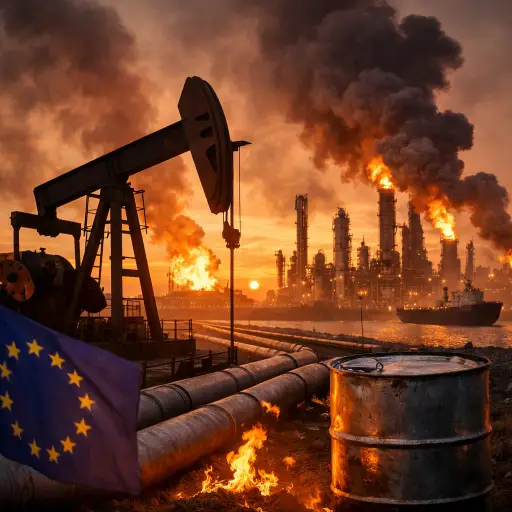
IEA warns supply disruptions could surpass historic crises, putting Europe on edge amid inflation and recession risks

A growing sense of unease is spreading across global energy markets as mounting tensions in the Middle East raise the specter of a major oil supply disruption—one that could rival or even exceed the shocks of previous decades. The International Energy Agency has issued a stark warning: the scale of potential supply losses could outstrip those seen during the most severe oil crises of the past century, with far-reaching consequences for economies already navigating fragile recoveries.
The warning comes at a time when global markets remain highly sensitive to geopolitical instability. Key transit routes and production hubs in the Middle East—responsible for a significant share of the world’s crude exports—have become increasingly vulnerable. Analysts note that even partial disruptions in these regions can trigger outsized reactions in oil prices, as traders factor in worst-case scenarios and the limited availability of spare production capacity elsewhere.
Unlike past crises, the current situation is unfolding against a backdrop of structural tightness in energy supply. Years of underinvestment in upstream oil production, combined with the uneven pace of the energy transition, have left markets with thinner buffers. Strategic reserves, while still substantial in some regions, have been drawn down in recent years and may not provide the same level of shock absorption as in previous emergencies.
Europe appears particularly exposed. Still heavily reliant on imported energy despite efforts to diversify supply sources, the region faces the dual threat of surging fuel costs and weakening economic momentum. A sharp rise in oil prices would quickly feed into transport and manufacturing costs, amplifying inflationary pressures that policymakers have struggled to contain.
Economists warn that the transmission mechanism could be swift and severe. Higher energy prices tend to act as a tax on consumers, reducing disposable income and dampening demand across sectors. For industries already grappling with elevated borrowing costs, the added burden of expensive energy could accelerate a slowdown, tipping vulnerable economies toward recession.
The memory of past oil shocks looms large. In earlier crises, sudden supply disruptions led to prolonged periods of stagflation—an unwelcome combination of stagnant growth and rising prices. While the global economy has evolved since then, many of the underlying dynamics remain unchanged. Energy remains a foundational input, and sharp price swings continue to reverberate through supply chains.
Policymakers across Europe are now facing difficult choices. Central banks, tasked with maintaining price stability, may find themselves constrained if inflation resurges due to external energy shocks. At the same time, governments could come under pressure to shield households and businesses from rising costs, potentially through subsidies or tax relief—measures that carry fiscal implications.
There are also concerns about market psychology. In times of uncertainty, expectations can become self-reinforcing. If businesses and consumers begin to anticipate sustained high energy prices, they may adjust behavior in ways that further entrench inflation. Wage demands could rise, pricing strategies could shift, and investment decisions could be delayed, compounding the economic impact.
Energy companies and traders are closely monitoring developments, but visibility remains limited. The complexity of the geopolitical landscape means that risks can escalate quickly and unpredictably. Even in the absence of a full-scale disruption, the mere threat of supply constraints can keep markets volatile.
Some analysts argue that the situation underscores the urgency of accelerating the energy transition. Expanding renewable capacity, improving energy efficiency, and reducing dependence on imported fossil fuels are seen as critical steps toward enhancing resilience. However, such changes take time, and in the near term, oil remains deeply embedded in the global economic system.
For now, the outlook is defined by uncertainty. The International Energy Agency has urged governments to remain vigilant and prepared to respond swiftly should disruptions materialize. Coordination among major economies, including the potential release of strategic reserves, could help mitigate immediate impacts, but would not eliminate the underlying vulnerability.
As markets brace for potential turbulence, the stakes are high. A significant oil shock would not only test the resilience of the global economy but also reshape the policy landscape, forcing governments and institutions to confront difficult trade-offs in real time. In Europe, where economic recovery remains uneven, the margin for error is particularly narrow.
The coming period may prove decisive. Whether the threat of disruption translates into a full-blown crisis will depend on a complex interplay of geopolitical developments, market dynamics, and policy responses. What is clear, however, is that the world is once again being reminded of the enduring power of oil—and the risks that come with it.